


 .
.


Home made tools

Thread Starter
|
Post Fiend
Joined: Jun 2003
Posts: 8,209
Likes: 12
From: Black Hills of SD
Home made tools
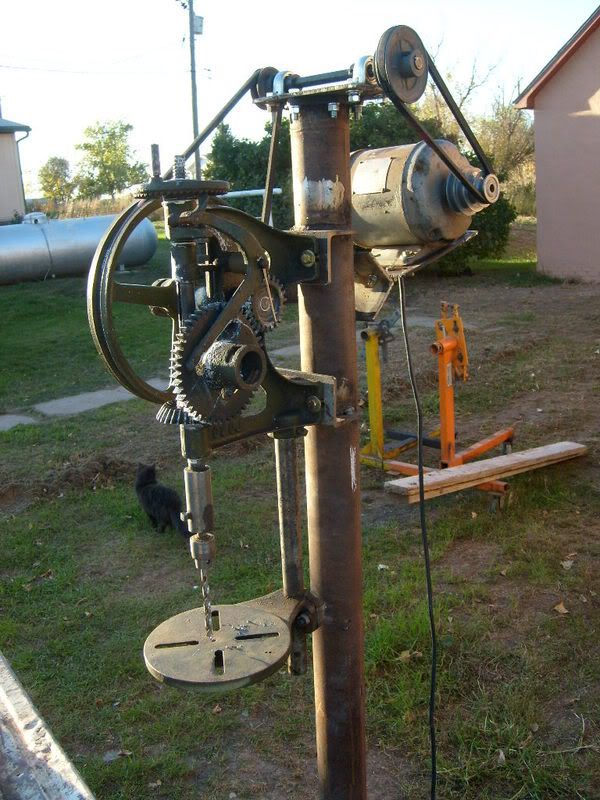
Only the guys working on vintage stuff might appreciate this. I dragged the pictures up to show on Fordbarn so thought I'd share here. Many years ago I was short on money, needed a drill press and wanted one that turned slow to run the bigger bits, like 1". So I built this, about 50 rpm on the slow and 3 speeds of auto feed. I did extend the rest pole to the base and get a better chuck after these pictures. It works awesome and also keeps your situational awareness tuned up.

Maybe you have something birthed of necessity that you want to share pictures of.


Maybe you have something birthed of necessity that you want to share pictures of.
Lead Driver


Joined: Jan 2005
Posts: 6,104
Likes: 138
From: Orcas Island Wa.

I dont have a photo.., But imagine this .. Need to remove a pilot bearing fron the end of a crank. No internet, hadnt heard of using grease and a drift. Working alone late at night. OK, I take a 3/8 " carriage bolt and grind the head around the perimeter until it fits through the bearing. Now I stand this bolt in the bench vice and saw across the head and down the shank of the bolt about an inch. Next I take a random chunk of steel and hacksaw off a wedge like for a hammer handle. maybe 3/8 wide and tapering from 3/16 to zero in 1/2 ". I lightly tap the wedge into my hacksaw's kerf. Now I insert it head first into the pilot bearing. When the wedge contacts the blind hole in the crank, I continue to tap on the threaded end of the carriage bolt. The head then spreads out. Now the carriage bolt's elongated head has a hold behind the pilot bearing. A 3/8 drive socket slides over the threads, add a nut and washer to draw the pilot bearing out of the crankshaft. Took about 3 minutes to make. I worked with a guy building a 52' wooden schooner when I was 16. It was fastened with locust 'treenails', pronounced 'trunnels. No metal in the hull. The 1" hole was drilled thru the planking and clear through the heavy frames. Then sawn flush both sides. After this it was sp,lit with a chisel and an oak wedge driven in sideways to the grain. If you couldn't get to the inside for structural reasons, you'd do a 'blind trunnel'. The 1" hole was now a blind hole, not clear through. Next You slot the starting end of the trunnel on the bandsaw and set a glued wedge into the kerf . Drive the trunnel in and when the wedge contacts the bottom of the blind hole, It spreads, becoming tighter as you drive.. Now cut the outside of the trunnel flush with the planking and split and wedge. That was my inspiration for my late night split bolt pilot bearing remover. Ok, I put my ownself to sleep wiyh this diatribe..... zzzzzzzzzzzz
Thread Starter
|
Post Fiend
Joined: Jun 2003
Posts: 8,209
Likes: 12
From: Black Hills of SD
Interesting GB, that I learned to blind wedge from one of your neighboring islanders. I used the process in some of my log furniture but never thought of applying it to metal. Very ingenious. I've ran a tap into those pesky pilot bearings before and threaded a bolt in and did the same thing with a pipe spacer and big washer.
Trending Topics

Laughing Gas
Joined: Feb 2013
Posts: 853
Likes: 4
From: W. Pa
That drill press is a piece of industrial art! Unfortunately OSHA is deploying a swat team as we speak.
FTE Stories
Ford Trucks for Ford Truck Enthusiasts

Top 10 Fords at 2026 Carlisle Ford Nationals
Joe Kucinski
3 Best / 3 Worst Parts of Modern Ford Ownership
Brett Foote
10 Amazing Upgrades That Solve Common Ford Truck Owner Headaches
Pouria Savadkouei
Every 2026 Ford Engine Explained
Brett Foote
10 Ugly Ford Trucks That We Still Kinda Love
Joe Kucinski
10 Things Every Truck Owner NEEDS (2026 Edition)
Michael S. Palmer
Rezvani's Latest Post-Apocalyptic Monster Is a Ford F-150 Raptor Underneath
Verdad Gallardo
Top 10 Most Expensive Ford Trucks Ever Sold on Bring a Trailer
Joe Kucinski
2027 Ford Super Duty Buyer's Guide (Every Model, Engine, & Package)
Brett Foote
Thread Starter
|
Post Fiend
Joined: Jun 2003
Posts: 8,209
Likes: 12
From: Black Hills of SD
I think it's called steampunk. The switch is bad right now so osha can't turn it on and it is just "art"

Posting Guru

Joined: Sep 2007
Posts: 1,433
Likes: 7
From: Los Banos, California
Only the guys working on vintage stuff might appreciate this. I dragged the pictures up to show on Fordbarn so thought I'd share here. Many years ago I was short on money, needed a drill press and wanted one that turned slow to run the bigger bits, like 1". So I built this, about 50 rpm on the slow and 3 speeds of auto feed. I did extend the rest pole to the base and get a better chuck after these pictures. It works awesome and also keeps your situational awareness tuned up.
Maybe you have something birthed of necessity that you want to share pictures of.
Maybe you have something birthed of necessity that you want to share pictures of.


Cargo Master
Joined: Aug 2014
Posts: 2,594
Likes: 72
From: North Central Arkansas
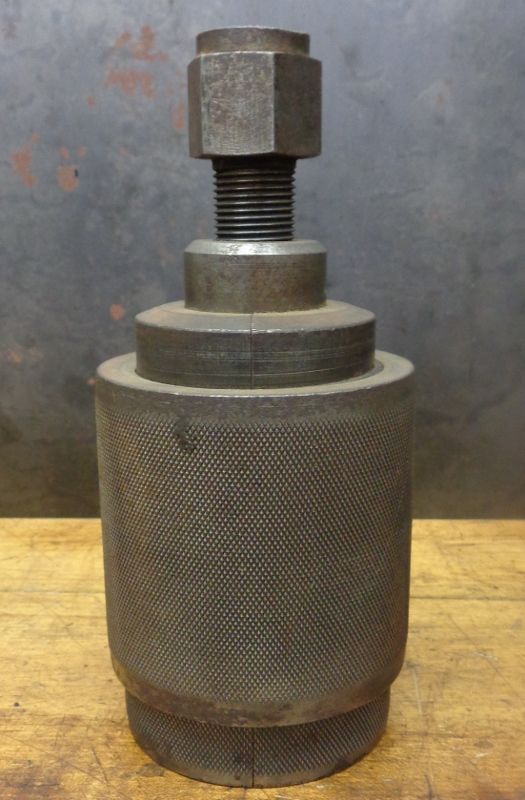
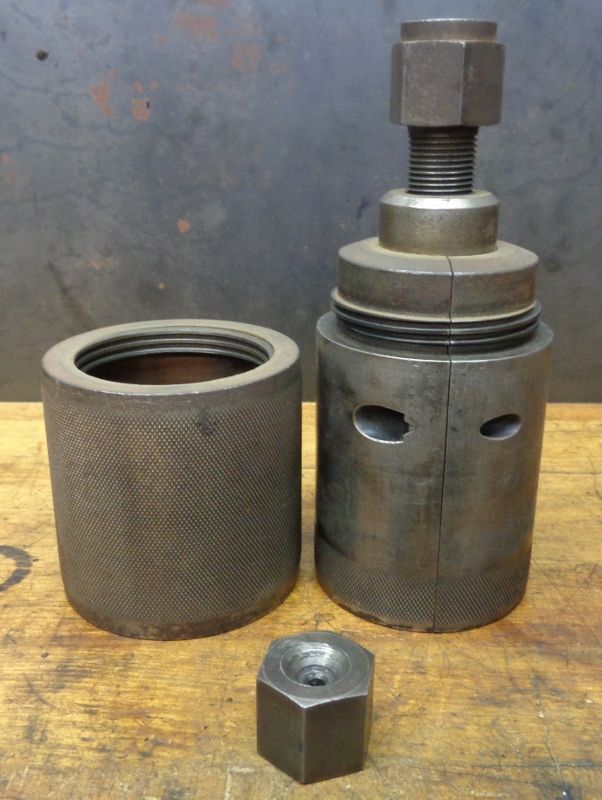
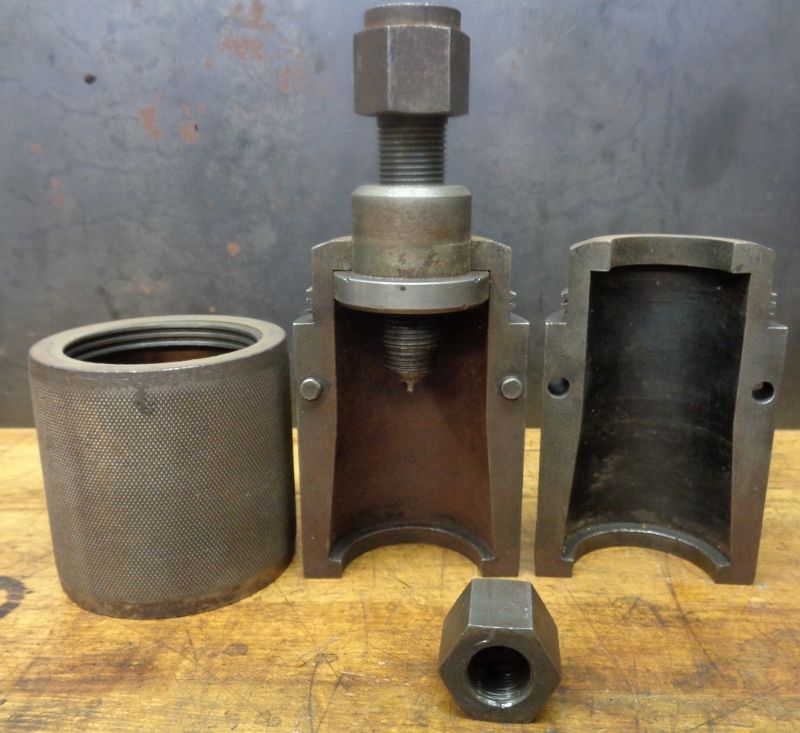
Here is a hub puller I made when I was taking the machine shop class at Twin Lakes Vocational Technical School about 40 years ago. I threaded the out side sleeve so it screws on to the body, otherwise it is very similar to the K.R. Wilson puller. The nut in the foreground screws on to the axle to keep from damaging the axle end.


Cargo Master
Joined: Aug 2014
Posts: 2,594
Likes: 72
From: North Central Arkansas
I have a post drill identical to the one you used on your drill press. I used to have it hanging on the wall in my shop. When my boys were small, they liked to come over to the shop and drill holes in scrap steel. Now they are grown, I miss having them around!
Lead Driver
Joined: Jan 2005
Posts: 6,104
Likes: 138
From: Orcas Island Wa.
Mark, your puller is a true masterpiece. I know all about the kids leaving home. 2 boys, 2 girls... Not a lot of careers on Orcas Island so they are all in Seattle now. Oldest 3 graduated from college, and youngest who spent the most time with dad after the deevorce works in an auto body shop down there. Funny he just called me about 20 minutes ago. Like you, I miss my kids, but am also proud they get by on their own. Excuse me for repeating this photo, but I can't help myself. OK I added some more photos. The girl in the last photo is getteing married on the island in August. There will be over 200 attending mostly his family from northern California. There are a million things I should do around the place before that but all I wanna do is work on stuck flatheads and drive some more screws into the woodie. Fortunately my kids know me and know I will never change. On the plus side we will have a dinner the night before where we roast a 120 lb pig in the old diesel tank on a 35 ford axle.

Cargo Master


Joined: Jan 2004
Posts: 2,198
Likes: 351
From: Mandan, ND
I have, or will when I pick it up, a champion blower and forge No. 203 post drill. It is a big one. It has two speeds and a flat belt pulley complete with idler. Was used with the power shafts in blacksmith shops. I bought a model a transmission for $15 recently to give it 6 speeds. When I get it set up I plan to run it off an old gas engine. I saw a picture once of a fellow who used an electric motor to power one through a model a transmission.
Speaking of model a transmissions, I ended up making a tool to remove lever spring. After seeing the spring I realise all the caution that is expressed when dealing with one
Speaking of model a transmissions, I ended up making a tool to remove lever spring. After seeing the spring I realise all the caution that is expressed when dealing with one
Thread Starter
|
Post Fiend
Joined: Jun 2003
Posts: 8,209
Likes: 12
From: Black Hills of SD
If you run the gas engine you will have to have a way to control the blower. You can't just turn it on. Maybe some kind of stomp pedal to a belt tensioner. With the electric motor you use a rheostat pedal.