When you click on links to various merchants on this site and make a purchase, this can result in this site earning a commission. Affiliate programs and affiliations include, but are not limited to, the eBay Partner Network.
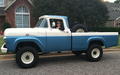
I spent the day today trying to tidy up the final pieces of my F500 restoration. One of those items was the headlight shroud and headlights. I noticed that the small nylon bushings that the large headlight angle adjustment screws fasten into were hanging by a very weak clip at both ends. I'm not sure they'd stay on, so I gave them a slight yank with needle nose pliers. Sure enough nearly all of the tabs came off too easily. So how does one fix this? You can’t weld the tabs without frying the nylon. The nylon bushing can’t be repositioned. Hmm.
Time to break out the 3D printer! I’m currently 3D printing two pieces that fit together. The below image shows the back of the bushing. It’s elongated so it hits the side of the headlight bucket when the screw is tightened and it won’t spin. The bushing ring will slide over the rear piece from the front and will get locked into place with superglue. It’s ABS so it’ll take about 400 degrees to soften it. I’ll tap the center to fit the thread of the bolt.
Worked perfectly. And I never get the first prototype to work! I guess 2016 is my year!
Anyone need these parts I'll print them for you. Just pay shipping. It's the least I can do. My contribution to all of you and your help over the last year.
3D printed headlight adjustment bushings to replace stripped/broken nylon bushings on the left.
OK, I'm still back in the 20th century. Just how much of an investment does it take to do this new 3D printing? I'll make sure I'm sitting down when you respond.
OK, I'm still back in the 20th century. Just how much of an investment does it take to do this new 3D printing? I'll make sure I'm sitting down when you respond.
I'll start from the beginning since some readers may not be familiar with the technology. 3D (Dimensional) printing is the reverse of CNC Machining. We're no longer taking material away to make a functioning product. We're adding material together. The origins of 3D printing can be traced back to the 1980s when Chuck Hull (of 3D Systems) came up with the idea of Stereolithography. Oddly, our print files carry the .stl extension nowadays. The system starts with a single layer of extruded liquid polymer filament (mostly PLA or polylactide acid or ABS plastics) that forms the basis of the model. The machine heats the plastic filament (looks like plastic string) and a robotic head moves according to the design. In our case here, the bushing was designed with the base down as you see in picture one. In 1/10th of a millimeter layer segments, the machine carefully extruded small amounts of plastic back and forth and side to side, layer by layer, until all layers are completed to finalize the model. This is a traditional printing method. There are other more complex forms that reduce some printing limitations that we experience with extruded plastics. Extruding 3D printers are becoming more and more consumer friendly. But where more "consumer-friendly" priced machines join the market you'll also see a reduction in features and print size/quality. My printer is from Felix Robotics in the Netherlands. It's a single extruder 3.0. It's a "prosumer" grade machine with a heated bed and a roughly 10" cubed print capability. It ran about $3,000. Dremel now makes a 3D printer and I believe that traditional brands of ink printers, like HP, is getting on board. Of course you'll need 3D software too. SolidWorks and CAD are famous for their industrial capabilities. However Google offers Sketchup free of charge. I use Sketchup Pro for the advanced features that are needed for my diecast modeling business on the side. Last year I taught an introductory course on Sketchup at my town's library to people curious about the technology. People in the room ranged from 7 years old all the way through 80. It's really a fun technology for everyone.
To answer your question, those looking to get into 3D printing can now start in the hobby for around $1,000 (Dremel's Idea Builder i.e.). The only cost above and beyond are spools of filament for printing. They typically run $50ish and last for a long time.
I'd be glad to answer questions for you or anyone here might have regarding the technology. I'm sure I'm not the only FTE member that has a printer or that does 3D design work. It would be interesting to see others chime in and hear what they design or what kind of equipment they use and what they use it for.
Thank you, I really appreciate you taking the time to explain the process. Is this process restricted to plastic or polymer based products?
You're welcome!
Absolutely not. There are machines available to print in many different types of metals as well. If you visit Shapeways.com you can search for hundreds of thousands of items everyday folks have 3D designed. You may then purchase any of those items for your own use and the Shapeways team will 3D print them for you and ship them to your door. You'll see in the material section what is available; stainless steel and even pure gold and platinum.
This Hennessey Takes the Expedition Tremor's Off-Roading Capability to the Next Level
Slideshow: The VelociRaptor Expedition gains a lift, upgraded suspension, Brembo brakes, and trail-ready equipment while retaining the stock 440-horsepower EcoBoost V6.
Rezvani's Latest Post-Apocalyptic Monster Is a Ford F-150 Raptor Underneath
Slideshow: Called the Fortress, the 850-horsepower pickup combines Raptor underpinnings with military-inspired features, survival equipment, and a starting price of $285,000.