


Disc brake installation

Thread Starter
|
New User
Joined: Aug 2015
Posts: 6
Likes: 0
Disc brake installation
I am currently re building the front end of my 1967 f100 mercury. I have put new spindles on that are off of a 1973. I have now put rotors on and am currently unsure of how to put the calipers on. There are a few bits and bobs that I am unsure of where they go and don't know which side they go on or how to tell. Any help will be greatly appreciated.

Fleet Owner
Joined: Dec 2009
Posts: 20,678
Likes: 82
From: NorCal
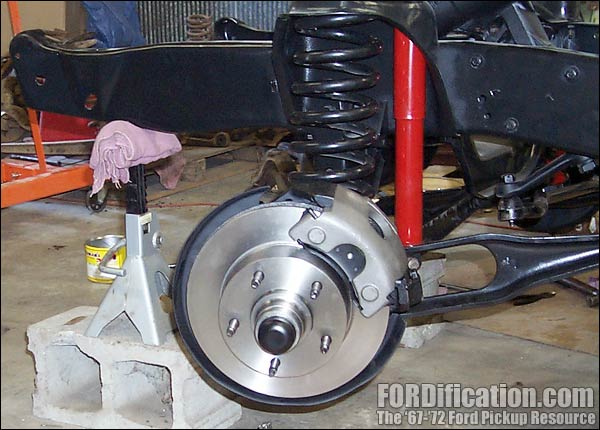
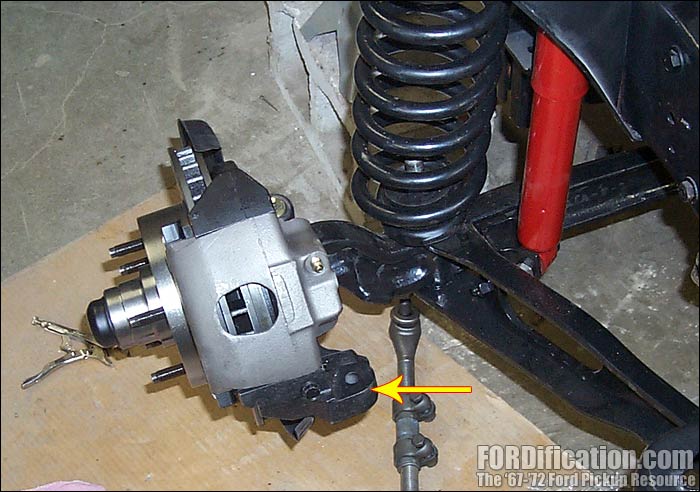
The calipers are inserted into the bracket and the caliper key and springy thing are assembled and tapped in sideways. The key and spring are installed between the caliper and the bracket and secured/pinned by a bolt. You can see the bolt in the right image if you continue following the direction of the arrow. The caliper key is barely visible because it was painted black.
Don't you have a repair manual? What about a catalog from the likes of NPD or LMC truck? If I recall correctly, their catalogs have exploded assembly drawings from which you should be able to figure out.
Or be patient and one of our fellow FTEers will post one.
Edit: Here you go:
Don't you have a repair manual? What about a catalog from the likes of NPD or LMC truck? If I recall correctly, their catalogs have exploded assembly drawings from which you should be able to figure out.
Or be patient and one of our fellow FTEers will post one.
Edit: Here you go:
Last edited by HIO Silver; Oct 2, 2015 at 08:30 PM. Reason: 'found some pics over on the other side.
Lead Driver


Joined: Apr 2011
Posts: 6,399
Likes: 40
From: El Dorado, Arkansas


You need to coat the key and the slides of the caliper/caliper anchor bracket with synthetic caliper slide grease (NOT petroleum-based grease), before you install the caliper.
This is what I use (from O'Reilly's).


Senior User
Joined: Feb 2015
Posts: 294
Likes: 1
Not to be a nag, but those jack stands placed on sideways concrete blocks is not a good idea. Those blocks are strong when verticle, but easy to break in that position. Think of the edges of those jack stands trying to split that block. You could turn the block upright and use a piece of wood to set the jack stand on. Like welding in flip flops...you might get by with it, but why risk it? Just my 2 cents!
Thread Starter
|
New User
Joined: Aug 2015
Posts: 6
Likes: 0
Oh wow that helps a lot thank you very much.
Thread Starter
|
New User
Joined: Aug 2015
Posts: 6
Likes: 0
The calipers are inserted into the bracket and the caliper key and springy thing are assembled and tapped in sideways. The key and spring are installed between the caliper and the bracket and secured/pinned by a bolt. You can see the bolt in the right image if you continue following the direction of the arrow. The caliper key is barely visible because it was painted black.
Don't you have a repair manual? What about a catalog from the likes of NPD or LMC truck? If I recall correctly, their catalogs have exploded assembly drawings from which you should be able to figure out.
Or be patient and one of our fellow FTEers will post one.
Edit: Here you go:
Don't you have a repair manual? What about a catalog from the likes of NPD or LMC truck? If I recall correctly, their catalogs have exploded assembly drawings from which you should be able to figure out.
Or be patient and one of our fellow FTEers will post one.
Edit: Here you go:
Fleet Owner
Joined: Dec 2009
Posts: 20,678
Likes: 82
From: NorCal
Not to be a nag, but those jack stands placed on sideways concrete blocks is not a good idea. Those blocks are strong when verticle, but easy to break in that position. Think of the edges of those jack stands trying to split that block. You could turn the block upright and use a piece of wood to set the jack stand on. Like welding in flip flops...you might get by with it, but why risk it? Just my 2 cents!
The open cells makes that dangerous... concrete has excellent compressive strength except when it is thin and has an open cell below it! It would be better rotated 90° with a piece of plywood btwn the block and the jackstands to spread the load. Still, the practice is to never use open cell concrete masonry units as supports.
Concrete is also weak in tension.
Trending Topics
Lead Driver
Joined: Apr 2011
Posts: 6,399
Likes: 40
From: El Dorado, Arkansas
Concur. Yeah I noticed that too after I hot linked the images. Well, it does say it's from the other website.
The open cells makes that dangerous... concrete has excellent compressive strength except when it is thin and has an open cell below it! It would be better rotated 90° with a piece of plywood btwn the block and the jackstands to spread the load. Still, the practice is to never use open cell concrete masonry units as supports.
Concrete is also weak in tension.
The open cells makes that dangerous... concrete has excellent compressive strength except when it is thin and has an open cell below it! It would be better rotated 90° with a piece of plywood btwn the block and the jackstands to spread the load. Still, the practice is to never use open cell concrete masonry units as supports.
Concrete is also weak in tension.
6-ton has plenty of height from the floor to the frame to lift the truck to a workable height.
When I was installing a disc brake front end about this time last year. 6-ton jack stands.

FTE Stories
Ford Trucks for Ford Truck Enthusiasts

AEV FXL Super Duty - the Super Duty Raptor Ford Doesn't Make
Brett Foote
Lobo Vs Lobo: Proof the F-150 Lobo Should Be Even Lower!
Michael S. Palmer
Ford's 2001 Explorer Sportsman Concept Looks For a New Home
Verdad Gallardo
10 Best Ford Truck Engines We Miss the Most!
Joe Kucinski
2026 Shelby F-150 Off-Road: Better Than a Raptor R?
Brett Foote
2027 Super Duty Carhartt Package First Look: 12 Things You NEED to Know!
Michael S. Palmer
10 Most Surprising 2026 Ford Truck Features!
Joe Kucinski
Top 10 Ford Trucks Coming to Mecum Indy 2026
Brett Foote
5 Best / 5 Worst Ford Truck Wheels of All Time
Joe Kucinski
Thread
Thread Starter
Forum
Replies
Last Post
rmorman
1980 - 1986 Bullnose F100, F150 & Larger F-Series Trucks
42
Jan 28, 2021 08:52 PM
mikerogers56
1973 - 1979 F-100 & Larger F-Series Trucks
12
Apr 3, 2015 02:32 PM
wizzy214
1968-Present E-Series Van/Cutaway/Chassis
62
Jul 2, 2010 12:14 AM
Mudd460
1973 - 1979 F-100 & Larger F-Series Trucks
12
Jun 18, 2009 05:01 AM
tonpartain
1973 - 1979 F-100 & Larger F-Series Trucks
4
May 29, 2006 08:25 PM