When you click on links to various merchants on this site and make a purchase, this can result in this site earning a commission. Affiliate programs and affiliations include, but are not limited to, the eBay Partner Network.
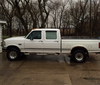
hi I am going to start a rebuild on a 1973 f100 soon and I have some motor questions. the f100 has a 360 in it now that ran when it was parked before I aquired it. is this a throw away motor, or do they have a good after market following? I also have aquired a 460b from a 70's Lincoln. so I am wondering, which motor would you throw performance parts at? what does the (b) stand for on the 460? my goal is to end up with a strong motor that has 500-600hp or more if it's even possible. thanks in advance
A 70 or 71, maybe a '72 Lincoln 460 would be a good candidate to hot rod. Later models have lower compression and worse heads, so more work required.
The 360 is an FE motor, so most of the FE hi-po stuff will bolt on. However, for the kind of power you want, you are looking at:
--390 crank and rods, probably new pistons, cam, headers, single plane 4bbl manifold, head work, large carb and a motor with a high-rpm oriented power band. Real high.
--a 445 stroker kit, the details of which can be viewed here:
Here is a 460 "cook book", and the site is all 460 all the time.
There is no inexpensive way to make the kind of power you want. Even the 460 is going to require some serious work for that level. It will last at those power levels. The FE will live a much shorter life. The FE is about 100 lbs lighter--the 460 puts the extra iron to good use, making a stronger block.
A 70 or 71, maybe a '72 Lincoln 460 would be a good candidate to hot rod. Later models have lower compression and worse heads, so more work required.
The 360 is an FE motor, so most of the FE hi-po stuff will bolt on. However, for the kind of power you want, you are looking at:
--390 crank and rods, probably new pistons, cam, headers, single plane 4bbl manifold, head work, large carb and a motor with a high-rpm oriented power band. Real high.
--a 445 stroker kit, the details of which can be viewed here:
Here is a 460 "cook book", and the site is all 460 all the time.
There is no inexpensive way to make the kind of power you want. Even the 460 is going to require some serious work for that level. It will last at those power levels. The FE will live a much shorter life. The FE is about 100 lbs lighter--the 460 puts the extra iron to good use, making a stronger block.
Then there is a transmission and some rear suspension work if you ever want to use that power.
thanks for the reply, I know I had alot of questions, but I figured this would be the place to ask. As far as work goes on either motor, I'm not really worried due to the fact I planed on tearing either motor down to the block and replacing stock parts with go fast parts. how can I tell which year the 460 is and does the b signify anything? this build will more then likely take years to do right but I am prepared to do it right the first time. I am typically a Chevy guy but I am kinda doing this build as a tribute truck to my father who was killed in a car accident 8 years ago . his first truck was a late 70's ford f100, so I want to build one of my own, buy on steroids. so I'm not really familiar with anything ford as far as what's good and what's bad about particular motors. the sticker on the drives side valve cover says it comply with 1977 emissions laws or something like that, so is that how you date a motor or is there a different way of finding the year ? thx again
I am sorry but I'm on my phone and can't search out all the links etc. There is a date code on the block. Iirc you have a tall block. Balance changed in maybe 79. Look at the 460 link for more. More later.
Agreed
IMHO 460's are easier to get parts for than FE motors, and as stated above, far more reliable power plants, in your hp goal range. It is probably an early casting, and probably a D1block, but could be the taller deck version. The only way to tell the exact year would be to pull the intake and find the date/revision code in the lifter galley. Those emissions stickers will get you pretty close to model year. Take a look on the bottom of the motor to find the casting number. If it is out of a 70's Lincoln it is probably a D1VE, or D9VE, and there are drastic differences.
Agreed
IMHO 460's are easier to get parts for than FE motors, and as stated above, far more reliable power plants, in your hp goal range. It is probably an early casting, and probably a D1block, but could be the taller deck version. The only way to tell the exact year would be to pull the intake and find the date/revision code in the lifter galley. Those emissions stickers will get you pretty close to model year. Take a look on the bottom of the motor to find the casting number. If it is out of a 70's Lincoln it is probably a D1VE, or D9VE, and there are drastic differences.
what are these drastic differences? bottom of motor where? like remove oil pan and it would be somewhere in the bottom end??
what are these drastic differences? bottom of motor where? like remove oil pan and it would be somewhere in the bottom end??
Main difference is that the early motors were internally balanced, and the later blocks were externally balanced. This was a running change in 79. The deck height is 10.322" on the D9 blocks which is taller than the earlier blocks.
You will find a casting number above and behind the rear frost plug on the passenger side. That is what I meant by the bottom of the motor.
hi I am going to start a rebuild on a 1973 f100 soon and I have some motor questions. the f100 has a 360 in it now that ran when it was parked before I aquired it. is this a throw away motor, or do they have a good after market following?
I also have aquired a 460b from a 70's Lincoln. so I am wondering, which motor would you throw performance parts at? what does the (b) stand for on the 460? my goal is to end up with a strong motor that has 500-600hp or more if it's even possible. thanks in advance
1975/78 E250/350 460 / Some 1979 F100/350 & E250/350 460. 460 notavailable in Passenger Cars after 1978. So, there's no such thing as a D9VE (1979 car) block casting number.
The 360 and 390 FE engines share the same block, heads and bore (4.05"), the stroke is different. 360 = 3.50" / 390 = 3.78."
All it takes to convert a 360 to a 390 is the 390's crank, rods and pistons.
OK so it appears you have an internally balanced engine with a deck height of 10.322". That's really all you need to know as a starting point for 500 HP. You are probably going to ditch those heads, or at least clean them up a bit porting wise, along with new springs and fix any guide wear, and new seals. Look at the "cook book" link I gave you. You don't get 500 horse by installing a chrome air cleaner and taking off the mufflers. You will be doing a complete overhaul rebuild to get to that power. You seriously gonna spin that thing to 6500 rpm with twice the cylinder pressure on the old bearings for example?
OK so it appears you have an internally balanced engine with a deck height of 10.322". That's really all you need to know as a starting point for 500 HP. You are probably going to ditch those heads, or at least clean them up a bit porting wise, along with new springs and fix any guide wear, and new seals. Look at the "cook book" link I gave you. You don't get 500 horse by installing a chrome air cleaner and taking off the mufflers. You will be doing a complete overhaul rebuild to get to that power. You seriously gonna spin that thing to 6500 rpm with twice the cylinder pressure on the old bearings for example?
thx for the input as I am not typically a ford guy I am a little new to the ford motors. I am aware that it will be a complete motor overhaul, my plan would be to strip the motor down to its block and go from there, I am mainly wanting to know if this is a suitable motor to get the desired results, those being as much hp as possible but still being able to run on pump gas.
As long as the block is within spec, it is a good place to start.
Look at the top of the pistons when you pull a head. If you see a number like ".030" or ".040", and especially ".060", you should (must with .060) have the block sonic checked before boring it further. Some blocks will go .080 and beyond, but you have to check first.
The only caution with the BIG blocks is "over-revving" them.
Unlike the small-blocks; wich you can wind-up some high rpms, the BIG blocks don't like to be wound-out in the high rpm range.
Unless, of course you build a BIG block that's "bullet proof", then you're dropping some serious "coin".
460 all the way.
A friend had a '73 F150 4X4 with a 351M that guzzled gas. He had a rebuilt 460 with a stock cam, that he dropped in. Turned-out he was getting WAY better gas mileage with the 460.
A better power-to-weight ratio; plus the 460 is a Torque Monster.
This Hennessey Takes the Expedition Tremor's Off-Roading Capability to the Next Level
Slideshow: The VelociRaptor Expedition gains a lift, upgraded suspension, Brembo brakes, and trail-ready equipment while retaining the stock 440-horsepower EcoBoost V6.
Rezvani's Latest Post-Apocalyptic Monster Is a Ford F-150 Raptor Underneath
Slideshow: Called the Fortress, the 850-horsepower pickup combines Raptor underpinnings with military-inspired features, survival equipment, and a starting price of $285,000.


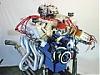





 from a 70's Lincoln. so I am wondering, which motor would you throw performance parts at? what does the (b) stand for on the 460? my goal is to end up with a strong motor that has 500-600hp or more if it's even possible. thanks in advance