When you click on links to various merchants on this site and make a purchase, this can result in this site earning a commission. Affiliate programs and affiliations include, but are not limited to, the eBay Partner Network.
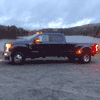
So, being stupid, I ran my truck until the trip calculator figured there were "zero miles until empty."
Well, it was still running, as you can see...but I took it to the gas station. My truck has a 35 gallon tank. It took 30.1 gallons, and that was with me repeatedly topping it off. So it had a good 5 gallons still in there; I was nowhere close to empty.
Wondering why there was such a large inaccuracy, I've come to one of two conclusions. Theory one is that if average gas mileage improved quickly, the screen doesn't add miles quickly enough (or stop taking miles away), especially if mpg improves rapidly near the bottom of the tank.
Theory two is to protect the fuel pump. Fuel pumps are cooled by the fuel itself. As the tank gets lower and lower, the pump is actually working a little harder due to the suction that builds in the airspace in the tank. So it heats up, and there is less and less fuel to cool it. If the DTE was accurate, or very close, and the customer of a new vehicle repeatedly only refueled with a few miles to empty each time...the fuel pump would likely fail during the warranty period. So perhaps Ford is conservative to save some warranty money...
Also, notice the position of the fuel gauge. With "zero till empty," the gauge is well off empty (exaggerated by the camera angle, but definitely above E).
Your results may vary, especially if my first theory is correct...meaning the average calculation the computer is using to determine distance doesn't jive with what's actually in the tank.
93-331-29PSI, let me know how many gallons yours takes to fill it up, compared to how many your tank holds.
It is not something new for Ford. And it is largely to protect the fuel pumps. Ford would leave excess gas in the tank even back in the early 90's, before the computers for miles to E. My mustang is the same way too.
I try to never run it that low, but sometimes you can't help getting stuck in construction, traffic, or a new area that pumps are closed at night.
In general you should have 50ish miles after it hits 0. The amount in gallons differs by cars, but I have found genrally you should be able to do the math and have 50-65 miles
Ford was doing trip computers by at least 1995 (Explorer Limited had one down on the center console). I can't remember if that one was more accurate. Some cars had this feature in the '80's.
Some cars, and I hate this, get to a certain amount of miles remaining and say "Range >50 miles please refuel" for something like that. Those last 50 miles are the most useful for a trip computer! My '97 Range Rover did this; my sister's '15 GMC terrain does this too.
Well, first off, the value varies with your driving style. M-E can go up and down depending on the load, hills or other variables.
Also, Ford has always calibrated their fuel gauges to have a reserve of 2 gallons or more when on E. So, I would see no difference with the M-E. I would hate for it to be exact or read low and run out in the middle of no where.
Of course M-E would have to vary...its based upon a rolling average.
But when you get down to the last 1 or 2 gallons of fuel, the computer should just about be able to nail it.
It sure would be nice for instruments to be accurate. We have fuel gauges that show empty but actually have 2 gallons in them. We have DTE calculators that say zero but really have another 50 miles to go. We have temperature gauges which read "normal" but in reality the coolant temp is only a few degrees from boiling over. Oil pressure gauges which rarely, if ever, move. Speedometers which intentionally read a little fast "to keep you out of trouble."
As for the amount remaining in the tank when the DTE or gauge shows empty, it is going to vary from model to model. A vehicle with a large tank needs more reserve to sufficiently cover and cool the pump. A small, efficient model may make do with a mere gallon...which might be good for another 30 miles.
Some cars, and I hate this, get to a certain amount of miles remaining and say "Range >50 miles please refuel" for something like that. Those last 50 miles are the most useful for a trip computer! My '97 Range Rover did this; my sister's '15 GMC terrain does this too.
My wife's Town and Country does this at 25 miles, at 30 miles the fuel light comes on with the chime and at 25 miles the DTE goes away and it just says "Low Fuel". It would be very helpful for the DTE to stay there at that point, more valuable than when it says 350 miles to empty.
A 50 mile reserve seems about right for my 350 with the gauge on E and the light coming on. I had the fuel light come on only once so far and it was right as I pulled up the pumps(no trip computer in my 99 XLT of course). I was able to put in about 33 gallons so that left 5 gallons in the 38 gallon tank which at 10mpg gives me a range of 50 miles. What bugs me on my truck is how much the gauge moves up and down while driving in the mountains. While traveling south on 395 in the Mammoth Lakes area (For those of you not familiar, it's in the Sierra Nevada mountains and full of 6-8% grades) the gauge was going anywhere from just under 3/4 to under a 1/2 tank just from climbing and descending hills.
The fuel gauges are stabilized. But of course, you still have a float on an arm that rises and falls with the tank level. On a big, long tank like on your truck, if it all sloshes to one end or the other, eventually the gauge will reflect that. The "stabilizing" simply means there is a built in timer which waits briefly before moving the gauge, so short uphills / downhills don't move the gauge much. But on a longer uphill / downhill...it makes sense.
I understand why fuel gauges are stabilized. But keep in mind your coolant temp is stabilized too. We wouldn't want the customer to think their engine actually heats up above normal on a long uphill, would we?
put in a "Pad" factor .. all is happy. or "Safe" to station.
just like most motorcycles made in "Japan"..... odometer is correct to 1 percent .. but most US based speedometers are off between 5 and 10 percent... to reduce speeding tickets.. MY opinion...
Yeah, my Harley speedo is a bit optimistic, but I guess that's just part of the tradition.
Most accurate gauges I have seen were on our old 1995 E-320, made by VDO. The oil pressure gauge moved all the time. At idle when hot it fell to about 1 bar; step on the gas, it pegged to 3 bars. Really hot weather, it fell lower. Cold weather, it moved much less. Coolant temp gauge moved around a fair amount. Fuel gauge was accurate. Speedometer was calibrated. I really liked it.
...Most accurate gauges I have seen were on our old 1995 E-320, made by VDO. The oil pressure gauge moved all the time. At idle when hot it fell to about 1 bar; step on the gas, it pegged to 3 bars. Really hot weather, it fell lower. Cold weather, it moved much less. Coolant temp gauge moved around a fair amount. Fuel gauge was accurate. Speedometer was calibrated. I really liked it.
I had an 85 VW Golf with VDO gauges (as they all do) and that was the only car I've ever had with a 100% accurate speedometer from 0-95 according to my GPS, don't ask how I got a VW Golf diesel to 95 mph. All the other gauges were very responsive and very accurate. My 350 is my favorite vehicle of those I've owned so far, but I can't stand the gauges, especially the non-analog movement of the coolant and oil pressure.
I had an 85 VW Golf with VDO gauges (as they all do) and that was the only car I've ever had with a 100% accurate speedometer from 0-95 according to my GPS, don't ask how I got a VW Golf diesel to 95 mph. All the other gauges were very responsive and very accurate. My 350 is my favorite vehicle of those I've owned so far, but I can't stand the gauges, especially the non-analog movement of the coolant and oil pressure.
Yes! Coolant temp and oil pressure MUST move around by nature of how they work. It's almost like, why even bother having them? My oil pressure gauge in my current truck never moves. It goes from zero to just over half when it starts. Then it doesn't move, ever, except back to zero when I shut the engine off. Stupid! That oil pressure is actually fluctuating a great deal. Ford (and most other manufacturers) don't want the consumer to be alarmed by the gauge moving.
Rezvani's Latest Post-Apocalytic Monster Is a Ford F-150 Raptor Underneath
Slideshow: Called the Fortress, the 850-horsepower pickup combines Raptor underpinnings with military-inspired features, survival equipment, and a starting price of $285,000.