


towing tune

Mountain Pass
Joined: Jun 2014
Posts: 191
Likes: 0
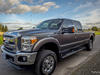
I have a 2014 F350 crew cab long box
6.7 4x4
Its my daily driver and daily work truck. It tows a 5000 pound trailer daily pretty much, 14,000 pound dump trailer a few times a month, and a 13,000lb camper 5-6 times a year 250 miles north. Also snow plowing in the winter.
I'm currently running the "towing tune" from my SCT x4 tuner which adds 95tq + 90hp. Gained 1.5-2.5 mpg and it pulls so much better.
I'm tempted to bump it up to the 100hp+115tq tune.
Any reason not to? I did a quick search for this topic and didn't find much, especially for 2014 trucks.
Thanks in advance.
6.7 4x4
Its my daily driver and daily work truck. It tows a 5000 pound trailer daily pretty much, 14,000 pound dump trailer a few times a month, and a 13,000lb camper 5-6 times a year 250 miles north. Also snow plowing in the winter.
I'm currently running the "towing tune" from my SCT x4 tuner which adds 95tq + 90hp. Gained 1.5-2.5 mpg and it pulls so much better.
I'm tempted to bump it up to the 100hp+115tq tune.
Any reason not to? I did a quick search for this topic and didn't find much, especially for 2014 trucks.
Thanks in advance.
My truck stock was 400hp 800 torque
I put in the tow tune putting me to 490 hp 895 torque
The 2015 ford my friend just got is what, 860 torque and 440 HP????
If my tuner didn't add actual power, then how did I beat him in a race from a stop sign last week ?
Food for thought.
I put in the tow tune putting me to 490 hp 895 torque
The 2015 ford my friend just got is what, 860 torque and 440 HP????
If my tuner didn't add actual power, then how did I beat him in a race from a stop sign last week ?
Food for thought.
To all the naysayers, one thing that has not been mentioned yet is the fact that not only is the tuning changing, but the airflow has changed as well. He has not said if he has changed intakes or not, but if he is running deleted, the DPF is gone and was replaced with a much more open exhaust. I'm not an expert on anything, but higher airflow rates plus more fuel when applied to move the same load will move it faster. If not faster, then at the same speed with less fuel and air than it did when stock. It has been proven over and over that an unloaded deleted truck will net higher than stock MPGs on the highest tune level under most normal (not dragging from light to light) driving conditions. There are some guys street testing and pulling dyno and drag runs on these trucks proving these thoughts.
Senior User
Joined: Dec 2014
Posts: 212
Likes: 4
Here is the real question when a tuner makes claims of added HP/Tq...show me the curves from the dyno. If you game is towing and a tune adds an extra 100 ponies of HP/Tq and it does not appear until 2500 rpm but to get it you had to give up ponies and Tq down around 1500 rpm, then you have not gained anything, in fact you have lost performance where you need it the most.
There is absolutely no guarantee that the winner of the race is the one with the most HP/Tq, its does not work that way...
There is absolutely no guarantee that the winner of the race is the one with the most HP/Tq, its does not work that way...
And unlike a super charger, a turbo is more or less free H/P from the otherwise wasted exhaust gases.
Here ya go...
Hows this for a great TQ curve...?



Post Fiend
Joined: Jun 2014
Posts: 6,801
Likes: 7
From: DFW, TX-GoldCanyon, AZ
Interesting numbers... Noted the 3 month gap in the one test... Some 120 hp difference just in removing the DPF? That's huge!
One of the issues I have with chassis dynos is that you still don't normally get all the numbers you need, but you do get a pretty good idea in terms of what it's putting down..
One of the things I always look for are the BSFC numbers and coolant temp numbers to see where they are at in the peak torque...
While this is geared toward a gasser, the same rules of physics hold true for oilers...
How to confirm your dyno results with easy and simple calculations
So while we are increasing the volumetric efficiency, we are still going to burn proportionaly more fuel (along with air) at those peak numbers..
One of the issues I have with chassis dynos is that you still don't normally get all the numbers you need, but you do get a pretty good idea in terms of what it's putting down..
One of the things I always look for are the BSFC numbers and coolant temp numbers to see where they are at in the peak torque...
While this is geared toward a gasser, the same rules of physics hold true for oilers...
How to confirm your dyno results with easy and simple calculations
So while we are increasing the volumetric efficiency, we are still going to burn proportionaly more fuel (along with air) at those peak numbers..
Posting Guru
Joined: Nov 2010
Posts: 1,347
Likes: 0
From: Eagle Mountian, Utah
Ok I have a SCT X4 with custom tunes I got from Rudys diesel. My truck overall runs best on "Level 2". I was getting 14 mpg mixed before on "Level 1". I swapped over to level 2 over the weekend. Im now getting 17.7 mpg. This is all off of the lie-o-meter which I reset evey tank filling. Just refilled today and got 592 miles and took 34 gallons to fill which is 17.41 mpg hand calculated. So the computers off but not alot. I ran level 1 for months before this change. Everytime it was 14-14.8 mpg mixed on the lie-o-meter. This is the only change that has happened. I ran level 2 last fall and also felt like it was a ton better overall. I just never thought about swapping back to 2 until friday
From the ebay add. "Level 2 Street +72 hp and +190 ft-lbs"
From the ebay add. "Level 2 Street +72 hp and +190 ft-lbs"
Senior User
Joined: Dec 2014
Posts: 212
Likes: 4
Interesting numbers... Noted the 3 month gap in the one test... Some 120 hp difference just in removing the DPF? That's huge!
Well, the 3 month gap you talk of is just for the oem BONE STOCK truck H/P.
Ford advertises 400hp at the crank. H&S dyno recorded 333 at the rear wheels. To me that sounds about right. 15-20% parasitic 4wheel drive train lose is the norm usually. Anyhow, its just there for comparison to the H&S tune hp numbers.
Actually its a 38hp mild or called tow (now) all the way up too 164hp increase, on wild or called performance (now).
It obviously is not just for removing the DPF, since you can't 'just remove the dpf'. Its also tuned, meaning boost/fuel/ipw increase and other parameters also.. All the tunes from H&S on the above dyno graphs are without emissions and tuned in 3 increments, or power levels.
One of the issues I have with chassis dynos is that you still don't normally get all the numbers you need, but you do get a pretty good idea in terms of what it's putting down..
One of the things I always look for are the BSFC numbers and coolant temp numbers to see where they are at in the peak torque...
While this is geared toward a gasser, the same rules of physics hold true for oilers...
How to confirm your dyno results with easy and simple calculations
"Diesels and gasoline engines will have very different B.S.F.C numbers. "
Also, turbocharged engines have a higher B.S.F.C
So while we are increasing the volumetric efficiency, we are still going to burn proportionaly more fuel (along with air) at those peak numbers..
Well, I guess that answers my question from above posts,,, you now agree we are increasing the VE...?
Well, the 3 month gap you talk of is just for the oem BONE STOCK truck H/P.
Ford advertises 400hp at the crank. H&S dyno recorded 333 at the rear wheels. To me that sounds about right. 15-20% parasitic 4wheel drive train lose is the norm usually. Anyhow, its just there for comparison to the H&S tune hp numbers.
Actually its a 38hp mild or called tow (now) all the way up too 164hp increase, on wild or called performance (now).
It obviously is not just for removing the DPF, since you can't 'just remove the dpf'. Its also tuned, meaning boost/fuel/ipw increase and other parameters also.. All the tunes from H&S on the above dyno graphs are without emissions and tuned in 3 increments, or power levels.
One of the issues I have with chassis dynos is that you still don't normally get all the numbers you need, but you do get a pretty good idea in terms of what it's putting down..
One of the things I always look for are the BSFC numbers and coolant temp numbers to see where they are at in the peak torque...
While this is geared toward a gasser, the same rules of physics hold true for oilers...
How to confirm your dyno results with easy and simple calculations
"Diesels and gasoline engines will have very different B.S.F.C numbers. "
Also, turbocharged engines have a higher B.S.F.C
So while we are increasing the volumetric efficiency, we are still going to burn proportionaly more fuel (along with air) at those peak numbers..
Well, I guess that answers my question from above posts,,, you now agree we are increasing the VE...?
Yes, at wot and much higher Hp level, the engine will use more fuel.
But, at 3/4 throttle, making the same Hp that the bone stock motor makes at wide open full throttle, the engine uses less fuel to make the same HP.
So the engine is more efficient, and actually use less fuel to make similar HP levels as the oem engine.
So, pulling up that long steep grade with a 10,000lb trailer, the oem engine might be at 2/3 throttle, and the tuned truck at half throttle to go the same speed, thus using less fuel.
The above is just a fictional example, not an exact throttle position/hp ratio. Just to give you an idea of VE as it relates to us in the real world. Less throttle to do the same work. Like I said before, this applies for a clean efficient tune, not a drag race wot tune.
jmo

Thread
Thread Starter
Forum
Replies
Last Post


