When you click on links to various merchants on this site and make a purchase, this can result in this site earning a commission. Affiliate programs and affiliations include, but are not limited to, the eBay Partner Network.
-Sorry for the new thread, but I posted in the related sticky thread a couple days ago and am not sure anyone saw it-
Hey all, thanks for managing such a helpful site. I've read a lot of threads in the past but this is my first time posting. I'm sure there's a thread here somewhere that describes my exact problem, but I can find it. Sorry to bring up something all over again, but hopefully me posting it in this sticky thread makes it a little less painful.
I have an '03 F350 with a 7.3. Last week, I had it idling to warm up. The RPMs were high, which has always been normal, and I went out to tap the brake pedal to bring them down, which is what I always do. This time, the RPMs dropped dramatically and the truck almost even died, which has never happened before. It then ran a little rough throughout the day, acting like it was cutting out if I didn't ease into the throttle smoothly. The check engine light was also on and off throughout the day. The following day (very cold here), it wouldn't start at all. It acted like it wanted to a couple times, but never did and tons of white smoke came out of the exhaust, smelling like un-burnt fuel.
In reading everyone's similar problems, I thought for sure it was my GPR. I first tested it with a volt meter, and I had 12.3 on the hot side and 11.6 on the other. After that, a mechanic told me that test wasn't fool-proof and suggested I jump the two posts for a while, then try to start the truck. I did this, letting the relay provide juice to the plugs for at least 45 seconds, but no luck. The only difference with the jump wire attached was that the truck sputtered and tried to start a little more this time, but still no luck for a full start.
I also rented a code reader from autozone, and of course, no codes were detected. I've had the block heater plugged in for a few hours which hasn't helped either. The only other information I can add that might help with a diagnosis is that the truck has always blown white smoke on start-up (at least for the last year or so), even when it's 100F outside. The smoke goes away after a couple seconds and it doesn't smoke at all if it hasn't sat overnight. One other thing I noticed while checking the GPR was that some other sensor (a rectangle going into the Y-pipe just on the passenger side of the turbo) was very loose in its worn out grommet and was making a constant 'clicking' sound after about two seconds of the ignition being turned on. It looks like the grommet seal has been leaking for a while because there's a lot of oil blow-by on both sides of the pipe... which actually reminds me of one more thing: I have a boost leak somewhere that a local diesel shop couldn't reproduce or fix. I only notice the leak (a high pitched turbo squeal) when I'm towing and the motor is under a decent load. The mechanic told me it was probably the turbo clamps and wanted $700 to fix them, with no promise that's what it actually was. He also told me, if I didn't notice any power loss, and it wasn't constant yet, it really didn't need to be fixed.
Anyway, sorry for the long post on a subject that's been covered a thousand times, but thanks in advance for any help.
Welcome to FTE. Sounds like the first thing you need to do is stop talking to that mechanic. He sounds expensive and full of advice that doesn't really sound the best.
How cold is cold? Was the truck having any trouble starting before (as in longer cranks to start)? How much white smoke has been coming out the tailpipe back when it would start compared to how much comes out now? How much white smoke comes out now? If you crank for 30 seconds, does it create a white cloud that's just about embarassing, or does it just give off some white puffs? Got a chip or tuner on the truck? Oil level full? What happens if you unplug that clicking sensor and try to start it?
Thanks for the reply... It's been lows around 1F and highs in the teens. No engine mods on my truck at all, completely stock. I didn't really notice any longer starts in the past, but if they were, it maybe only took an extra 2-3 seconds to fire up. As far as the smoke goes, yes, very embarrassing cloud. Even when it was starting well, there was a pretty shocking cloud that would puff out after the truck fired up. Now, after about 30 seconds of cranking, it is twice as bad and smells even more of fuel.
Oil level is great and was just changed a few months ago. Batteries both test good, and plateau at about 10.8V even while the starter's still cranking and are both around 13V while not trying to start it.
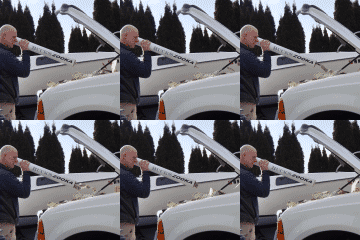
I haven't tried unplugging the sensor yet, the pic above is the one I'm talking about. Another thing I haven't tried yet is testing the glow plugs, but my understanding (again from the mechanic), is that I'd have to have 4 or 5 of them out for the truck not to start. I'll test them this weekend and post an update.
That is your wastegate control, and it's always loose. There is no boost there to leak, but a clicking wastegate could mean the Exhaust Back Pressure sensor is plugged up.
I learned something recently: Just because the GPR works and the GP ohms check out, they can still be diminished in performance to the point of not working well enough. You describe a GP problem, or an ICP sensor problem (which would trigger the SES light). A bad UVCH harness will make the truck run rough, but not smoke. I would pull the connector from the ICP sensor and try to start the truck, then let's see where we are.
Embarrassing white cloud is glow plug or GPR related. Since it looks like you've eliminated the GPR as an issue, I'd say it's time for glow plugs. Stay away from autolite brand glow plugs. The tips have been known to swell up and get stuck in the head upon trying to remove them. Motorcraft glow plugs perform well.
The glow plugs on your truck won't throw the CEL or cause the symptoms you're describing, but diagnosing what you have going on might be easier with functioning glow plugs.
Since you don't have a way to pull the codes, unplugging the ICP sensor is a good place to start.
it sounds to me like you have gelled fuel.
i would try tenting the truck and putting a heater under it trying to bring the temperature up to at least 35 degrees for a day or so.
if it fires up, you know it is gelled fuel.
to read the codes, you need a diesel code reader. those parts store rentals 99.99% of the time will not work on diesel engines.
So it warmed up to about 37F here & I figured I'd try to start the truck one more time before I did anything else. This time I cycled the glow plugs (turned the ignition on and off until the WTS light went off) about eight times and it was hard to start, but it did finally fire up.
I'm thinking it's definately glow plugs now, but that wouldn't cause my check engine light to come on or the truck to run rough, right?
Still haven't taken it into the dealer to have the codes read, but the check engine light isn't on at the moment either... Still stumped and worried about my "always reliable" truck.
I agree with your diagnosis, and with what everyone else suggested; your hard starting is probably caused by one or more bad glow plugs.
If you have an ohm meter, check the resistance of each glow plug to see if any are open. Disconnect the 9 pin valve cover electrical connectors and read the resistance between each of the 4 large contacts on the engine side of the connector and ground. These contacts are the ones that mate up to the yellow wires on the driver side and brown wires on the passenger side. You should see very low resistance (1-2 ohms). If you see an open circuit (high resistance) the respective glow plug has failed and needs to be replaced. If there are any bad glow plugs it makes sense to replace all of them.
Rezvani's Latest Post-Apocalyptic Monster Is a Ford F-150 Raptor Underneath
Slideshow: Called the Fortress, the 850-horsepower pickup combines Raptor underpinnings with military-inspired features, survival equipment, and a starting price of $285,000.