


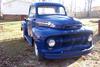
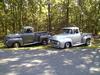


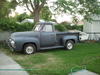
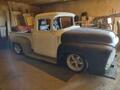
Possible paint over rust?
Laughing Gas


Joined: Jun 2007
Posts: 815
Likes: 29
From: Richland, WA.
The rust most likely came from backside. Fenders are not hard to replace so drive it and look for more parts (like we never have done that before). I would be more worried about what looks like where door opened into cab panel.
Lead Driver


Joined: Aug 2006
Posts: 8,094
Likes: 654
From: Brentwood, TN

Manufacturers of the day (1953) did not spend much time/money finishing the inside sheetmetal...especially on work vehicles that usually had a short lifespan. As has been stated, that sort of rust began inside and ate its way out. The door jamb on the drivers side is probably eaten away around the hinge pockets which permitted the door to open past it's normal stop point. All signs that this old girl has some "issues". I would steam clean/pressure wash the undercarriage and put her up on a lift and do a thorough inspection of the underside of the cab, fenders, and bed. I bet that the front cab mounts are collapsed and that the front cab corners/pockets are rotted. Once you get to the point where you are seeing a degradation of the structural integrity of the truck then it's time to consider your options.
Trending Topics

Hotshot

Joined: Oct 2004
Posts: 15,882
Likes: 88
From: Durham NC
The 56 had no stop rods on the doors to keep them from opening far enough to contact the cowl sides, especially if a strong gust of wind catches it or someone backed it up with the door open and caught it on something, not a rare occurrence in the day when it was common to open the door and look out when backing up (now who put that fence post, tree or building corner there when I wasn't looking???). I found the same kind of damage on my panel's driver's side cowl, and there wasn't a speck of rust on it. typically it would have bent the hinges, but if the door fits the opening the hinges were likely replaced or straightened.
Ford didn't put any undercoating or more than primer (sometimes not even that, just bare metal where the paint didn't hit it) and the trucks were "run hard and put up wet", and the only washing they got was from the rain. dirt built up between doublers and exterior sheet metal which would aborb moisture (and road salt in the North) until the rust would eat thru from the inside. Most of the troublesome areas are where there is a doubler or where pockets were located like at the bottom of the fenders and over the headlights as well as the cab corners and over the doublers on the running boards, Mice like to nest in the inside of the "forehead" over the windshield behind the inside header.
Ford didn't put any undercoating or more than primer (sometimes not even that, just bare metal where the paint didn't hit it) and the trucks were "run hard and put up wet", and the only washing they got was from the rain. dirt built up between doublers and exterior sheet metal which would aborb moisture (and road salt in the North) until the rust would eat thru from the inside. Most of the troublesome areas are where there is a doubler or where pockets were located like at the bottom of the fenders and over the headlights as well as the cab corners and over the doublers on the running boards, Mice like to nest in the inside of the "forehead" over the windshield behind the inside header.
FTE Stories
Ford Trucks for Ford Truck Enthusiasts

3 Best / 3 Worst Parts of Modern Ford Ownership
Brett Foote
10 Amazing Upgrades That Solve Common Ford Truck Owner Headaches
Pouria Savadkouei
Every 2026 Ford Engine Explained
Brett Foote
10 Ugly Ford Trucks That We Still Kinda Love
Joe Kucinski
10 Things Every Truck Owner NEEDS (2026 Edition)
Michael S. Palmer
Rezvani's Latest Post-Apocalyptic Monster Is a Ford F-150 Raptor Underneath
Verdad Gallardo
Top 10 Most Expensive Ford Trucks Ever Sold on Bring a Trailer
Joe Kucinski
2027 Ford Super Duty Buyer's Guide (Every Model, Engine, & Package)
Brett Foote
Top 10 Ford Truck Tragedies
Joe Kucinski
Phantom of the Phorum

Joined: Jan 2011
Posts: 5,472
Likes: 1,696
From: Kentucky

That's what we think got the top of the cab in my '53. You can see some of the nest through the rust hole.
Lead Driver
Joined: Aug 2006
Posts: 8,094
Likes: 654
From: Brentwood, TN
While it is true that the 53-56 F100s do not have the same stop rods as the earlier F1 series there is a reason for this...the later F100 series trucks have the door hinges mounted inside the body and the design of the hinge itself precludes the need for any other "stop" mechanism to limit the range of motion of the door. Attached are two photos showing a 53-56 series door hinge, one photo is positioned as it would be with the door closed, the other at the widest door open position. As you can see in the photo (second one) where the door is open, the arm of the hinge contacts the two tabs that keep it from opening any further. IF a door opens far enough to contact the cowl, then the most likely cause is the lack of structural integrity of the hinge mounting pocket in the door jamb of the cab.

Laughing Gas
Joined: Jun 2004
Posts: 823
Likes: 4
From: Calais, Vermont
For many of these old trucks sitting out doors, a lot of condensation forms daily on the underside of the roof and dribbles down to the head of the windshield.

Thread Starter
|
Senior User
Joined: Oct 2014
Posts: 143
Likes: 0
From: White Oak WV
While it is true that the 53-56 F100s do not have the same stop rods as the earlier F1 series there is a reason for this...the later F100 series trucks have the door hinges mounted inside the body and the design of the hinge itself precludes the need for any other "stop" mechanism to limit the range of motion of the door. Attached are two photos showing a 53-56 series door hinge, one photo is positioned as it would be with the door closed, the other at the widest door open position. As you can see in the photo (second one) where the door is open, the arm of the hinge contacts the two tabs that keep it from opening any further. IF a door opens far enough to contact the cowl, then the most likely cause is the lack of structural integrity of the hinge mounting pocket in the door jamb of the cab.
Believe Nothing
Joined: Jun 2004
Posts: 7,516
Likes: 403
From: W. Central FL.
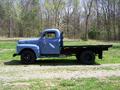
We can speculate and discuss what caused the damage and how much damage there is. We can speculate how much structural deterioration the truck has. A set of very good up close, detail pictures may reveal what we need to know. An on site set of experienced eyes would be best, of course. Ask for such pictures.
Do I see the front wheels setting in the center of the wheel opening? Do I see a sway bar under that truck? What modifications does the seller say the truck has?
Do I see the front wheels setting in the center of the wheel opening? Do I see a sway bar under that truck? What modifications does the seller say the truck has?

Thread
Thread Starter
Forum
Replies
Last Post
Meridian_Mike
1973 - 1979 F-100 & Larger F-Series Trucks
64
May 1, 2019 06:34 AM
kickstand03263
1999 - 2016 Super Duty
8
Oct 6, 2013 01:29 PM
460 FORD MAN
1973 - 1979 F-100 & Larger F-Series Trucks
4
Aug 3, 2012 05:37 PM