


GAW vs GVW
Thread Starter
|
More Turbo
Joined: Feb 2005
Posts: 576
Likes: 4
From: Graham, WA
GAW vs GVW
I was out looking at the placard on the door jam and it shows the truck has GVW of 11,500 lbs. However, the front GAW is 6,000 lbs and the rear GAW is 7,000 lbs. Shouldn't the truck GVW be 13,000 lbs?
Rob
Rob
Posting Guru
Joined: Jan 2010
Posts: 1,616
Likes: 6
From: Whitecourt AB, Canada
Well, there is also the vehicle frame and suspension that is taken into account to come up with the complete GVWR. Axle weight ratings don't take those into account. The recommendation is to comply with the lesser of any of the ratings, if you are at the vehicle's GVWR but haven't exceeded any one axle's particular GAWR, you still should not exceed the GVWR.
There's what you can actually do, then there's what the vehicle manufacturer says you can do, then there's what the law says you can and can't do.
There's what you can actually do, then there's what the vehicle manufacturer says you can do, then there's what the law says you can and can't do.
Super Moderator


Joined: Aug 2008
Posts: 37,379
Likes: 1,863
From: Frederick, MD

some states don't want you to exceed your registered weight, which may or may not be that 11,500. depends on how you registered it. Some states you can register for more. In that case don't exceed the axle ratings.
Don't forget the tires as well. Never exceed those. I always just went with the tires and axle ratings.
Don't forget the tires as well. Never exceed those. I always just went with the tires and axle ratings.
Postmaster
Joined: Sep 2006
Posts: 2,598
Likes: 5
From: Maryland
The sum of the axle ratings has to be more than the GVWR because of load variances. The way you load your truck may be different than the way I load my truck. Some guys carry a snow plow and need heavier front axle capacity. Some guys carry truck campers and need a lot more rear axle capacity. Ford has to build a truck that will accommodate everybody's needs. What Ford does not expect is for you to carry a snow plow and a truck camper at the same time which is basically what you are talking about when you assess the GVW at the sum of the axle ratings.

Elder User
Joined: Jan 2008
Posts: 529
Likes: 0
Just to add there are many variables, the size of brakes and center of gravity. One reason that your 5<SUP>th</SUP> wheel pin is ahead of the rear axle, I have a sliding hitch and it is obvious when you put a 2700 pounds behind the rear axle.

Senior User
Joined: Dec 2012
Posts: 166
Likes: 3
When one considers "weight" they must also consider "inertia" and that means calculating "brakes".
Can't go by axle ratings alone.
Trending Topics
Post Fiend
Joined: Oct 2002
Posts: 11,314
Likes: 4
Hmmm, braking "should" be only a consideration if your trailer brakes don't do their part --- ideally, THEY should stop the trailer leaving your truck brakes to stop the truck...
And in the wonderful state of Texas you CAN register for more than the 11.5k... which I did.... a bit more $ and a piece o paper to say more.
I asked the lady at the dmv what can I do and thank goodness she had a fifth wheel also and knew exactly what to do !
I asked do I need to change the registered weight and carrying capacity and she said not important - just gross wt !
now, does that make me legal or just documented hope I don't have to find out...
And in the wonderful state of Texas you CAN register for more than the 11.5k... which I did.... a bit more $ and a piece o paper to say more.
I asked the lady at the dmv what can I do and thank goodness she had a fifth wheel also and knew exactly what to do !
I asked do I need to change the registered weight and carrying capacity and she said not important - just gross wt !
now, does that make me legal or just documented
hope I don't have to find out...
FTE Stories
Ford Trucks for Ford Truck Enthusiasts

Rezvani's Latest Post-Apocalytic Monster Is a Ford F-150 Raptor Underneath
Verdad Gallardo
Top 10 Most Expensive Ford Trucks Ever Sold on Bring a Trailer
Joe Kucinski
2027 Ford Super Duty Buyer's Guide (Every Model, Engine, & Package)
Brett Foote
Top 10 Ford Truck Tragedies
Joe Kucinski
AEV FXL Super Duty - the Super Duty Raptor Ford Doesn't Make
Brett Foote
Lobo Vs Lobo: Proof the F-150 Lobo Should Be Even Lower!
Michael S. Palmer
Ford's 2001 Explorer Sportsman Concept Looks For a New Home
Verdad Gallardo
10 Best Ford Truck Engines We Miss the Most!
Joe Kucinski
2026 Shelby F-150 Off-Road: Better Than a Raptor R?
Brett Foote
Elder User
Joined: Jan 2008
Posts: 529
Likes: 0
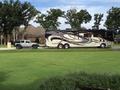
Nice truck and slide-in Camper as you know when you pull a trailer behind, it can’t put you over the GCWR and the reason you understand inertia. By your picture I assume that you have been on the highway in the Rockies.
Simply the government sets the guide lines for safety and make manufacturers put the sticker on the door. The manufacturer also has to design the brakes to stop the weight on the sticker in case the brakes on the trailer fail or trailers that don’t require brakes. I believe that the Ford TBC won’t activate the trailer brakes till the truck is over a certain MPH so this leaves it up to the Truck’s Brakes and the need for engine braking. There are reasons that My 2013 F350 has bigger brakes then a 2012 F350. There are reasons why I can pull a heavier 5th wheel trailer then a ball hitch.<O
 </O<O</O
Senior User
Joined: Dec 2012
Posts: 166
Likes: 3
Nice truck and slide-in Camper as you know when you pull a trailer behind, it can’t put you over the GCWR and the reason you understand inertia. By your picture I assume that you have been on the highway in the Rockies.
Simply the government sets the guide lines for safety and make manufacturers put the sticker on the door. The manufacturer also has to design the brakes to stop the weight on the sticker in case the brakes on the trailer fail or trailers that don’t require brakes. I believe that the Ford TBC won’t activate the trailer brakes till the truck is over a certain MPH so this leaves it up to the Truck’s Brakes and the need for engine braking. There are reasons that My 2013 F350 has bigger brakes then a 2012 F350. There are reasons why I can pull a heavier 5th wheel trailer then a ball hitch.<O</O<O</O
Simply the government sets the guide lines for safety and make manufacturers put the sticker on the door. The manufacturer also has to design the brakes to stop the weight on the sticker in case the brakes on the trailer fail or trailers that don’t require brakes. I believe that the Ford TBC won’t activate the trailer brakes till the truck is over a certain MPH so this leaves it up to the Truck’s Brakes and the need for engine braking. There are reasons that My 2013 F350 has bigger brakes then a 2012 F350. There are reasons why I can pull a heavier 5th wheel trailer then a ball hitch.<O
</O<O</OMy signature truck is well over its GVWR without a trailer.
Yes, that truck has seen many mountain ranges in North American countries.
The worst though, was on level ground in a full-on panic stop.
Picture the full weight of the truck and load shoved onto to the front axle from the 50 mph forward motion - and the tires folding and popping off the rims.
That's when one hopes that "brakes" and "tires" were included in the GVWR engineering calculation.
I wish that we had the actual formula that the factory engineers use for calculating GVWR.
.
.
.

Lead Driver
Joined: Dec 2013
Posts: 9,762
Likes: 115
The obvious answer for me is that I could put 7k on the back axle and then I can only put 4.5k on the front axle to not be over GVWR. (On my truck that is)
You can only safely carry the rating of the weakest link - which I have no idea what that is on a SD. Can't be the OEM tires or the axle if you go by ratings. So maybe brakes or suspension? One of the reasons I like the new proposed towing standard, you have to test things and certify them in order to put a safe GVWR on the truck and it is universal across the board. Stopping and accelerating are at least two metrics that I know of.
You can only safely carry the rating of the weakest link - which I have no idea what that is on a SD. Can't be the OEM tires or the axle if you go by ratings. So maybe brakes or suspension? One of the reasons I like the new proposed towing standard, you have to test things and certify them in order to put a safe GVWR on the truck and it is universal across the board. Stopping and accelerating are at least two metrics that I know of.
Lead Driver
Joined: Dec 2013
Posts: 9,762
Likes: 115
The obvious answer for me is that I could put 7k on the back axle and then I can only put 4.5k on the front axle to not be over GVWR. (On my truck that is)
You can only safely carry the rating of the weakest link - which I have no idea what that is on a SD. Can't be the OEM tires or the axle if you go by ratings. So maybe brakes or suspension? One of the reasons I like the new proposed towing standard, you have to test things and certify them in order to put a safe GVWR on the truck and it is universal across the board. Stopping and accelerating are at least two metrics that I know of.
You can only safely carry the rating of the weakest link - which I have no idea what that is on a SD. Can't be the OEM tires or the axle if you go by ratings. So maybe brakes or suspension? One of the reasons I like the new proposed towing standard, you have to test things and certify them in order to put a safe GVWR on the truck and it is universal across the board. Stopping and accelerating are at least two metrics that I know of.

Thread
Thread Starter
Forum
Replies
Last Post
ed from houston
1999 - 2016 Super Duty
20
Feb 8, 2008 09:26 PM