When you click on links to various merchants on this site and make a purchase, this can result in this site earning a commission. Affiliate programs and affiliations include, but are not limited to, the eBay Partner Network.
If I was going to do anything to a set of stock manifolds, I would ceramic coat the inside and outside just to help keep the heat inside the manifold. Other than that, just put your high temp paint on the outside and leave them alone. They'll be fine.
JP, are you going to section the up pipes so they will come apart from the adapter at the back of the turbo or make the adapter and up pipes all one piece? The reason I'm asking is, if you make both up pipes and the adapter all one in one piece, then you're gonna want to make the adapter bolt to the pedestal plate rather than weld it. They are hard enough to get in and out with just the adapter and up pipes. If you add the plate to the bottom of the adapter as one welded piece, you'll definitely have to pull the engine to get it out if you ever have to. If you use v-band flanges and v-bands on the up pipes as close to the adapter as possible then it won't matter. I had the v-band stuff to do mine that way when I built it, but I put a funny bend in the pass. side up pipe to make sure I had room for the 3 1/2" down pipe, and I didn't have a long enough straight section to put the v-bands in. I'm gonna build another one this winter and use the v-bands and swap it in my truck.
Thanks for the advice Bill. Def something to consider that I hadn't thought of. I'll be bolting the turbo mount to the adapter plate, I'm just waiting to mark and drill the holes until I have the up pipes at least somewhat laid out.
I hadn't thought of v-bands in the up pipes though. I just assumed I'd be pulling the engine to pull that one piece up-pipe-t4-mount weldment if I ever needed to. ...and considering the practice I'll have had, I wasn't too concerned.
Also, Bill, did that extra bend in your passenger up-pipe wind up helping with your DP? I know you had to section your DP close to the turbo. Was that to clear the head/up-pipe or just to get the right angle at the turbo?
Also, Bill, did that extra bend in your passenger up-pipe wind up helping with your DP? I know you had to section your DP close to the turbo. Was that to clear the head/up-pipe or just to get the right angle at the turbo?
When it was all said and done I probably didn't need that bend in the up pipe after all. I'm gonna build another set maybe this winter and use the v-band stuff that I ordered for this one. The down pipe is a two piece down pipe just like the ones they sell. I did that so i could get it in and out without pulling the engine.
When it was all said and done I probably didn't need that bend in the up pipe after all. I'm gonna build another set maybe this winter and use the v-band stuff that I ordered for this one. The down pipe is a two piece down pipe just like the ones they sell. I did that so i could get it in and out without pulling the engine.
good! that's the answer i was hoping for - the stock passenger side up pipe seems to hug the trans adaptor plate pretty well. i think i'll just cut it in half for the bellow and rotate the upper half toward the front of the engine a bit. hopefully it'l just be a 90 degree bend right into the t4 mount from there. i guess we'll see!
and i ordered a one-piece diamondeye 4"-er from Clay. i have a 2-piece 3" on the white truck now and that sucker was a pain to get in there right, rubbed all over the trans and I swear the joint in the two opened up just a few months after installing it. so, it was a one-piecer for me this time!
ok, not a whole lot to report on turbo mount work, but I did get the ½” version of the adaptor plate made up and test fitted. I even surface machined the mounting surfaces for a nice flat fit on the o-ring (hopefully).
I’ll try to explain it here, but probably won’t do so very well. The idea of an NPT fitting with the oil supply o-ring sealing on the adapter plate just doesn’t sit right with me, so I’m trying something a little different. I’ll be using an 9/16-18 o-ring boss to AN-fitting adapter. With this setup, the stock o-ring will seal against the adapter plate like usual, but the size of the o-ring boss fitting is just right so that its chamfered end will also seal against this stock o-ring. BUT, I’ve measured it all up and sized another o-ring to fit inside the stock o-ring such that the face of the fitting compresses this smaller o-ring at the same time. so it should be a triple-sealed connection.
...or with my luck, once heck of a leaky mess I’ll be sure to report my findings!
here are some pics of the plate and the 2 o-rings nested together:
this is the top side of the plate. a counterbore was required to make the fitting protrusion on the bottom side work out as described above. if i later prove that this method works and anyone wants to replicate it, the counterbore depth was 0.175" and it was 1" in diameter. you'd also need to match the small o-ring size i used to get the right compression of it for the seal, but i don't have that number handy. i do have a bag of 100 of them, though!
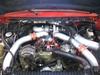
And here’s the turbo and t4 mount just clamped back in place with the stock manifolds and up-pipes bolted back in position.
I didn’t get any further than this last night, but from what I can tell, if I cut the passenger side pipe at the faint red line below and put the bellow there, I should be able to rotate the upper end of this stock pipe so that I would just need a 90 going into the t4 mount from there.
And the driver side looks like a 90 is all that’s needed. it wont go into the mount perfectly perpendicular to the tube axis, but it seems like the misalignment will be gentle enough to not warrant extra cutting and welding (i.e. time) to get it perfect. you can see my reason for leaving the holes un-drilled in the t4 mount to adapter plate connection now. i figure, i'll work on the passenger side first as that's the most difficult. i'll check against the driver side as i go, but being able to slide the turbo around to meet up with the resulting up-pipes will hopefully help. hopefully my downpipe comes in sometime soon as well and i'll check against that every so often during the whole process.
Hopefully I’ll have more to report back this week. wish me luck!
I think that pass side one is going to have to come in lower or it will hit your dp. That 4 inch dp is big!
As for test fitting along with the dp, that is going to be tough. The SD 4 inch dp (which I assume you are getting) needs a lot of modifying to make it clear the uppipe, back of the head, firewall, floor, etc... That will be impossible to do without the motor in the truck.
Everything looks awesome. But my question is why don't you want to use the npt fitting? I've never heard of anyone having a leak there. It seems to me that you are making more work for yourself and taking an unnecessary risk. I totally get it if you just feel more comfortable doing it that way. Sometimes I do things out-of-norm too.
I think that pass side one is going to have to come in lower or it will hit your dp. That 4 inch dp is big!
As for test fitting along with the dp, that is going to be tough. The SD 4 inch dp (which I assume you are getting) needs a lot of modifying to make it clear the uppipe, back of the head, firewall, floor, etc... That will be impossible to do without the motor in the truck.
i may wind up doing exactly that - sort of. my plan is to rip the front end off the truck, set the bed aside, lift the cab off the frame, remove the old motor and tranny, blast and paint the frame up, put the motor and tranny back in, and maybe then complete the turbo install, lowering the cab on and off the truck about a million times to try to "optimize" the DP fit and minimize cutting into the cab.
there - several months worth of work condensed into one run-on sentence :-)
honestly, i was hoping to get the turbo all mounted up on the stand, but its looking like it might more sense to intermingle all the projects together! i know that sounds crazy, but that just might be how i do it.
Originally Posted by cowmilker08
Everything looks awesome. But my question is why don't you want to use the npt fitting? I've never heard of anyone having a leak there. It seems to me that you are making more work for yourself and taking an unnecessary risk. I totally get it if you just feel more comfortable doing it that way. Sometimes I do things out-of-norm too.
Thanks! And yes, it sounds like if you use 1/2" plate and go the NPT fitting route, everything is fine - it just doesnt feel right to me and i'm stubborn. so i'll have to prove to myself that i should have just left well enough alone, i guess :-)
Haven’t made much progress on t4/s366 turbo stuff lately, but finally found time at lunch to make these parts at work yesterday – the turbo oil return adaptor for the old fuel pump block hole. It’ll be double-o-ring sealed like the fuel pump was, with one more o-ring on top for good measure to take up any slop/misalignment when tightening it down.
Looks pretty clean if I do say so myself and fit up first time!
That’s 1” aluminum bar and about 45 mins on the lathe, and a 3/8 NPT to 3/8” 37 degree flare (AN) fitting.
And here it is assembled with o-rings and the hold-down plate
(and this bug where the image rotates back to how it was in camera after I rotate it on my computer is really bugging me lately!)
This must be the first time I saw anything about multiple o-rings for the oil feed at the pedestal. I have to say it... There is no reason for the NPT fitting with the factory o-ring under the plate to bother you. It's simple and it flat out WORKS. It has worked for years and years and years... With every single aftermarket turbo kit that has yet to be designed.... There is NOTHING about the design that would cause concern for anyone. The o-ring sit's in it's factory groove and seals to a nice flat surface... That's what o-rings freaking do... Then there is a fitting threaded into that hole from the other side and the fitting does not go all the way through the plate.. ZERO cause for concern... What that seemed to boil down to is you finding the need to reinvent the wheel when it isn't needed, cause more reason for concern with two more o-rings (each o-ring now becomes another potential fail point), and build a more complicated design.. That is what I saw.. Don't over complicate things.. This is a pretty quick and easy project if you don't over think it. In no way does that mean you aren't doing a good job. I just can't figure out why you're making it more complicated than it has to be in some areas.
because that's what i do!!! just ask my wife :-) if there is a disorder that makes you incapable of leaving well enough alone, i have it!
i appreciate the input, though seriously. i've already committed to this way though, so if it doesnt work, it'll be on me and you can say "i told you so." and i post lots of pictures about the resulting oil leaks/spouts/carnage.
in the spirit of debate, though, my concern with the existing design is not with the o-ring seal to the bottom of the plate as this is just as the stock pedestal would seal.
My concern was that such a setup relies on a less-than-standard pipe thread engagement to hold back 50-100psi of hot oil pressure. yes, it should (and apparently does :-) ) work, but the teflon tape or other pipe selant on the few threads that are there is the only thing between you and an oil leak.
so, i'm keeping the seal between the engine block and adapter plate, but using an o-ring face seal fitting instead of pipe threads, which takes the threads of the fitting completely out of the sealing part of the equation. the small oring in my image is the face seal washer, but the OD on the fitting chamfer actually kisses on the ID of the larger oring as well. in theory, the small oring should be all you need with this setup, but there are essentially 2 backup seals now. and i'll probably put loctite pipe sealant on the ORFS threads as well, just to hold it all in place.
...a triple sealed sealed setup to replace a single-sealed setup that has been proven to work just fine. ...that's just what i do!
Rezvani's Latest Post-Apocalyptic Monster Is a Ford F-150 Raptor Underneath
Slideshow: Called the Fortress, the 850-horsepower pickup combines Raptor underpinnings with military-inspired features, survival equipment, and a starting price of $285,000.