



351m tuning project

Senior User
Joined: Jan 2013
Posts: 290
Likes: 0
Very interesting on all counts.
I wonder if you could get away with the pink cam and an 8.5 or 9.5 power valve.
As I'm sure you know you can plug the PV for diagnostics, but if you run it that way long term you'll just be perpetually lean under load.
You're going to convince me to spend some of my car money on my truck... lol
I wonder if you could get away with the pink cam and an 8.5 or 9.5 power valve.
As I'm sure you know you can plug the PV for diagnostics, but if you run it that way long term you'll just be perpetually lean under load.
You're going to convince me to spend some of my car money on my truck... lol
Senior User
Joined: Jan 2013
Posts: 290
Likes: 0
Finally got to spend some time on mine this afternoon. Had to fix the Ranger, didn't really feel like it, but I'm down to only my wife's car, so...
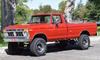
When I got finished I decided to push ahead and gap the plugs on the F100. Even after going from 8mpg to 6mpg, back to 9mpg, even hit 12.5, the plugs are still black.
I just gapped them to .050, runs better, still puffs black smoke. Something has to be wrong with my carb
When I got finished I decided to push ahead and gap the plugs on the F100. Even after going from 8mpg to 6mpg, back to 9mpg, even hit 12.5, the plugs are still black.
I just gapped them to .050, runs better, still puffs black smoke. Something has to be wrong with my carb
Thread Starter
|
Senior User
Joined: Sep 2012
Posts: 372
Likes: 4
From: New Mexico
So which carb are you running now? I recall you were looking at some different ones. Any gas smell from under the hood? With my original carb, it was pretty bad which got me down the road of trying to rebuild it and the ultimately replacing it with the 1850 I have now. The gaskets on the original one were just soaked with gas - it looked to me like it was leaking gas into the intake.
Thread Starter
|
Senior User
Joined: Sep 2012
Posts: 372
Likes: 4
From: New Mexico
I've continued to experiment with the accelerator pump system. Since having a load on the engine is what I really care about (versus reving the engine in the driveway), I made some runs around the block. As I mentioned before, I was seeing some rich AFRs when opening the throttle (see for example the pink cam trace in a previous post). My hypothesis was that the PV was opening. Using the vacuum gauge, I could see the vacuum drop to around 5 which is just below the 6.5 PV I have. So I went ahead and plugged the PV - I couldn't see a difference in the AFR. Maybe it's opening some, but I don't think it's adding much fuel.
Now with the PV plugged, I ran through the various cams again and saw little impact except to make the rich 'spike' worse. And it was there even with the #25 squirter right after the stumble. Long story short, I believe this is a fundamental property of the carb. For example, when turning 3000 RPM and then closing the throttle, there is excess fuel due to the loss of air. I see the same thing happening when shifting gears. As confirmation, if I wait a second or so after a shift before hitting the gas, I see a higher AFR (say 11.5 versus 10). In this case I think the engine consumes some of rich mixture before I add to it - otherwise, I make it worse by immediately hitting the gas.
To those out there still watching, sorry for the long posts. I've found little detail out there on the internet, so I'm leaning towards sharing as much as reasonable so others might have a better start in such an endeavor.
So to help mitigate the above, I took the #25 squirter I had and enlarged the holes to make it a #28 (I was using a #31). This also helped lower the AFR while I'm accelerating before each shift by spreading out the fuel some over time. I now see AFRs around 13 versus 14. Also, I ended up with the pink cam using hole #1 versus the red I found from just reving the engine in the driveway.
As a final thought, I have a sense I'll need to make some adjustments to 'richen' the carb for winter. This morning was about 60 and with the engine cold (and some choke), it was hesitating some when taking off. Once the engine is up to temp, all is fine. This makes sense as the engine/manifold heat is important in helping to atomize the fuel. Now I'm more motivated for an electric fan as I don't need to cool the radiator/engine all the time. The faster I can get the engine to temp - and keep it at 195 - the better. Today the engine was running about 185 - 190 and I'd like to see it a tad higher when on the road.
Now with the PV plugged, I ran through the various cams again and saw little impact except to make the rich 'spike' worse. And it was there even with the #25 squirter right after the stumble. Long story short, I believe this is a fundamental property of the carb. For example, when turning 3000 RPM and then closing the throttle, there is excess fuel due to the loss of air. I see the same thing happening when shifting gears. As confirmation, if I wait a second or so after a shift before hitting the gas, I see a higher AFR (say 11.5 versus 10). In this case I think the engine consumes some of rich mixture before I add to it - otherwise, I make it worse by immediately hitting the gas.
To those out there still watching, sorry for the long posts. I've found little detail out there on the internet, so I'm leaning towards sharing as much as reasonable so others might have a better start in such an endeavor.
So to help mitigate the above, I took the #25 squirter I had and enlarged the holes to make it a #28 (I was using a #31). This also helped lower the AFR while I'm accelerating before each shift by spreading out the fuel some over time. I now see AFRs around 13 versus 14. Also, I ended up with the pink cam using hole #1 versus the red I found from just reving the engine in the driveway.
As a final thought, I have a sense I'll need to make some adjustments to 'richen' the carb for winter. This morning was about 60 and with the engine cold (and some choke), it was hesitating some when taking off. Once the engine is up to temp, all is fine. This makes sense as the engine/manifold heat is important in helping to atomize the fuel. Now I'm more motivated for an electric fan as I don't need to cool the radiator/engine all the time. The faster I can get the engine to temp - and keep it at 195 - the better. Today the engine was running about 185 - 190 and I'd like to see it a tad higher when on the road.
Senior User
Joined: Jan 2013
Posts: 290
Likes: 0
You've still got a thermostat, right? The fan shouldn't affect it until the water has cycled through and warmed the radiator a second time.
Very interesting about the pink cam. I didn't realize it wasn't under load on your first test. That makes a difference. Mine will free rev fast enough to burn off the excess fuel but not under load. Still does it in neutral but it is worse when under load.
Very interesting about the pink cam. I didn't realize it wasn't under load on your first test. That makes a difference. Mine will free rev fast enough to burn off the excess fuel but not under load. Still does it in neutral but it is worse when under load.
Thread Starter
|
Senior User
Joined: Sep 2012
Posts: 372
Likes: 4
From: New Mexico
Yes, installed a new 195 a few months ago. Since my fan is always turning, there's a reasonable amount of air blowing across the engine when it's trying to warm up. Currently I don't have a shroud (removed by the original owner) and haven't had any cooling issues even when it's been 100 degrees outside. Right now I'm looking at different electric fan options.
Regarding the differences between load versus no load, it has me thinking it would be useful to have a throttle position sensor connected to the data logger. And vacuum as well. All these things are interrelated and trying to just control one is problematic. Overall I can now better appreciate the value of fuel injection which utilizes lots of real-time information, but requires a computer to optimize the fuel and timing.
Regarding the differences between load versus no load, it has me thinking it would be useful to have a throttle position sensor connected to the data logger. And vacuum as well. All these things are interrelated and trying to just control one is problematic. Overall I can now better appreciate the value of fuel injection which utilizes lots of real-time information, but requires a computer to optimize the fuel and timing.
Senior User
Joined: Jan 2013
Posts: 290
Likes: 0
I'm sure the air blowing across the engine has an effect, but the majority of the impact would be cold air going into the intake. If you have a cold air intake then it doesn't matter. Even like my open filter it won't have much effect on the initial heat up. Air blowing over cast iron pretty much just cools the surface.
FTE Stories
Ford Trucks for Ford Truck Enthusiasts

10 Things Every Truck Owner NEEDS (2026 Edition)
Michael S. Palmer
Rezvani's Latest Post-Apocalyptic Monster Is a Ford F-150 Raptor Underneath
Verdad Gallardo
Top 10 Most Expensive Ford Trucks Ever Sold on Bring a Trailer
Joe Kucinski
2027 Ford Super Duty Buyer's Guide (Every Model, Engine, & Package)
Brett Foote
Top 10 Ford Truck Tragedies
Joe Kucinski
AEV FXL Super Duty - the Super Duty Raptor Ford Doesn't Make
Brett Foote
Lobo Vs Lobo: Proof the F-150 Lobo Should Be Even Lower!
Michael S. Palmer
Ford's 2001 Explorer Sportsman Concept Looks For a New Home
Verdad Gallardo
10 Best Ford Truck Engines We Miss the Most!
Joe Kucinski
Posting Guru
Joined: Jul 2013
Posts: 1,685
Likes: 2
From: Oregon
NM- I don't know if you have seen this link or not, but I found it full of information. A lot of it may be refresher for you, but I thought I would share it with you.
Carb Tunning
Carb Tunning
Thread Starter
|
Senior User
Joined: Sep 2012
Posts: 372
Likes: 4
From: New Mexico
0ldman - I generally agree with what you saying. The time for the intake manifold and carburetor to heat up is dominated by thermal conduction and probably not affected too much by airflow . . . although now I'm curious to do a few back of the envelope calculations and see what this looks like.
After researching electric fans over the past week, I thought I'd see what the pull-n-pay had to offer. I got lucky and finally stumbled across a Cougar that still had a fan and a Taurus 3g alternator - $54 total including the core fee and tax! And both speeds on the fan work!

After researching electric fans over the past week, I thought I'd see what the pull-n-pay had to offer. I got lucky and finally stumbled across a Cougar that still had a fan and a Taurus 3g alternator - $54 total including the core fee and tax! And both speeds on the fan work!

Senior User
Joined: Jan 2013
Posts: 290
Likes: 0
Just got a 6AL on eBay, now I patiently wait... yeah, patiently...
Hoping to see similar results. It runs better with a .050 gap than it did with the .035, opened the gap on the Pertronix to 2mm to increase dwell and improve spark, seems to have helped a bit as well.
Hoping to see similar results. It runs better with a .050 gap than it did with the .035, opened the gap on the Pertronix to 2mm to increase dwell and improve spark, seems to have helped a bit as well.

Senior User
Joined: Jul 2013
Posts: 307
Likes: 1
From: Isla de Muerta
Maybe it's been mentioned previously, if so I missed it, but what are the current gear ratios in your axle?
I wonder how much of an increase in MPG you'd see by swapping the 35's back to the OE spec tire size.
I wonder how much of an increase in MPG you'd see by swapping the 35's back to the OE spec tire size.
Thread Starter
|
Senior User
Joined: Sep 2012
Posts: 372
Likes: 4
From: New Mexico
I'm running 4.10s in mine. Not sure if the mileage would get better with the OE tires - I'd probably be driving much faster to avoid being seen with such little tires and a 4" lift.  But seriously, I think the gain would depend on what type of driving. For example, I wouldn't think the smaller tires would gain much on the highway as air drag dominates.
But seriously, I think the gain would depend on what type of driving. For example, I wouldn't think the smaller tires would gain much on the highway as air drag dominates.