





Ticking sound under load:
Thread Starter
|
Elder User
Joined: Jul 2001
Posts: 581
Likes: 2
From: Milton, Wa
Ticking sound under load:
I did a search and read through some of the posts, but my "tick" is a bit different. No abnormal tick at idle. The only time I really hear the ticking is when I get on it pretty good. As soon as I let off it goes away.
No lack of power.
Any suggestions?
Ryan
No lack of power.
Any suggestions?
Ryan
Hotshot


Joined: Jan 2011
Posts: 18,849
Likes: 179
From: Puget Sound
That's frequently one noisy injector. The Injector Control Pressure is elevated when you check the temperature of the firewall with your foot, and the injector can protest aloud with a foot up its butt.
Hotshot
Joined: Jan 2011
Posts: 18,849
Likes: 179
From: Puget Sound
Sometimes they just get noisy as they age. You can play with the Hutch mod to make sure there's no air in your fuel, you can check the injector hold-down bolt torque or maybe replace the O-rings, you can install a fuel return on the heads, try different oil (I use synthetic) - or just replace the injector. I have learned the injectors are pretty much the noisiest thing under the hood on these trucks, unless you get them under control.
How much do you want to spend to silence a stick?
How much do you want to spend to silence a stick?
Fleet Mechanic


Joined: Mar 2009
Posts: 1,856
Likes: 52
From: Sacramento Delta, CA
Cleatus12r: I've always wondered with an exhaust manifold leak (my wife's Dakota has one now, my previous 1993 Bronco had one) if it was the exhaust valve itself opening and closing which makes the ticking sound and we are just hearing it through the warp or other gap in the manifold?
Or is it the exhaust gasses being expelled out the manifold gap which makes that ticking sound?
Also, is it true if you don't fix the leak it will burn out that exhaust valve?
What do you think?
Or is it the exhaust gasses being expelled out the manifold gap which makes that ticking sound?
Also, is it true if you don't fix the leak it will burn out that exhaust valve?
What do you think?
Trending Topics

Fleet Mechanic
Joined: Dec 2010
Posts: 1,546
Likes: 9
From: Wellington, Co
I second the possible exhaust leak. It could be coming from manifold to head, sneaking out around the awesome seal of the uppies. I don't believe it would hurt a valve unless really bad. Never quite understood the dynamics on how it would burn a valve, but have heard that from way back.
FTE Stories
Ford Trucks for Ford Truck Enthusiasts

Rezvani's Latest Post-Apocalytic Monster Is a Ford F-150 Raptor Underneath
Verdad Gallardo
Top 10 Most Expensive Ford Trucks Ever Sold on Bring a Trailer
Joe Kucinski
2027 Ford Super Duty Buyer's Guide (Every Model, Engine, & Package)
Brett Foote
Top 10 Ford Truck Tragedies
Joe Kucinski
AEV FXL Super Duty - the Super Duty Raptor Ford Doesn't Make
Brett Foote
Lobo Vs Lobo: Proof the F-150 Lobo Should Be Even Lower!
Michael S. Palmer
Ford's 2001 Explorer Sportsman Concept Looks For a New Home
Verdad Gallardo
10 Best Ford Truck Engines We Miss the Most!
Joe Kucinski
2026 Shelby F-150 Off-Road: Better Than a Raptor R?
Brett Foote
Thread Starter
|
Elder User
Joined: Jul 2001
Posts: 581
Likes: 2
From: Milton, Wa
I just checked this thread......guess I didn't get any notifications of replys.
So the click/tick/pft is pretty loud on acceleration. I'd like it if it were a exhaust leak.
I have a video I'll post up later.
Ryan
So the click/tick/pft is pretty loud on acceleration. I'd like it if it were a exhaust leak.
I have a video I'll post up later.
Ryan
Fleet Mechanic
Joined: Mar 2009
Posts: 1,856
Likes: 52
From: Sacramento Delta, CA
Hey Ryan:
Your symptoms are different than my wife's Dodge where the ticking is most pronounced when the engine is cold and at idle and quiets down when warmer and while driving at higher rpm. (I have read that higher rpm actually reduces exhaust back pressure so quieter ticking results. I have also read that when the engine is under a load, the ticking get louder. So, go figure...) Here is a quotes from a thread I found which seemed helpful to me:
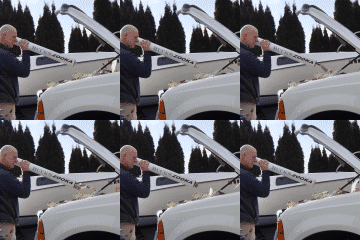
"The easiest way that I've found to isolate an exhaust leak it to have about a 2-foot long piece of 3/8" hose. Stick one end in your ear and trace the other end around
the exhaust ports and flanges. If there's a leak, you'll be able to hear it very clearly. This way you won't burn your fingers either."
Your symptoms are different than my wife's Dodge where the ticking is most pronounced when the engine is cold and at idle and quiets down when warmer and while driving at higher rpm. (I have read that higher rpm actually reduces exhaust back pressure so quieter ticking results. I have also read that when the engine is under a load, the ticking get louder. So, go figure...) Here is a quotes from a thread I found which seemed helpful to me:
"The easiest way that I've found to isolate an exhaust leak it to have about a 2-foot long piece of 3/8" hose. Stick one end in your ear and trace the other end around
the exhaust ports and flanges. If there's a leak, you'll be able to hear it very clearly. This way you won't burn your fingers either."
Thread Starter
|
Elder User
Joined: Jul 2001
Posts: 581
Likes: 2
From: Milton, Wa
I'll check for a leak tonight.
So I'm going to add a curve ball to the symptoms......probably should have mentioned it before. If I don't start it for a couple days then most times it has what feels like a miss and extreme loss of power. Sometimes it goes away after I give it a little throttle and get going down the road. The miss just goes away suddenly and it'll run smooth. If I let it sit for a few days in the cold it'll go away after a mile or two down the road.
So I'm going to add a curve ball to the symptoms......probably should have mentioned it before. If I don't start it for a couple days then most times it has what feels like a miss and extreme loss of power. Sometimes it goes away after I give it a little throttle and get going down the road. The miss just goes away suddenly and it'll run smooth. If I let it sit for a few days in the cold it'll go away after a mile or two down the road.