





Thinking about a turbo mod

Thread Starter
|
Freshman User
Joined: Aug 2005
Posts: 30
Likes: 0
From: Aurora / Moores Hill, IN
Thinking about a turbo mod
Has anyone here put in a Wicked Wheel 2 for their 6.7 yet? My buddy told me about these today. Looking for some feedback on these WW2s please.
http://www.dieselsite.com/wickedwhee...13ford67l.aspx
http://www.dieselsite.com/wickedwhee...13ford67l.aspx
Thread Starter
|
Freshman User
Joined: Aug 2005
Posts: 30
Likes: 0
From: Aurora / Moores Hill, IN
Yep they do now. 450 bucks. Not sure I want to spend that much on something that has not been proven yet.
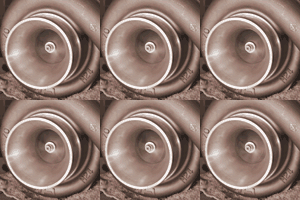
One thing I did learn is what the compressor wheel looks like. I heard things like twin turbo before but I didn't know exactly what they meant but after looking at the site below and the this video link it's pretty cool how they did a twin turbo.
http://www.dieselsite.com/wickedwhee...13ford67l.aspx
One thing I did learn is what the compressor wheel looks like. I heard things like twin turbo before but I didn't know exactly what they meant but after looking at the site below and the this video link it's pretty cool how they did a twin turbo.
http://www.dieselsite.com/wickedwhee...13ford67l.aspx

More Turbo


Joined: Jan 2012
Posts: 740
Likes: 152
From: USA
Very interesting.
I'm see'ing a 60.2 hp increase over stock with a 117.2 torque increase over stock.
This is of course the tested engine was completely stock.
A few of us have modded trucks. So, what tuning would be required if the WW being dropped into a modded truck? It would be nice to hear from both DieselSite and H&S.
I would be willing to give this a try if the tuning was right.
I use their Ford 6.7L Fuel Filter / Water Separator System. I love it.
I'm see'ing a 60.2 hp increase over stock with a 117.2 torque increase over stock.
This is of course the tested engine was completely stock.
A few of us have modded trucks. So, what tuning would be required if the WW being dropped into a modded truck? It would be nice to hear from both DieselSite and H&S.
I would be willing to give this a try if the tuning was right.
I use their Ford 6.7L Fuel Filter / Water Separator System. I love it.
Posting Guru
Joined: Jan 2010
Posts: 1,616
Likes: 6
From: Whitecourt AB, Canada
But it's not the wheel itself that is the failure mode on the stock turbos is it? Something else lets go, the wheel crashes into something, and then it's all downhill from there...
Trending Topics
Fleet Owner

Joined: Mar 2012
Posts: 20,168
Likes: 15,997
From: Wisconsin
So far bearing failure has led to the turbo issues that I have seen. Not sure how that wheel and the increased boost it creates addresses the strain on the stock bearings.
FTE Stories
Ford Trucks for Ford Truck Enthusiasts

Top 6 Best Deals Available on New Fords & Lincolns Right Now
Brett Foote
This Hennessey Takes the Expedition Tremor's Off-Roading Capability to the Next Level
Verdad Gallardo
Top 10 Fords at 2026 Carlisle Ford Nationals
Joe Kucinski
3 Best / 3 Worst Parts of Modern Ford Ownership
Brett Foote
10 Amazing Upgrades That Solve Common Ford Truck Owner Headaches
Pouria Savadkouei
Every 2026 Ford Engine Explained
Brett Foote
10 Ugly Ford Trucks That We Still Kinda Love
Joe Kucinski
10 Things Every Truck Owner NEEDS (2026 Edition)
Michael S. Palmer
Rezvani's Latest Post-Apocalyptic Monster Is a Ford F-150 Raptor Underneath
Verdad Gallardo

More Turbo
Joined: Sep 2013
Posts: 596
Likes: 23
From: Watson
To me, this seems like a really well-thought way of addressing a turbocharger upgrade.
Most OEM turbo wheel/shaft assemblies are spun in excess of hundreds of thousands of RPM. At those speeds, out-of-balance amounts in the microns can lead to shaft wobble which leads to bearing failure. Now turn up the boost like all the tuners are doing and you further remove any margin for error. And I'm not knocking that approach, we all do it willingly for the fun factor.
But what I'm seeing out of that wicked wheel is a lighter wheel, for one, being billet, so less strain on the entire shaft assembly, and they also claim to move more air at the same operating RPM, so no need to overspin your turbo to get the more PSI we're all looking for. There's your power upgrade without theoretically decreasing overall longevity of the unit.
Running larger compressor wheels in existing assemblies certainly isn't new technology, but the billet angle is. Only concern I could voice is it was always my understanding that if you modified anything about a turbocharger assembly, on either wheel hot or cold, you wanted to re-balance the entire rotating assembly as a unit.
Interesting.....
Most OEM turbo wheel/shaft assemblies are spun in excess of hundreds of thousands of RPM. At those speeds, out-of-balance amounts in the microns can lead to shaft wobble which leads to bearing failure. Now turn up the boost like all the tuners are doing and you further remove any margin for error. And I'm not knocking that approach, we all do it willingly for the fun factor.
But what I'm seeing out of that wicked wheel is a lighter wheel, for one, being billet, so less strain on the entire shaft assembly, and they also claim to move more air at the same operating RPM, so no need to overspin your turbo to get the more PSI we're all looking for. There's your power upgrade without theoretically decreasing overall longevity of the unit.
Running larger compressor wheels in existing assemblies certainly isn't new technology, but the billet angle is. Only concern I could voice is it was always my understanding that if you modified anything about a turbocharger assembly, on either wheel hot or cold, you wanted to re-balance the entire rotating assembly as a unit.
Interesting.....

Lead Driver


Joined: Apr 2011
Posts: 7,302
Likes: 1,153
From: Edmonton Alberta

From what I have heard and seen on mine it is the bearing that fails. Both the old sleeve bearings and the new ball bearings have failed. Seems once the bearing goes out the shaft goes out of balance and bends (in my case) or breaks in some other cases. The shaft bending was definately the cause of my failure. The shaft is bent in the direction of the damage to the wheel. If the impact had cause the shaft to bend, the bend would be in the other direction. The wheel is twin aluminum stock but not made from billet.
Possibly... if the wicked wheel made more boost at a lower RPM it could prolong bearing life. Stock wheel is really light so I can't see much of an advantage there... I think it would be the weight of the steel exhaust side wheel that would be the major factor in bearing life.
Just my $0.02, I am by no means an expert on turbos

That is really cool tho


More Turbo
Joined: Sep 2013
Posts: 596
Likes: 23
From: Watson
1st.... too bad I just put a turbo in last week! Never seen that before and would have been pretty easy with a brand new turbo on the bench...... But it is not coming back out at this point....
From what I have heard and seen on mine it is the bearing that fails. Both the old sleeve bearings and the new ball bearings have failed. Seems once the bearing goes out the shaft goes out of balance and bends (in my case) or breaks in some other cases. The shaft bending was definately the cause of my failure. The shaft is bent in the direction of the damage to the wheel. If the impact had cause the shaft to bend, the bend would be in the other direction. The wheel is twin aluminum stock but not made from billet.
Possibly... if the wicked wheel made more boost at a lower RPM it could prolong bearing life. Stock wheel is really light so I can't see much of an advantage there... I think it would be the weight of the steel exhaust side wheel that would be the major factor in bearing life.
Just my $0.02, I am by no means an expert on turbos
That is really cool tho


From what I have heard and seen on mine it is the bearing that fails. Both the old sleeve bearings and the new ball bearings have failed. Seems once the bearing goes out the shaft goes out of balance and bends (in my case) or breaks in some other cases. The shaft bending was definately the cause of my failure. The shaft is bent in the direction of the damage to the wheel. If the impact had cause the shaft to bend, the bend would be in the other direction. The wheel is twin aluminum stock but not made from billet.
Possibly... if the wicked wheel made more boost at a lower RPM it could prolong bearing life. Stock wheel is really light so I can't see much of an advantage there... I think it would be the weight of the steel exhaust side wheel that would be the major factor in bearing life.
Just my $0.02, I am by no means an expert on turbos
That is really cool tho
I wouldn't be surprised if the higher boost pressures you were running and overspinning the center section to accomplish that, eventually led to an initially infinitesimal out-of-balance amount becoming a much greater out-of-balance amount, which wobbled the shaft taking out the bearings and wheel in the process.
It's probably impossible to know at this point, but my experience with turbochargers leads me to lean that way.

Junior User
Joined: Nov 2010
Posts: 88
Likes: 0
From: Hermitage, TN
I would love to try this but I feel the only true 60hp and 100+ lbs of torque would only be realized by a stock truck. A tuned truck will run out of fuel without a second pump or at least a single modified pump. I know my truck pulls like a freight train with the Hot X tune and I would love to add the WW2 but swapping the wheel isn't gonna gain me 60 more hp and 100+ ft lbs. I'd like to see dyno numbers of a typical bolt on exhaust/intake/tuner truck and see the numbers............... Along with either enough money to upgrade my fuel system or a halfway house that takes in newly divorced men with nothing but a pickup truck!! 

Lead Driver
Joined: Apr 2011
Posts: 7,302
Likes: 1,153
From: Edmonton Alberta
I'm more leaning towards the opposite happening, D.
I wouldn't be surprised if the higher boost pressures you were running and overspinning the center section to accomplish that, eventually led to an initially infinitesimal out-of-balance amount becoming a much greater out-of-balance amount, which wobbled the shaft taking out the bearings and wheel in the process.
It's probably impossible to know at this point, but my experience with turbochargers leads me to lean that way.
I wouldn't be surprised if the higher boost pressures you were running and overspinning the center section to accomplish that, eventually led to an initially infinitesimal out-of-balance amount becoming a much greater out-of-balance amount, which wobbled the shaft taking out the bearings and wheel in the process.
It's probably impossible to know at this point, but my experience with turbochargers leads me to lean that way.
I am not knocking the stock turbo, I think it works good. If I didn't I would have put one of the kits in. I am long done with mods on this truck and just want to drive it for a couple years.
More Turbo
Joined: Sep 2013
Posts: 596
Likes: 23
From: Watson
IDK... but I guess I should not have said the bearing "out". There is excessive play there but it still spins freely. The shaft is bent and it was not the impact that bent it. I agree with this for sure. The thing was pushed way past design for 70,000 miles, up to 38 PSI.
I am not knocking the stock turbo, I think it works good. If I didn't I would have put one of the kits in. I am long done with mods on this truck and just want to drive it for a couple years.
I am not knocking the stock turbo, I think it works good. If I didn't I would have put one of the kits in. I am long done with mods on this truck and just want to drive it for a couple years.