



Electrical Help Needed

Thread Starter
|
New User
Joined: Sep 2013
Posts: 7
Likes: 0
Electrical Help Needed
Have a 78 F150 Custom that I just picked up and have been having electrical issues that have me baffled. Went out to turn on the truck and the starter "drug" when starting but still started, drove immediately to Auto Zone and had the battery checked as well as the alternator and volt. regulator. Battery was good but only had a 35% charge and the alternator and regulator both came back as bad diodes. Replaced them both with new parts and after starting the truck removing the positive cable from the battery to check that the system was charging the truck immediately shuts off. Went back to parts store had another test run on new parts alternator good, but regulator is still coming back as bad (had them give me another to try in parking lot and the results were the same with another new one). Was told that there was an issue other than the alternator and regulator. Frustration has now set in and I am at a total loss where to go to next on trouble shooting the problem. Could this be a ground issue and where would I even start. I mean which ground or what would cause the the voltage regulator to not work. And if the regulator is not working doesn't that mean that my alternator is not working as well. Please help!!!
Hotshot


Joined: Apr 2009
Posts: 14,333
Likes: 247
From: Stanley, VA

Disconnecting the battery cable is NOT a valid test for the charging system in fact this can damage the alternator.
Get a multimeter, check the battery voltage with the engine off. It should be around 12 volts. Start the engine and hold it at high idle and check the voltage again. It should now be around 14.2 volts.
Report back what you find.
Get a multimeter, check the battery voltage with the engine off. It should be around 12 volts. Start the engine and hold it at high idle and check the voltage again. It should now be around 14.2 volts.
Report back what you find.

Cargo Master
Joined: Oct 2010
Posts: 2,339
Likes: 32
From: Lost In a Pit of Despair
You say the battery is good, but only has 35% charge. Have you charged up the battery? Will it even hold a charge? What kind of voltage does it have?
General rule of thumb is if your battery has less than 12.8 volts surface charge, it needs/will need replacing. Also know that batteries are usually only good for 4-6 years, and if it was ever fully discharged at some point during its use, than you'll probably need to replace it.
As for the charging system, do what Mike is suggesting. Without knowing what kind of voltage your system is putting out, we can't really determine what your issue might be.
-Jameson
General rule of thumb is if your battery has less than 12.8 volts surface charge, it needs/will need replacing. Also know that batteries are usually only good for 4-6 years, and if it was ever fully discharged at some point during its use, than you'll probably need to replace it.
As for the charging system, do what Mike is suggesting. Without knowing what kind of voltage your system is putting out, we can't really determine what your issue might be.
-Jameson

Elder User
Joined: May 2004
Posts: 836
Likes: 2
From: Shreveport, LA
Mother of God.
It's nice to see someone who recognizes this. Oddly enough, the things it's most likely to damage are....diodes in the regulator!!
How pulling a cable came to be thought of as troubleshooting is a mystery.
It's nice to see someone who recognizes this. Oddly enough, the things it's most likely to damage are....diodes in the regulator!!
How pulling a cable came to be thought of as troubleshooting is a mystery.
Hotshot
Joined: Apr 2009
Posts: 14,333
Likes: 247
From: Stanley, VA
Remember when cars had generators, not alternators? Back then this was considered a valid test. Generators had residual magnetism that would energize the circuit and the generator would put out regardless of whether it had an outside power source.
Alternators need to be energized from an outside source to produce power, remove the battery and you remove the power source and the alternator stops producing power.
Plus, generators are real old school technology. No solid state parts to get fried from voltage spikes.

Logistics Pro
Joined: May 2003
Posts: 4,238
Likes: 21
From: Northern Illinois
Pulling a cable off and checking the back bearing for magnetism has been around for a long time.
Elder User
Joined: May 2004
Posts: 836
Likes: 2
From: Shreveport, LA
The diodes are in the regulator. The regulator may or may not be in the alternator.
I'd forgotten about residual magnetism...I just flashed a field last week too.
Oh well, I never claimed to be the smartest person around. Thanks for mentioning the generators.
I'd forgotten about residual magnetism...I just flashed a field last week too.
Oh well, I never claimed to be the smartest person around. Thanks for mentioning the generators.
Trending Topics

MSEE
Joined: Apr 2004
Posts: 10,386
Likes: 35
From: Austin, TX
In the interest of completeness: it's not so much the diodes that get damaged when removing the battery cable while the engine is running. Rather, it's any onboard electronics (like an ignition module or radio). The battery acts as a current sink that helps load the alternator output. With this load suddenly disconnected from the alternator, the regulator cannot react quickly enough, and the alternator output is allowed to spike very high. Not only can this take out sensitive electronics, but in some cases it can even blow out bulbs (rare).
The most common way to blow the rectifier diodes is hooking up the battery backwards, which forward-biases the diodes. A fusible link is supposed to help protect the rectifier bridge, but it doesn't always happen.
FTE Stories
Ford Trucks for Ford Truck Enthusiasts

3 Best / 3 Worst Parts of Modern Ford Ownership
Brett Foote
10 Amazing Upgrades That Solve Common Ford Truck Owner Headaches
Pouria Savadkouei
Every 2026 Ford Engine Explained
Brett Foote
10 Ugly Ford Trucks That We Still Kinda Love
Joe Kucinski
10 Things Every Truck Owner NEEDS (2026 Edition)
Michael S. Palmer
Rezvani's Latest Post-Apocalyptic Monster Is a Ford F-150 Raptor Underneath
Verdad Gallardo
Top 10 Most Expensive Ford Trucks Ever Sold on Bring a Trailer
Joe Kucinski
2027 Ford Super Duty Buyer's Guide (Every Model, Engine, & Package)
Brett Foote
Top 10 Ford Truck Tragedies
Joe Kucinski
Thread Starter
|
New User
Joined: Sep 2013
Posts: 7
Likes: 0
Well first of all thank you all for your input on this issue as well as learning some interesting facts along the way. I was not aware that removing the positive cable while running would cause any problems so thank you for that, good thing no onboard computer to worry about! So here's were I am so far. First of all let me clear up that the battery is NOT at 35% anymore fully charged it before moving any further, after replacing the regulator and alternator using a multimeter and following the suggestions while off the battery registered @12.5 started the truck and brought up the RPM's and it read exactly the same no change in either direction. So long story short same spot as when I started. Does anyone have anymore suggestions to try. Thanks in advance.
Logistics Pro
Joined: May 2003
Posts: 4,238
Likes: 21
From: Northern Illinois
As I suspected.
Well first of all thank you all for your input on this issue as well as learning some interesting facts along the way. I was not aware that removing the positive cable while running would cause any problems so thank you for that, good thing no onboard computer to worry about! So here's were I am so far. First of all let me clear up that the battery is NOT at 35% anymore fully charged it before moving any further, after replacing the regulator and alternator using a multimeter and following the suggestions while off the battery registered @12.5 started the truck and brought up the RPM's and it read exactly the same no change in either direction. So long story short same spot as when I started. Does anyone have anymore suggestions to try. Thanks in advance.
Cargo Master

Joined: Nov 2009
Posts: 2,364
Likes: 117
From: starship enterprise
Check all the connections and ring terminals, all of your wiring and plugs for continuity, And I believe that the ammeter might (might not) have to check the schematic, have a bearing on the ALT. out put. The regulators have a bunch of flat tabs that plug into the socket, make sure that those are connecting right, It might need the ground hooked up/cleaned from the fire wall to the bell housing bolt, this can cause some strange activity. Good luck.

Elder User
Joined: May 2004
Posts: 836
Likes: 2
From: Shreveport, LA
Maybe you should look into doing a 3G swap at this point? It probably would be a good idea for everyone with NOT a 3g to look into a 3G swap and having issues keeping voltage flowing is a good time to look into it.
If youre able to swap your old unit and regulator, you've already got the mad skillz for this swap.
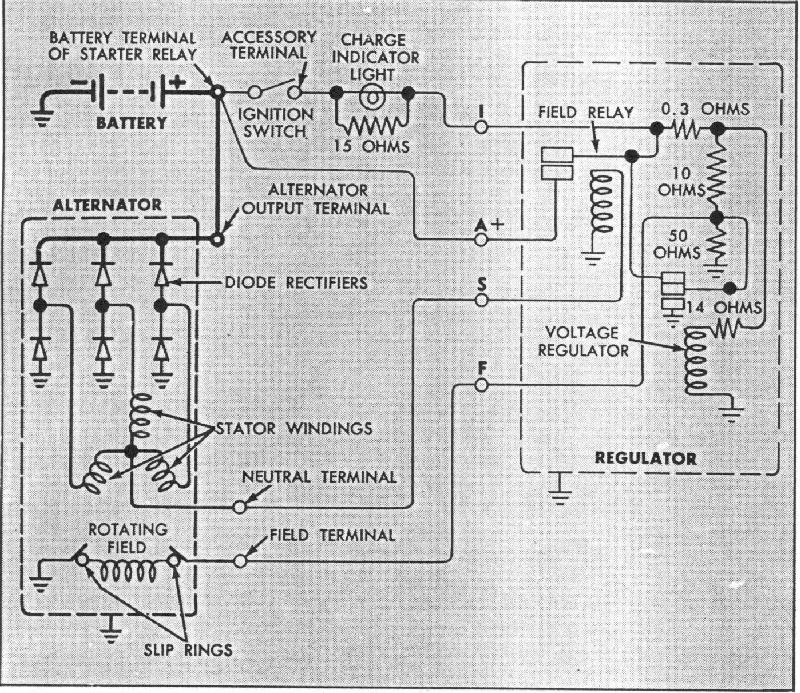
FMC 400, thanks for that diagram; what is that from? My Haynes isnt quite that complete. The fusible link you mentioned wont cant from reversing the battery cables; Ford left that up to the owner...
If youre able to swap your old unit and regulator, you've already got the mad skillz for this swap.
FMC 400, thanks for that diagram; what is that from? My Haynes isnt quite that complete. The fusible link you mentioned wont cant from reversing the battery cables; Ford left that up to the owner...
MSEE
Joined: Apr 2004
Posts: 10,386
Likes: 35
From: Austin, TX
That specific diagram is drawn by Ford and appears in the Electrical volume of many factory shop manuals.
When the battery is connected backwards, all six diodes in the rectifier bridge are forward biased, and act essentially as a short. In the absence of any current limiting, these diodes will blow. However, the output of the alternator is protected by a fusible link (separate than what appears at the starter solenoid).
This fusible link is installed specifically to protect the alternator if the output is shorted externally. It's desirable for the fusible link to blow before the diodes if the battery polarity is reversed. However, this does not always happen in practice; as such it's common to face a puff of smoke followed by a no-charge situation following polarity reversal. It's not guaranteed protection by any means and it really falls upon the owner to simply not do this, as you describe.
This fusible link is installed specifically to protect the alternator if the output is shorted externally. It's desirable for the fusible link to blow before the diodes if the battery polarity is reversed. However, this does not always happen in practice; as such it's common to face a puff of smoke followed by a no-charge situation following polarity reversal. It's not guaranteed protection by any means and it really falls upon the owner to simply not do this, as you describe.
