


Power Steering
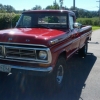
Thread Starter
|
Senior User
Joined: Aug 2012
Posts: 252
Likes: 0
From: Corvallis, OR
On that note, anybody from the Portland/Vancouver area want to go check out this truck with me? I could use some experience and would probably be able to compensate you in beer.
-ADJ
-ADJ
Thread Starter
|
Senior User
Joined: Aug 2012
Posts: 252
Likes: 0
From: Corvallis, OR
Hey guys I went and checked it out today and I think I'm in love. I took some more pictures.
F100 p2 - Imgur
Is there anything here that is horrible looking?
The steering felt pretty loose, and the brakes worked well but came on really hard. What would be the cost to rebuild the power steering.
Also the paint job seems to be a cheap respray to cover up some surface rust, but the cab corners, and cab mounts all seem free of rust.
Thanks for the advice.
Aidan
F100 p2 - Imgur
Is there anything here that is horrible looking?
The steering felt pretty loose, and the brakes worked well but came on really hard. What would be the cost to rebuild the power steering.
Also the paint job seems to be a cheap respray to cover up some surface rust, but the cab corners, and cab mounts all seem free of rust.
Thanks for the advice.
Aidan
Thread Starter
|
Senior User
Joined: Aug 2012
Posts: 252
Likes: 0
From: Corvallis, OR

Hotshot
Joined: Oct 2002
Posts: 18,488
Likes: 22
From: The Big, Oregon

That missing spot on the backing plate looks like it had a wheel-loss incident at some point. The hole in the underside of the frame is normal as far as I know. The power steering looks like a 78-79 F150 4x4 box, so it shouldn't be expensive to replace if needed.

Fleet Owner
Joined: Dec 2009
Posts: 20,678
Likes: 83
From: NorCal
Hey guys I went and checked it out today and I think I'm in love. I took some more pictures.
F100 p2 - Imgur
Is there anything here that is horrible looking?
The steering felt pretty loose, and the brakes worked well but came on really hard. What would be the cost to rebuild the power steering.
Also the paint job seems to be a cheap respray to cover up some surface rust, but the cab corners, and cab mounts all seem free of rust.
Thanks for the advice.
F100 p2 - Imgur
Is there anything here that is horrible looking?
The steering felt pretty loose, and the brakes worked well but came on really hard. What would be the cost to rebuild the power steering.
Also the paint job seems to be a cheap respray to cover up some surface rust, but the cab corners, and cab mounts all seem free of rust.
Thanks for the advice.
Yep, that's a 76-79 integral PS steering box and linkage that was swapped in. The front axle is still drums so the swap was pretty much exactly what I did to my 73 4x4. See, the later drag link and tie rod has a thicker shank so the PO likely reamed out the steering arms for it to seat properly. The flame-cut hole under the frame is the access for the lower steering box bolt. The 1/4-inch plate inboard of the frame secures the other two bolts. It's OK but a better way to do it is to sleeve the frame. Get a Redhead power steering box.. the fellow FTE'ers rave about its thorough rebuilds... moreso than the seal-and-paint job from Autozone. I'll be getting one in the near future.
Something is funky with the tie rod to pitman arm connection in the last pic. A 78-79 would insert into the underside of the pitman arm. The length of that thing, plus the fact that it looks like it is binding, is a cause for some concern. It's leveraging on the joint. The steering stablizer bracket is also bent. I'd definitely use that wonkiness as a negotiating point. New linkages is about $200.
Wheel cylinder is leaking... that's an easy fix. But a section of the backing plate looks like it has been flame-cut. What's up with that???
I think that's a 2WD oil filter mount. I believe a 4x4 of this vintage would be 90°. Meaning, the filter is vertical and not horizontal. The filter is prolly a Fram PH-16 or equivalent... same diameter as a Fram PH-8 or Motocraft FL-1 but a couple of inches short to clear the steering box. You'll have to research that.
Also looks like the NP203 got rebuilt or something.. there is oil/dirt splashed above the T-case but the T-case is clean. However, the trans (NP435?) looks to have a bad rear seal since it look wet, the rear mount is greasy, and there is oil slung under the cab. Not a deal breaker to me.
The left front coil spring is coil binding. Sagged! And should be replaced but you were prolly gonna throw a lift at it anyway, right?
Lastly, check if 72 FE engines are supposed to have a fuel filter canister. My 73 uses an inline filter. Just a small detail worth noting.
That's all I got.
Fleet Owner
Joined: Dec 2009
Posts: 20,678
Likes: 83
From: NorCal
C'mon man.... Do I have to teach ya how to do research? Have some skin in the game: Red Head Steering Gears - Steering Gear | Steering Gear Box Gonna have to call 'em.
Whoa... just saw yer post. Congrats.

Here's a lil ditty I wrote up a couple of years ago for new owners:
Originally Posted by Me! HIO Silver!
Here's what I do to every new-to-me vehicle. Doing some of these simple steps when looking at a vehicle to buy can also reveal stuff the seller may not tell ya.:
Preserve sanity. Grab a trash bag and a small box… trash and garbage goes in the bag and any spare parts goes into the box. The owners manual and, if present, fuses goes in the glove box.
Powerwash the body, wheel wells, and even the engine compartment.
Vacuum it out. Cleanliness is next to….
Basic Visual Inspection
Grab a note pad and do a bumper to bumper visual inspection.. this is also time to go on “Hack Patrol” – All those so-called “repairs” made by previous owners. Look for duct tape, household wire nuts, electrical tape, wood screws, wires that go to nowhere.
On the notepad make three columns/categories:
Gotta fix/replace now.. these include safety items like lights and brakes, cab mounts;
Gotta fix/upgrade/replace soon or “The Watch List” – floor pans.; and,
Fix later – rust holes, old wiper blades, loose ***** and switches.
Look for loose, missing, or broken hardware like lug nuts, fender and bumper bolts, and bellhousing to engine bolts. Feel around for soft or cracked hoses – radiator hoses degrade from the inside. Crimp it with your hand and it should have the same firmness all the way around.
Fluid Check.
You’re just doing this so ya don’t burn anything up and the fluids will be replaced later.
Engine oil, coolant, auto trans, power steering, and brake fluid. If possible, front and rear axle lube, T-case, and gear lube in a manual trans.
Air up the tires and the spare.
Hardware Check (Bumper to Bumper)
With a screwdriver, sockets, and wrenches double-check the tightness of everything that is easily accessible.
Torque the lug nuts.
Tighten hose clamps in the engine compartment.
Double-check spark plugs and seat the plug wires. I like to also verify the firing order.
Pre-Operation
Check for brake pressure.
Turn on the ignition system (no engine start). Turn on everything - blower motor, exterior and interior lights, turn signals, hazards, heater controls, wipers, etc.
Engine Start.
With a fire extinguisher at the ready, fire it up and let’er cook.
Set the idle speed and timing.
Verify that the thermostat works by leaving off the rad cap. You’ll see the coolant flowing which is an indication that the thermostat had indeed opened.
Take it for a test drive and note how it tracks, turns, accelerates, and stops.
Park it and let it idle for about five minutes to check if it overheats.
Shut it off for 10 minutes and then restart it. Hopefully it starts right up. If not, then it can be a vapor lock, a carb that needs to be rebuilt, or defective ignition components like an ICU or coil.
Full Tune Up (to establish a baseline)
Rebuild the carburetor!!!
Replace points, plugs, wires, cap, and rotor.
Change the engine oil and oil filter.
Change coolant, axle gear lube, transmission, & T-case lube.
Replace air and fuel filter
Bleed and change brake fluid.
Replace all the drive belts and at least the radiator hoses. Verify there is an anti-collapse spring in the lower radiator hose.
Take a grease gun and service all grease fittings.
Lube door latches, locks, tailgate latches, door hinges, etc.
Preserve sanity. Grab a trash bag and a small box… trash and garbage goes in the bag and any spare parts goes into the box. The owners manual and, if present, fuses goes in the glove box.
Powerwash the body, wheel wells, and even the engine compartment.
Vacuum it out. Cleanliness is next to….
Basic Visual Inspection
Grab a note pad and do a bumper to bumper visual inspection.. this is also time to go on “Hack Patrol” – All those so-called “repairs” made by previous owners. Look for duct tape, household wire nuts, electrical tape, wood screws, wires that go to nowhere.
On the notepad make three columns/categories:
Gotta fix/replace now.. these include safety items like lights and brakes, cab mounts;
Gotta fix/upgrade/replace soon or “The Watch List” – floor pans.; and,
Fix later – rust holes, old wiper blades, loose ***** and switches.
Look for loose, missing, or broken hardware like lug nuts, fender and bumper bolts, and bellhousing to engine bolts. Feel around for soft or cracked hoses – radiator hoses degrade from the inside. Crimp it with your hand and it should have the same firmness all the way around.
Fluid Check.
You’re just doing this so ya don’t burn anything up and the fluids will be replaced later.
Engine oil, coolant, auto trans, power steering, and brake fluid. If possible, front and rear axle lube, T-case, and gear lube in a manual trans.
Air up the tires and the spare.
Hardware Check (Bumper to Bumper)
With a screwdriver, sockets, and wrenches double-check the tightness of everything that is easily accessible.
Torque the lug nuts.
Tighten hose clamps in the engine compartment.
Double-check spark plugs and seat the plug wires. I like to also verify the firing order.
Pre-Operation
Check for brake pressure.
Turn on the ignition system (no engine start). Turn on everything - blower motor, exterior and interior lights, turn signals, hazards, heater controls, wipers, etc.
Engine Start.
With a fire extinguisher at the ready, fire it up and let’er cook.
Set the idle speed and timing.
Verify that the thermostat works by leaving off the rad cap. You’ll see the coolant flowing which is an indication that the thermostat had indeed opened.
Take it for a test drive and note how it tracks, turns, accelerates, and stops.
Park it and let it idle for about five minutes to check if it overheats.
Shut it off for 10 minutes and then restart it. Hopefully it starts right up. If not, then it can be a vapor lock, a carb that needs to be rebuilt, or defective ignition components like an ICU or coil.
Full Tune Up (to establish a baseline)
Rebuild the carburetor!!!
Replace points, plugs, wires, cap, and rotor.
Change the engine oil and oil filter.
Change coolant, axle gear lube, transmission, & T-case lube.
Replace air and fuel filter
Bleed and change brake fluid.
Replace all the drive belts and at least the radiator hoses. Verify there is an anti-collapse spring in the lower radiator hose.
Take a grease gun and service all grease fittings.
Lube door latches, locks, tailgate latches, door hinges, etc.
FTE Stories
Ford Trucks for Ford Truck Enthusiasts

Top 10 Fords at 2026 Carlisle Ford Nationals
Joe Kucinski
3 Best / 3 Worst Parts of Modern Ford Ownership
Brett Foote
10 Amazing Upgrades That Solve Common Ford Truck Owner Headaches
Pouria Savadkouei
Every 2026 Ford Engine Explained
Brett Foote
10 Ugly Ford Trucks That We Still Kinda Love
Joe Kucinski
10 Things Every Truck Owner NEEDS (2026 Edition)
Michael S. Palmer
Rezvani's Latest Post-Apocalyptic Monster Is a Ford F-150 Raptor Underneath
Verdad Gallardo
Top 10 Most Expensive Ford Trucks Ever Sold on Bring a Trailer
Joe Kucinski
2027 Ford Super Duty Buyer's Guide (Every Model, Engine, & Package)
Brett Foote
Ford Parts Specialist
Joined: Nov 2006
Posts: 88,826
Likes: 787
From: Simi Valley, CA
25 gallon auxillary fuel tank available as a factory installed option for 1967/72 F100/350 Stylesides, mounted on the inside of the left frame rail.
Inside the bed is a shield to protect the filler tube from possible cargo damage.
1967/69: Fuel filler tube/exposed fuel cap located above the scallop (bumpside) line, in front of the left rear wheel.
1970/72: Fuel filler tube/exposed fuel cap located below the scallop line in front of the left rear wheel.
-------------------------------------------------------------------------------------------------------------------
1973: First year P/S was available in F100/250 4WD's. 1973/75 F100 4WD/1975 F150 4WD were available with Garrison Power Assist P/S.
The manual gearbox was used, as it had nothing to do with Power Assist. 1976 was the first year for Ford integral P/S in F100/150 4WD's.
Ford P/S pumps used 1965/77 have a steel reservoir, P/S pressure hose threads onto the pump.
Ford changed the P/S pump in 1978, has a plastic reservoir, this pump is a different shape than the steel reservoir pumps.
P/S pressure hose has a straight tube with an O-ring on it, attaches to the pump using a qwik connect fitting.
Thread Starter
|
Senior User
Joined: Aug 2012
Posts: 252
Likes: 0
From: Corvallis, OR
More pictures! And questions.
PS - Imgur
This looks like the plastic reservoir pump. The dipstick is dry right now so it definitely needs to be filled. Doing some research I get conflicting opinions. Some people say use ATF type F while others say universal power steering fluid is just fine. Also I've never worked on engines with a carburetor (or many engines at all in the first place) what is the part that is currently a PBR can and how soon should I replace it.
Thanks
Aidan
PS - Imgur
This looks like the plastic reservoir pump. The dipstick is dry right now so it definitely needs to be filled. Doing some research I get conflicting opinions. Some people say use ATF type F while others say universal power steering fluid is just fine. Also I've never worked on engines with a carburetor (or many engines at all in the first place) what is the part that is currently a PBR can and how soon should I replace it.
Thanks
Aidan
Fleet Owner
Joined: Dec 2009
Posts: 20,678
Likes: 83
From: NorCal
That's a Ford (Thompson) pump and correct for the vintage. It's a metal housing.
Type F only!! The only thing "universal fluid" does it universally screw up the internals.
The PBR can is someone's idea of an ignition coil cover. If the works then don't bother replacing it. But I would remove the PBR cover.
Wow.. the carburetor has its metal tag. Those things are almost always missing. There's no guarantee that it's the correct vintage but it's a nice piece just to have. Don't lose it.
Yup, the PO (previous owner) used a short oil filter to clear the steering box.
I think the bracket behind the PS bracket is an AC bracket that has been cut.
Type F only!! The only thing "universal fluid" does it universally screw up the internals.
The PBR can is someone's idea of an ignition coil cover. If the works then don't bother replacing it. But I would remove the PBR cover.
Wow.. the carburetor has its metal tag. Those things are almost always missing. There's no guarantee that it's the correct vintage but it's a nice piece just to have. Don't lose it.
Yup, the PO (previous owner) used a short oil filter to clear the steering box.
I think the bracket behind the PS bracket is an AC bracket that has been cut.
Ford Parts Specialist
Joined: Nov 2006
Posts: 88,826
Likes: 787
From: Simi Valley, CA
PS - Imgur This looks like the plastic  reservoir pump.
reservoir pump.Short oil filter: Motorcraft FL-300 .. Used in lieu of Motorcraft FL-1A
Originally installed in 1975/78 Mustang II 302. Ford shoehorned the engine in, FL-1A couldn't be used as there wasn't enough space between the oil filter adapter and the engine cross member.
Left: Example of a steel reservoir pump / Right: Example of a plastic reservoir pump // 3A713 is P/S return hose, 3A719 is P/S pressure hose.
Thread Starter
|
Senior User
Joined: Aug 2012
Posts: 252
Likes: 0
From: Corvallis, OR
I'm getting a little lost in the whole steering configurations.
So there were 2 pitman arm setups? a "Y" and a "T" setup? One of them works with the skyjacker lift kit and the other doesn't?
Im having trouble finding a picture of a "Y" type setup, and am not able to determine whether I need the extra parts, or just the dropped pitman arm.
Thanks,
Aidan
So there were 2 pitman arm setups? a "Y" and a "T" setup? One of them works with the skyjacker lift kit and the other doesn't?
Im having trouble finding a picture of a "Y" type setup, and am not able to determine whether I need the extra parts, or just the dropped pitman arm.
Thanks,
Aidan