



1977 F250 Alternator Problems

Thread Starter
|
New User
Joined: Mar 2013
Posts: 7
Likes: 0
1977 F250 Alternator Problems
Hello,
I have a '77 F250 and am having trouble with getting the alternator to charge. Here is what I have already done to the truck:
- New (remanufactured) alternator from advance auto parts because the old alternator tested bad.
- I have taken my voltage regulator and attached it into a '79 f250 with a working alternator and the alternator put out the correct voltage (about 14V)
So when everything is hooked up and the truck is running, I am getting a reading of 0 volts measured on the back of the alternator BAT stud. Also, when the truck is running I am getting 0 volts on the back of the alternator Field stud. This field stud should have voltage in order for the alternator to charge right? That is what I am confused about and am not sure what could be causing this problem. I have tried to look up wiring diagrams and it appears that everything is wired right, and I have even tried running new wires to everything and it still doesn't work. Since this didn't work I am out of ideas on how to fix this problem.
Thanks for your help,
- Ryan
I have a '77 F250 and am having trouble with getting the alternator to charge. Here is what I have already done to the truck:
- New (remanufactured) alternator from advance auto parts because the old alternator tested bad.
- I have taken my voltage regulator and attached it into a '79 f250 with a working alternator and the alternator put out the correct voltage (about 14V)
So when everything is hooked up and the truck is running, I am getting a reading of 0 volts measured on the back of the alternator BAT stud. Also, when the truck is running I am getting 0 volts on the back of the alternator Field stud. This field stud should have voltage in order for the alternator to charge right? That is what I am confused about and am not sure what could be causing this problem. I have tried to look up wiring diagrams and it appears that everything is wired right, and I have even tried running new wires to everything and it still doesn't work. Since this didn't work I am out of ideas on how to fix this problem.
Thanks for your help,
- Ryan

MSEE
Joined: Apr 2004
Posts: 10,386
Likes: 35
From: Austin, TX

Either way, zero volts period sounds like you have your meter set up incorrectly or you are not using a clean ground. Does this truck have an ALT light or an ammeter in the dash?
Thread Starter
|
New User
Joined: Mar 2013
Posts: 7
Likes: 0
The truck has an ammeter in it although I am not sure if it has ever worked or not. As far as setting up the meter, I have it set to read DC volts. When I read the voltage on the battery I get around 12 volts (I have to jump the truck to actually start it). Then, when I would measure the voltage coming off of the BAT terminal on the back, which I wont do anymore, I would actually get around 0.14V, and on the field I would get a reading of absolutely 0V. I'm not sure if the voltage regulator is wired up wrong and that is why there is no voltage on the field post or what the deal is.
Thanks for your help,
- Ryan
Thanks for your help,
- Ryan

Lead Driver


Joined: Nov 2006
Posts: 5,217
Likes: 506
From: Pa.
If the battery is that low that it won't start the vehicle then you need to charge it with a battery charger and not the alternator .. Asking the alternator to charge it when it is that discharged is just asking for more trouble ..

MSEE
Joined: Apr 2004
Posts: 10,386
Likes: 35
From: Austin, TX
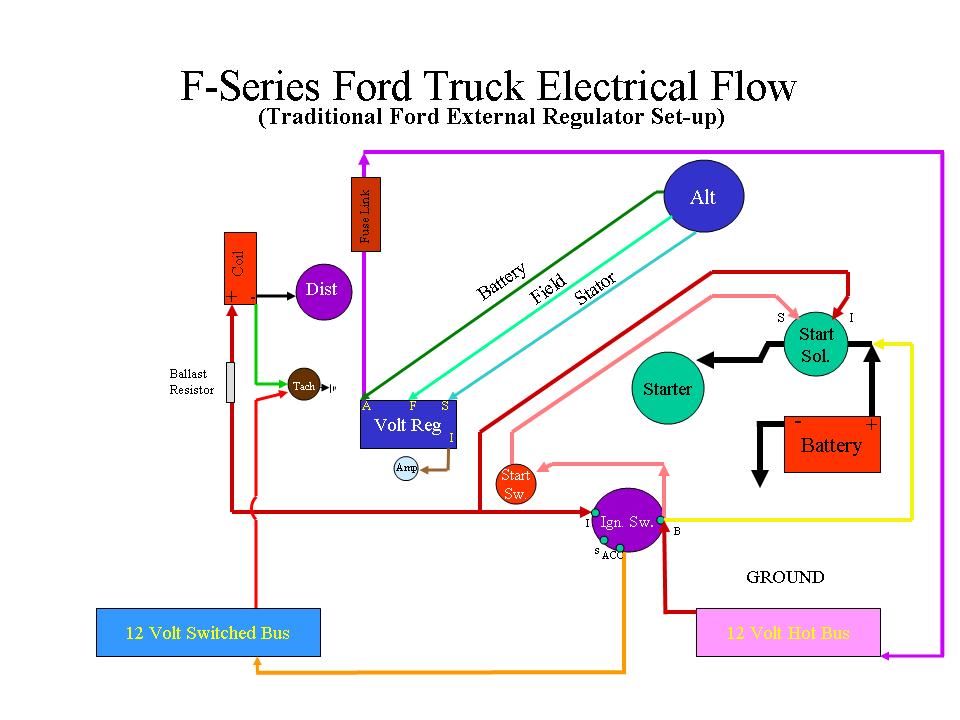
The voltage at the BAT stud of the alternator with respect to ground should be exactly the same as the voltage across the battery terminals because they are physically shorted together. If they're different, it's possible the fusible link that protects the output of the alternator is blown. Shut the truck off, and disconnect the negative battery cable. Check that you have continuity between the alternator BAT stud and the large battery-side post of the starter solenoid. Use your meter's "beep" function; if it doesn't have one, set it to resistance and make sure that the resistance is no more than the resistance of your meter's leads alone.
The other possibility is that your meter wasn't properly grounded when taking the measurement.
The other possibility is that your meter wasn't properly grounded when taking the measurement.
Thread Starter
|
New User
Joined: Mar 2013
Posts: 7
Likes: 0
I had been working on it some more and when the truck was running I was getting 30 volts at the BAT stud on the alternator, which is way too much. I do think that the fusible link is blown because it was putting out too many volts, so I am going to have to replace it but now I have to figure out why the alternator is putting out too many volts. It is like now it is just running at full capacity, and I am not sure why this is. When I saw that it was running at this many volts though I shut the truck back off because I didn't want to burn up the alternator.
Thanks for your help,
- Ryan
Thanks for your help,
- Ryan
Trending Topics
MSEE
Joined: Apr 2004
Posts: 10,386
Likes: 35
From: Austin, TX
Why did things change? The alternator output can shoot sky high if the battery is effectively disconnected from the alternator. Please check the continuity of the fusible link before continuing any further. I have to stress that probing the back of the alternator is dangerous and atypical of proper charging system diagnosis.
FTE Stories
Ford Trucks for Ford Truck Enthusiasts

3 Best / 3 Worst Parts of Modern Ford Ownership
Brett Foote
10 Amazing Upgrades That Solve Common Ford Truck Owner Headaches
Pouria Savadkouei
Every 2026 Ford Engine Explained
Brett Foote
10 Ugly Ford Trucks That We Still Kinda Love
Joe Kucinski
10 Things Every Truck Owner NEEDS (2026 Edition)
Michael S. Palmer
Rezvani's Latest Post-Apocalyptic Monster Is a Ford F-150 Raptor Underneath
Verdad Gallardo
Top 10 Most Expensive Ford Trucks Ever Sold on Bring a Trailer
Joe Kucinski
2027 Ford Super Duty Buyer's Guide (Every Model, Engine, & Package)
Brett Foote
Top 10 Ford Truck Tragedies
Joe Kucinski
Thread Starter
|
New User
Joined: Mar 2013
Posts: 7
Likes: 0
Things changed with the alternator because i took the voltage regulator off of my dads truck (1979 f250) and used it instead. I thought I had checked my voltage regulator before and thought that it was good, but it turns out that it is bad. As for the continuity for the fusible link there is none on the wire, so that means that the fusible link is blown i guess. I am going to try to get another one hooked up and see what happens then. Hopefully the alternator still doesnt try to put out too much voltage and blow that one too.
Thanks for your help,
- Ryan
Thanks for your help,
- Ryan
Lead Driver
Joined: Nov 2006
Posts: 5,217
Likes: 506
From: Pa.
Things changed with the alternator because i took the voltage regulator off of my dads truck (1979 f250) and used it instead. I thought I had checked my voltage regulator before and thought that it was good, but it turns out that it is bad. As for the continuity for the fusible link there is none on the wire, so that means that the fusible link is blown i guess. I am going to try to get another one hooked up and see what happens then. Hopefully the alternator still doesnt try to put out too much voltage and blow that one too.
Thanks for your help,
- Ryan
Thanks for your help,
- Ryan

MSEE
Joined: Apr 2004
Posts: 10,386
Likes: 35
From: Austin, TX
If I read your post correctly, you're saying that the alternator put out nothing with the original voltage regulator, but now puts out something with a different voltage regulator. But your concern now is that the alternator puts out too much.
Anytime an alternator runs unloaded without a battery sinking current from it, the output voltage climbs sky high. This can happen if the fusible link goes open circuit, which you verified. In all likelihood, the alternator output will climb back down after you replace the fusible link. However, before replacing the fusible link, you want to understand why the original one blew in the first place. 99% of the time, it's due to the owner doing something he shouldn't do, like working behind the back of the alternator, or working on the charging system with the battery connected.
Fusible links can be bought at most parts stores. Replace the fusible link with one rated two sizes below the wiring it protects. For example, 10-gauge wiring would be protected with a 14-gauge fusible link.
Anytime an alternator runs unloaded without a battery sinking current from it, the output voltage climbs sky high. This can happen if the fusible link goes open circuit, which you verified. In all likelihood, the alternator output will climb back down after you replace the fusible link. However, before replacing the fusible link, you want to understand why the original one blew in the first place. 99% of the time, it's due to the owner doing something he shouldn't do, like working behind the back of the alternator, or working on the charging system with the battery connected.
Fusible links can be bought at most parts stores. Replace the fusible link with one rated two sizes below the wiring it protects. For example, 10-gauge wiring would be protected with a 14-gauge fusible link.

Thread
Thread Starter
Forum
Replies
Last Post
Fellenz
1961 - 1966 F-100 & Larger F-Series Trucks
18
Jan 31, 2014 02:44 PM
55FordLover
1948 - 1956 F1, F100 & Larger F-Series Trucks
26
Mar 26, 2012 10:45 AM
1996 150
1987 - 1996 F150 & Larger F-Series Trucks
2
Apr 20, 2010 06:51 AM