


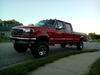


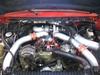




Bed Replacement Project

Thread Starter
|
More Turbo

Joined: Dec 2002
Posts: 664
Likes: 129
From: Columbia, MD
Bed Replacement Project
I started constructing a custom aluminum flatbed last summer to replace the stock bed, and finally got to the critical point- removing the stock bed. Powerwashed the exposed frame and running gear, spray-bombed the frame and some corrosion spots on the tanks with red primer, then topped off with gloss black on the frame and gray on the tanks. I looked at the corrosion on tank lockrings, and declined to harpoon the tanks. Didn't want to risk messing up the fittings.
My intent is to have more locking, weatherproof storage space for kayaking and camping, and get that gear out of the back seat of the cab. The result will look like a work body... bed, side boxes, bulkhead & headache rack. The construction concept is an aluminum flatbed with sideboxes. I found side boxes with full length bottom doors... 88" box with 84" clear opening on the bottom door. Whitewater kayak paddles are about 72"... so paddles can go in the boxes. Other gear can go in the top compartments.
I'll probably add under-body boxes forward of the wheel wells. There will be additional lighting, and a location for a water-methanol tank. The injector nozzles are already in the intake plumbing, and the pump will go under the new bed.
I started building the bed last summer. Here are some videos on the assembly. More will be coming as I add assemblies. I don't have a video of the bare frame... I had the camera set wrong.
There's really nothing wrong with the stock bed... a longer bed with sideboxes just fits my uses better. Now I need to disposition the stock bed before HOA has a fit.
My intent is to have more locking, weatherproof storage space for kayaking and camping, and get that gear out of the back seat of the cab. The result will look like a work body... bed, side boxes, bulkhead & headache rack. The construction concept is an aluminum flatbed with sideboxes. I found side boxes with full length bottom doors... 88" box with 84" clear opening on the bottom door. Whitewater kayak paddles are about 72"... so paddles can go in the boxes. Other gear can go in the top compartments.
I'll probably add under-body boxes forward of the wheel wells. There will be additional lighting, and a location for a water-methanol tank. The injector nozzles are already in the intake plumbing, and the pump will go under the new bed.
I started building the bed last summer. Here are some videos on the assembly. More will be coming as I add assemblies. I don't have a video of the bare frame... I had the camera set wrong.
There's really nothing wrong with the stock bed... a longer bed with sideboxes just fits my uses better. Now I need to disposition the stock bed before HOA has a fit.
Thread Starter
|
More Turbo
Joined: Dec 2002
Posts: 664
Likes: 129
From: Columbia, MD
Another vid, answers to questions
Here's the flatbed assembly sitting loose on the frame; you can start to see what this will look like.
If this works, here's a slideshow of the bare frame. Tops of the tanks are now gray, with straps and frame black. Rustoleum spray cans, rusty metal red primer base under the colorcoat.
The stock bed is "available". I need to sell it or otherwise get it out of here before the HOA gets pissed. Bed, tailgate, drop-in liner, chrome headache rack, taillight lenses, taillight pigtails...
The fuel fills will get turned back up once the bed is attached for the last time. I turned them down to get them out of the way while we took the stock bed off and I play with mounting the new flatbed. With the 2x3s between bed and frame, I'm pretty sure I can slide the new bed off the frame onto sawhorses & 2x3s to work on it, then slide it back so it's less likely to be noticed by the homeowners association.
I got the bleacher planks from Eastern Metal Supply.
Custom Aluminum Extrusions & Wholesale Aluminum Distributor - Welcome to EMS
11.5" wide, 1.75" deep- fits nicely into the 2" x 1/8" architectural channel on the edges.
Getting all the aluminum back from Delaware to Columbia MD was a bit interesting. I recollect that I got 24' planks to minimize wastage (I only have some 6" pieces left), and the other pieces ranged from 12' to 24' long. 12s went in the bed with tailgate up, and longer pieces went on the cab roof racks (Quick and Easy mounts, with 2x4 cross pieces)... with a forklift. Lashed all the pieces together, tied down well, and drove conservatively. The length of the pieces put a lot of torque on the rack... much more so than the canoes that I usually carry on the racks.
But everything is coming together. I'm going to put 32x12x12 boxes under the bed in front of the wheels, and probably something smaller behind the wheels on the the driver's side. I haven't figured out if I have enough space above the tailpipe on the passenger's side. Standard big-truck 18x18s are too wide and too low to the ground.
Next step will be working on the mounts to the frame. And I guess I need to mod my signature now that there's no stock bed.
If this works, here's a slideshow of the bare frame. Tops of the tanks are now gray, with straps and frame black. Rustoleum spray cans, rusty metal red primer base under the colorcoat.
The stock bed is "available". I need to sell it or otherwise get it out of here before the HOA gets pissed. Bed, tailgate, drop-in liner, chrome headache rack, taillight lenses, taillight pigtails...
The fuel fills will get turned back up once the bed is attached for the last time. I turned them down to get them out of the way while we took the stock bed off and I play with mounting the new flatbed. With the 2x3s between bed and frame, I'm pretty sure I can slide the new bed off the frame onto sawhorses & 2x3s to work on it, then slide it back so it's less likely to be noticed by the homeowners association.
I got the bleacher planks from Eastern Metal Supply.
Custom Aluminum Extrusions & Wholesale Aluminum Distributor - Welcome to EMS
11.5" wide, 1.75" deep- fits nicely into the 2" x 1/8" architectural channel on the edges.
Getting all the aluminum back from Delaware to Columbia MD was a bit interesting. I recollect that I got 24' planks to minimize wastage (I only have some 6" pieces left), and the other pieces ranged from 12' to 24' long. 12s went in the bed with tailgate up, and longer pieces went on the cab roof racks (Quick and Easy mounts, with 2x4 cross pieces)... with a forklift. Lashed all the pieces together, tied down well, and drove conservatively. The length of the pieces put a lot of torque on the rack... much more so than the canoes that I usually carry on the racks.
But everything is coming together. I'm going to put 32x12x12 boxes under the bed in front of the wheels, and probably something smaller behind the wheels on the the driver's side. I haven't figured out if I have enough space above the tailpipe on the passenger's side. Standard big-truck 18x18s are too wide and too low to the ground.
Next step will be working on the mounts to the frame. And I guess I need to mod my signature now that there's no stock bed.

Post Fiend
Joined: Dec 2010
Posts: 10,121
Likes: 3
From: Orrville, Ohio
Sweet project! Be sure to update the progress, I can't wait to see what this thing will look like when you're finished!
Trending Topics
Fleet Owner


Joined: May 2009
Posts: 21,437
Likes: 75
From: Gilbert, PA
FTE Stories
Ford Trucks for Ford Truck Enthusiasts

10 Best Ford Truck Engines We Miss the Most!
Joe Kucinski
2026 Shelby F-150 Off-Road: Better Than a Raptor R?
Brett Foote
2027 Super Duty Carhartt Package First Look: 12 Things You NEED to Know!
Michael S. Palmer
10 Most Surprising 2026 Ford Truck Features!
Joe Kucinski
Top 10 Ford Trucks Coming to Mecum Indy 2026
Brett Foote
5 Best / 5 Worst Ford Truck Wheels of All Time
Joe Kucinski
Ford Super Duty: 5 Things Owners LOVE, 5 Things They LOATHE!
Joe Kucinski
Every 2026 Ford Truck Engine RANKED from WORST to FIRST!
Michael S. Palmer
The Best F-150 Deal of Every Trim Level (XL through Raptor)
Joe Kucinski
Cargo Master
Joined: Nov 2006
Posts: 2,171
Likes: 20
From: Denton, TX
Can you do me a huge favor? Measure the gap between the frame mount and the body at the rear most two body bushings? I've seen another truck that had the left body bushing gap visably shorter on the drivers side.
Thanks!!
Thanks!!
Thread Starter
|
More Turbo
Joined: Dec 2002
Posts: 664
Likes: 129
From: Columbia, MD
Update- getting closer
Got the deck assembly completed, flipped over (it was upside down to work on mounts), and placed on the frame. And all four bolts main bolts went through the frame holes with little drama. Three dropped in when we set the bed down. The fourth needed a bit of wiggling to find the hole and drop in. Two of the bolts seated all the way with a bit of push from the top, and I just put the nut and washers on the other two and tightened to draw the bolts in place.
This sequence shows the mounts fit "loose" (not glued & screwed) on the underside of the bed assembly, and the additional structure I put underneath. All the plates and angles on the mounts (the rectangular cross-tubes) basically capture the fore/aft structural C-channels and the side-to-side flanges on the planks, so everthing is located pretty tightly even without the machine screws.
This sequence show the main mounts on trial fit. I spent some time measuring to get the four bolt holes in the main mounts lined up with the holes in the frame. Note the plates and flanges sticking up from the rectanglar tube... those capture the deck structure, and will get screwed-and-glued. Note also that the frame and tank tops got painted.
Last trial fit, after cutting the bolt access holes in the tops of the tubes. 2.5" long 1/2" grade 8 bolts, dropped in from the top. The bolts are in their "final" placement. The main bolts have Grade 8 washers against the nut and head and fender washers next. The aluminum tube has a 1/4-thick plate above and below to spread the load, and a "chafing plate" of high-density polyethylene from a dead kayak between the aluminum and the steel frame. After this view, the tubes get screwed-and-glued to the deck. "Glue" = Dupont 5200 marine polyurethane, screws = 10-24 stainless truss-head machine screws and flange nuts.
Victory! Final placement. Bed right-side up on the frame, bolts through the bed mounts and frame holes. And you get to see what the final product is going to look like. Big thanks to my primary lifters, Daniel and Lisa, for helping me move and flip the bed assembly several times, and to Tim and Cahil for helping get the old bed off. No more multi-person lifts... but plenty of work to do. Oh, and there will be lights
After this, attach the top boxes and bulkhead to deck, add 3 auxilliary frame-to-C-channel mounts on each side, add tailgate, wire up lights, attach fuel fills, mount underside boxes. And figure out a bumper... won't be the stock one. Lots yet to do, but I can move the parts myself and can work in shorter time chunks.
Oh, and Leo- I still owe you a cab mount height measurement.
This sequence shows the mounts fit "loose" (not glued & screwed) on the underside of the bed assembly, and the additional structure I put underneath. All the plates and angles on the mounts (the rectangular cross-tubes) basically capture the fore/aft structural C-channels and the side-to-side flanges on the planks, so everthing is located pretty tightly even without the machine screws.
This sequence show the main mounts on trial fit. I spent some time measuring to get the four bolt holes in the main mounts lined up with the holes in the frame. Note the plates and flanges sticking up from the rectanglar tube... those capture the deck structure, and will get screwed-and-glued. Note also that the frame and tank tops got painted.
Last trial fit, after cutting the bolt access holes in the tops of the tubes. 2.5" long 1/2" grade 8 bolts, dropped in from the top. The bolts are in their "final" placement. The main bolts have Grade 8 washers against the nut and head and fender washers next. The aluminum tube has a 1/4-thick plate above and below to spread the load, and a "chafing plate" of high-density polyethylene from a dead kayak between the aluminum and the steel frame. After this view, the tubes get screwed-and-glued to the deck. "Glue" = Dupont 5200 marine polyurethane, screws = 10-24 stainless truss-head machine screws and flange nuts.
Victory!
Final placement. Bed right-side up on the frame, bolts through the bed mounts and frame holes. And you get to see what the final product is going to look like. Big thanks to my primary lifters, Daniel and Lisa, for helping me move and flip the bed assembly several times, and to Tim and Cahil for helping get the old bed off. No more multi-person lifts... but plenty of work to do. Oh, and there will be lights After this, attach the top boxes and bulkhead to deck, add 3 auxilliary frame-to-C-channel mounts on each side, add tailgate, wire up lights, attach fuel fills, mount underside boxes. And figure out a bumper... won't be the stock one. Lots yet to do, but I can move the parts myself and can work in shorter time chunks.
Oh, and Leo- I still owe you a cab mount height measurement.

Thread Starter
|
More Turbo
Joined: Dec 2002
Posts: 664
Likes: 129
From: Columbia, MD
Length
Multiple considerations. I scratched my head a good bit on planning, but certainly got a bit lucky that the plan worked so well.
The planks are 11.5" wide, so to avoid cutting I used whole widths. 10 x 11.5 = 115", 9 x 11.5 = 103.5, 8 = 92".
Many of the kayaks I haul are 8'2" to 8'8" and some are longer. 9 planks gives about 8'6" clear inside length. Hmmm... 9 is a bit tight, 10 is about 9'5" clear length.
Creating the "waist" on the deck for tires- basically where the wheel wells were... and the fuel fills worked well with 3 long planks forward of the wheels, 4 short aroung the wheels, then 2 or 3 long planks behind the wheels.
The side boxes hold paddles. 88" boxes work well for paddles. 9 planks would let me put either the water/methanol tank or the spare in front of the boxes on one side, 10 planks lets me use both.
With the height and relative thinness of the deck, 10 planks, 115" deck length, still gives me good access to the hitch ball. The deck overhangs the ball a bit, but there's plenty of room for hook-up and articulation.
The extra length will be an issue for angle parking, but I'll accept that issue to gain more carrying space. In parking lots, I already take up 2 spaces. Going from 1.25 spaces long to 1.33 still equals two parking spaces. OK, those are guess numbers, but you get the idea. At informal stream access areas, I'm already parking well out of the way, so no change there. I'm no longer with a trailer, so that's not an issue.
But I still got a bit lucky.
The planks are 11.5" wide, so to avoid cutting I used whole widths. 10 x 11.5 = 115", 9 x 11.5 = 103.5, 8 = 92".
Many of the kayaks I haul are 8'2" to 8'8" and some are longer. 9 planks gives about 8'6" clear inside length. Hmmm... 9 is a bit tight, 10 is about 9'5" clear length.
Creating the "waist" on the deck for tires- basically where the wheel wells were... and the fuel fills worked well with 3 long planks forward of the wheels, 4 short aroung the wheels, then 2 or 3 long planks behind the wheels.
The side boxes hold paddles. 88" boxes work well for paddles. 9 planks would let me put either the water/methanol tank or the spare in front of the boxes on one side, 10 planks lets me use both.
With the height and relative thinness of the deck, 10 planks, 115" deck length, still gives me good access to the hitch ball. The deck overhangs the ball a bit, but there's plenty of room for hook-up and articulation.
The extra length will be an issue for angle parking, but I'll accept that issue to gain more carrying space. In parking lots, I already take up 2 spaces. Going from 1.25 spaces long to 1.33 still equals two parking spaces. OK, those are guess numbers, but you get the idea. At informal stream access areas, I'm already parking well out of the way, so no change there. I'm no longer with a trailer, so that's not an issue.
But I still got a bit lucky.

Thread
Thread Starter
Forum
Replies
Last Post
scottlathrop
1961 - 1966 F-100 & Larger F-Series Trucks
26
Jun 3, 2019 08:19 PM