




7.3 Rebuilding ???
Postmaster
Joined: Jun 2010
Posts: 2,555
Likes: 9
From: Longview, TX
No, not really. I didn't do a test, but what was talked about was a little hair brained to be honest, but should work. We had talked about taking a bicycle tire tube, cutting it to the approximate size of the upper coolant hose and clamping it on in place of the hose (with the valve stem in this section). Pump up to 10 psi and visually look for leaks.
Now with the block out, the tire tube might be harder to use. But you could clamp over the outlet and cap it, (where the return line exits and goes to the radiator) and reduce down at the inlet to screw an air chuck in. I'm visualizing a smaller version if a boost leak tester. I'd have to measure and walk around the plumbing isle for the right fittings. An old coolant hose that you can cut, just buy a plug that fits one end and a clamp. The other end create what you need to add the air.
Now with the block out, the tire tube might be harder to use. But you could clamp over the outlet and cap it, (where the return line exits and goes to the radiator) and reduce down at the inlet to screw an air chuck in. I'm visualizing a smaller version if a boost leak tester. I'd have to measure and walk around the plumbing isle for the right fittings. An old coolant hose that you can cut, just buy a plug that fits one end and a clamp. The other end create what you need to add the air.

Got Data?

Joined: Dec 2012
Posts: 4,250
Likes: 1,382
From: Lake Stevens, WA

I've had a heck of a time changing out the injector cups and getting them to seal. It's tempting not to touch them until you have a leak.
I've pulled the injectors 4 times trying to get this job done. My mistake, among many, was not cleaning the bores well enough with a brush and brakeclean so the locktite will seal.
You can pressure test pretty easily with a cooling system test kit from Harbor Freight. I put 15lbs in. Then put some soapy water spray or rag in the cup after the 12 hour cure time and see what you have. I skipped the soapy water, and while I caught one cup that did not seal, I missed another. I'll be doing this job again - waiting for Clay to have a rental available. I should just buy his insertion/removal tools at this point.


I've pulled the injectors 4 times trying to get this job done. My mistake, among many, was not cleaning the bores well enough with a brush and brakeclean so the locktite will seal.
You can pressure test pretty easily with a cooling system test kit from Harbor Freight. I put 15lbs in. Then put some soapy water spray or rag in the cup after the 12 hour cure time and see what you have. I skipped the soapy water, and while I caught one cup that did not seal, I missed another. I'll be doing this job again - waiting for Clay to have a rental available. I should just buy his insertion/removal tools at this point.
Postmaster
Joined: Jun 2010
Posts: 2,555
Likes: 9
From: Longview, TX
Look at that, I like it almost as much as the tire tube idea 
I've been monitoring my bottle. No fuel has shown up, but I've seen a little oil. I think it's just residue that didn't get flushed, so I mity vac'd it out and will keep an eye on it. That pump will come in handy if I have to test.
I've been monitoring my bottle. No fuel has shown up, but I've seen a little oil. I think it's just residue that didn't get flushed, so I mity vac'd it out and will keep an eye on it. That pump will come in handy if I have to test.
Got Data?
Joined: Dec 2012
Posts: 4,250
Likes: 1,382
From: Lake Stevens, WA
It is. That pic was taken before the 1st try at changing the cups. Shows up pretty clear in the OEM degas tank. I have an aftermarket tank on there now that's white and a bit tougher to tell, but pop the cap and the smell of raw diesel is strong.
FTE Stories
Ford Trucks for Ford Truck Enthusiasts

10 Things Every Truck Owner NEEDS (2026 Edition)
Michael S. Palmer
Rezvani's Latest Post-Apocalyptic Monster Is a Ford F-150 Raptor Underneath
Verdad Gallardo
Top 10 Most Expensive Ford Trucks Ever Sold on Bring a Trailer
Joe Kucinski
2027 Ford Super Duty Buyer's Guide (Every Model, Engine, & Package)
Brett Foote
Top 10 Ford Truck Tragedies
Joe Kucinski
AEV FXL Super Duty - the Super Duty Raptor Ford Doesn't Make
Brett Foote
Lobo Vs Lobo: Proof the F-150 Lobo Should Be Even Lower!
Michael S. Palmer
Ford's 2001 Explorer Sportsman Concept Looks For a New Home
Verdad Gallardo
10 Best Ford Truck Engines We Miss the Most!
Joe Kucinski
Postmaster
Joined: Jun 2010
Posts: 2,555
Likes: 9
From: Longview, TX
So you're getting more fuel leaking with the cups that didn't seal? Any oil? I haven't looked at schematics, but I was thinking the bottom mate of the cup would leak fuel, the top mate would leak oil. I'm not 100% where the Orings sit in the cup.
Got Data?
Joined: Dec 2012
Posts: 4,250
Likes: 1,382
From: Lake Stevens, WA
While there may be oil, the smell is diesel, so that's my primary leak. I think the fuel gets into the coolant through the top edge of the cup, because when I pressure tested with coolant in the engine, coolant leaked out the top edge of the cup. So in normal operation, fuel at higher pressure than the coolant, would leak past the top edge of the cups into the coolant passage.
That orange gasket on the injector in the pic sits just below the top edge of the cup. Fuel is above that gasket, where it is free to push past the poorly sealed cup edge, I think.

That orange gasket on the injector in the pic sits just below the top edge of the cup. Fuel is above that gasket, where it is free to push past the poorly sealed cup edge, I think.
Postmaster
Joined: Jun 2010
Posts: 2,555
Likes: 9
From: Longview, TX
And you are correct. Per image from How the PowerStroke injection system works
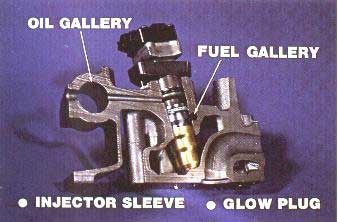
So there shouldn't be any oil making its way to the coolant from the cup not sealing properly. This actually has me feeling pretty comfortable that what I'm seeing in the bottle is just residue and trash that didn't get flushed out. Will probably add a coolant filter and be done with it. I just checked again and don't smell any fuel. I even compared the smell to another bottle of clean coolant and there's no difference.
Now, one more question that's slightly bothering me: if the orange oring is good, and the washer is good, how does fuel get to the crack in a cracked cup? I'm assuming from the crack on my cup that it didn't extend to the top edge of the cup. Maybe it did, which would explain it.
By the way, sorry for the hijack and slight off topic to the OP.
So there shouldn't be any oil making its way to the coolant from the cup not sealing properly. This actually has me feeling pretty comfortable that what I'm seeing in the bottle is just residue and trash that didn't get flushed out. Will probably add a coolant filter and be done with it. I just checked again and don't smell any fuel. I even compared the smell to another bottle of clean coolant and there's no difference.
Now, one more question that's slightly bothering me: if the orange oring is good, and the washer is good, how does fuel get to the crack in a cracked cup? I'm assuming from the crack on my cup that it didn't extend to the top edge of the cup. Maybe it did, which would explain it.
By the way, sorry for the hijack and slight off topic to the OP.

Lead Driver


Joined: Sep 2005
Posts: 9,399
Likes: 188
From: Norco,CA

And you are correct. Per image from How the PowerStroke injection system works
So there shouldn't be any oil making its way to the coolant from the cup not sealing properly. This actually has me feeling pretty comfortable that what I'm seeing in the bottle is just residue and trash that didn't get flushed out. Will probably add a coolant filter and be done with it. I just checked again and don't smell any fuel. I even compared the smell to another bottle of clean coolant and there's no difference.
Now, one more question that's slightly bothering me: if the orange oring is good, and the washer is good, how does fuel get to the crack in a cracked cup? I'm assuming from the crack on my cup that it didn't extend to the top edge of the cup. Maybe it did, which would explain it.
By the way, sorry for the hijack and slight off topic to the OP.
So there shouldn't be any oil making its way to the coolant from the cup not sealing properly. This actually has me feeling pretty comfortable that what I'm seeing in the bottle is just residue and trash that didn't get flushed out. Will probably add a coolant filter and be done with it. I just checked again and don't smell any fuel. I even compared the smell to another bottle of clean coolant and there's no difference.
Now, one more question that's slightly bothering me: if the orange oring is good, and the washer is good, how does fuel get to the crack in a cracked cup? I'm assuming from the crack on my cup that it didn't extend to the top edge of the cup. Maybe it did, which would explain it.
By the way, sorry for the hijack and slight off topic to the OP.


Postmaster
Joined: Jun 2010
Posts: 2,555
Likes: 9
From: Longview, TX
There's a removal tool (several styles, from ford's tool, modified ford tool, to clay's tool)
Here's how Clays works: http://www.riffraffdiesel.com/mm5/RE...eplacement.pdf
Here's how Clays works: http://www.riffraffdiesel.com/mm5/RE...eplacement.pdf

Thread Starter
|
Mountain Pass
Joined: Sep 2011
Posts: 139
Likes: 0
From: Forest River ND
And you are correct. Per image from How the PowerStroke injection system works
So there shouldn't be any oil making its way to the coolant from the cup not sealing properly. This actually has me feeling pretty comfortable that what I'm seeing in the bottle is just residue and trash that didn't get flushed out. Will probably add a coolant filter and be done with it. I just checked again and don't smell any fuel. I even compared the smell to another bottle of clean coolant and there's no difference.
Now, one more question that's slightly bothering me: if the orange oring is good, and the washer is good, how does fuel get to the crack in a cracked cup? I'm assuming from the crack on my cup that it didn't extend to the top edge of the cup. Maybe it did, which would explain it.
By the way, sorry for the hijack and slight off topic to the OP.
So there shouldn't be any oil making its way to the coolant from the cup not sealing properly. This actually has me feeling pretty comfortable that what I'm seeing in the bottle is just residue and trash that didn't get flushed out. Will probably add a coolant filter and be done with it. I just checked again and don't smell any fuel. I even compared the smell to another bottle of clean coolant and there's no difference.
Now, one more question that's slightly bothering me: if the orange oring is good, and the washer is good, how does fuel get to the crack in a cracked cup? I'm assuming from the crack on my cup that it didn't extend to the top edge of the cup. Maybe it did, which would explain it.
By the way, sorry for the hijack and slight off topic to the OP.
 . Can Clay's tool be used with the heads off or do they need to secured to something?