


300ci i6 engine identification

Thread Starter
|
Freshman User
Joined: Dec 2012
Posts: 28
Likes: 0
From: Woodstock
300ci i6 engine identification
Hello, i have been reading some threads for the past couple months on research and comparing my truck to others. I have a 1985 F150 with a 300ci i6 and i am wondering if there is a way to identify the engine due to the fact that it is not original. The first owner, i am the third, put a brand new engine and transmission in the truck. And i am curious as to what year the engine is. Any advice/help is appreciated!

Fleet Mechanic

Joined: Jul 2011
Posts: 1,916
Likes: 4
The casting numbers on the block would probably tell you. Another way would be the sticker on the valve cover if it's still there.
A general way to tell how old the motor is is by appearance.
Does the valve cover and pushrod cover look like this model (65 to 83)?
Valve cover:
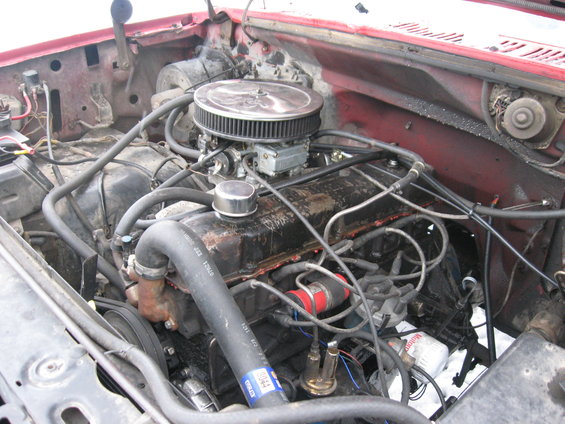
Lifter Cover (Exhaust gas side-plate, between the distributor and block):
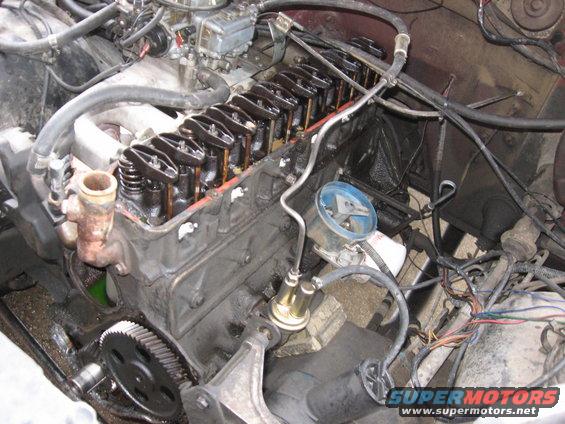
Or does it look like this model (84 to 96):
Valve cover:

Lifter cover (exhaust gas side-plate):

(grey one in this photo, the blue one on the motor is 65 to 83):

A general way to tell how old the motor is is by appearance.
Does the valve cover and pushrod cover look like this model (65 to 83)?
Valve cover:
Lifter Cover (Exhaust gas side-plate, between the distributor and block):
Or does it look like this model (84 to 96):
Valve cover:
Lifter cover (exhaust gas side-plate):
(grey one in this photo, the blue one on the motor is 65 to 83):
Fleet Mechanic
Joined: Jul 2011
Posts: 1,916
Likes: 4
Also, as an aside, is all of your feedback equipment still present? If there are no emissions inspections in your area and you have missing emissions equipment, it's imperative that you swap to DSII so that your motor has working distributor and the fuel mixture can be set.
Thread Starter
|
Freshman User
Joined: Dec 2012
Posts: 28
Likes: 0
From: Woodstock
Where are the casting numbers located? unfortunately the stick has faded. By appearance i would say it looks more like the 65-83, the thing is though the motor was brand new when it was put in, there is currently 33,xxx miles on the engine. I will post pictures this weekend and maybe you could help, there are some lose ends with the engine with vacuum hoses not hooked up or hoses missing completely
Thread Starter
|
Freshman User
Joined: Dec 2012
Posts: 28
Likes: 0
From: Woodstock
Forgive me for this is my first vehicle and i am trying to learn as much as i can so i don't appear to be a complete idiot, but i am not sure what you mean by feedback equipment. There is no emissions inspection for my truck and i do believe that i am missing emissions equipment. I know the o2 sensor is not attached because the local ford dealer said the air filter housing had vacuum hoses not attached and the hot air box(?) is missing along with the hose so it was non functional.
Last edited by ctubutis; Dec 6, 2012 at 10:42 PM. Reason: disable smilies
Fleet Mechanic
Joined: Jul 2011
Posts: 1,916
Likes: 4
Stock 84 to 86 F-series trucks came with what is known as a "Feedback Carburetor." It's a computer controlled carburetor that Ford Motor Company implemented on the inline 6's, 302's, and 351's that allowed Ford to pass emissions requirements before the transition to EFI was complete.
If all of the emissions equipment is there and properly functioning, it's a great setup (albeit complicated). However, if there's any emissions equipment missing, the computer will throw a code and lock your ignition timing so that it won't advance, and the fuel mixture gets rich and locked as well. This is a function so you can get your vehicle home. Here, it's referred to as "limp-home mode".
Dating is done by finding the casting #'s on the block. They're on the passenger side of the block on a 300.
FORDSIX PERFORMANCE • View topic - Dating Ford castings & parts.
Possible casting #'s for a 1965 to a 1983 300:
C5TE, C6TE, C7TE, C8TE, C9TE
D0TE, D1TE, D2TE, D3TE, D4TE, D5TE, D6TE, D7TE, D8TE, D9TE
E0TE, E1TE, E2TE, E3TE
C is the 60's, D is the 70's, and E is the 80's. The second digit, the number, is the year. Ex. : E3TE is a 1983 series block.
FORDSIX PERFORMANCE • View forum - 240-300 "Big Block" Six Performance
Take a photo of your motor from various angles just as it sits right now and I'll be able to give you a general year range that the motor came from (provided the lifter cover and valve cover are original). I'll also be able to tell you whether or not it's worth it to keep the feedback carburetor you have or swap to DSII. We have a resident feedback expert here that can help you with your feedback system if it looks like it can be easily fixed. If not...
Ford Truck Enthusiasts Forums - View Single Post - '80-'86 Tech Tips, Tricks and Projects:
Then you'll want to look at those.
If all of the emissions equipment is there and properly functioning, it's a great setup (albeit complicated). However, if there's any emissions equipment missing, the computer will throw a code and lock your ignition timing so that it won't advance, and the fuel mixture gets rich and locked as well. This is a function so you can get your vehicle home. Here, it's referred to as "limp-home mode".
Dating is done by finding the casting #'s on the block. They're on the passenger side of the block on a 300.
FORDSIX PERFORMANCE • View topic - Dating Ford castings & parts.
Possible casting #'s for a 1965 to a 1983 300:
C5TE, C6TE, C7TE, C8TE, C9TE
D0TE, D1TE, D2TE, D3TE, D4TE, D5TE, D6TE, D7TE, D8TE, D9TE
E0TE, E1TE, E2TE, E3TE
C is the 60's, D is the 70's, and E is the 80's. The second digit, the number, is the year. Ex. : E3TE is a 1983 series block.
FORDSIX PERFORMANCE • View forum - 240-300 "Big Block" Six Performance
Take a photo of your motor from various angles just as it sits right now and I'll be able to give you a general year range that the motor came from (provided the lifter cover and valve cover are original). I'll also be able to tell you whether or not it's worth it to keep the feedback carburetor you have or swap to DSII. We have a resident feedback expert here that can help you with your feedback system if it looks like it can be easily fixed. If not...
Ford Truck Enthusiasts Forums - View Single Post - '80-'86 Tech Tips, Tricks and Projects:
Then you'll want to look at those.

Moderator


Joined: Nov 2007
Posts: 22,415
Likes: 92
From: Denver Metro Area, CO

Remember that a Casting ID will only tell you when the part was designed for use, not when any particular discrete component was actually manufactured.
Classic Mustang Part Number Decoding Guide
Classic Mustang Part Number Decoding Guide
Trending Topics
Thread Starter
|
Freshman User
Joined: Dec 2012
Posts: 28
Likes: 0
From: Woodstock
if my truck is in "limp-home mode", how soon should i get it fixed? I only drive on the weekends, no more than 50-75 miles
FTE Stories
Ford Trucks for Ford Truck Enthusiasts

2027 Ford Super Duty Buyer's Guide (Every Model, Engine, & Package)
Brett Foote
Top 10 Ford Truck Tragedies
Joe Kucinski
AEV FXL Super Duty - the Super Duty Raptor Ford Doesn't Make
Brett Foote
Lobo Vs Lobo: Proof the F-150 Lobo Should Be Even Lower!
Michael S. Palmer
Ford's 2001 Explorer Sportsman Concept Looks For a New Home
Verdad Gallardo
10 Best Ford Truck Engines We Miss the Most!
Joe Kucinski
2026 Shelby F-150 Off-Road: Better Than a Raptor R?
Brett Foote
2027 Super Duty Carhartt Package First Look: 12 Things You NEED to Know!
Michael S. Palmer
10 Most Surprising 2026 Ford Truck Features!
Joe Kucinski
Old School Hot Rodder


Joined: Feb 2006
Posts: 6,472
Likes: 11
From: Exmore, VA

If it is in "limp-in mode" it will have no power and get worse fuel mileage than a 460. As for identification, there will also be a date cast into the block, it will usually be up to a year older than the truck build date.
The hazard of running an engine in limp mode is possible overheating, and maybe ruining your catalytic converter.
The hazard of running an engine in limp mode is possible overheating, and maybe ruining your catalytic converter.

Senior User
Joined: Apr 2009
Posts: 152
Likes: 0
From: St. Louis
A properly tuned 300 can normally get upwards of 17 MPG, so its probably not running optimally. There are tons of things that can cause poor mileage, especially from a feedback carb equipped vehicle.
I may be wrong, but a way to tell if it is limp home mode is to check the timing with a timing light, if it is not advancing when the throttle is pushed open, then it is in limp home mode. (be careful of the fan!)
I may be wrong, but a way to tell if it is limp home mode is to check the timing with a timing light, if it is not advancing when the throttle is pushed open, then it is in limp home mode. (be careful of the fan!)
Moderator
Joined: Dec 2007
Posts: 7,987
Likes: 104
From: Boise, Idaho
Here's a discussion we had some time back about engine date codes. It might help:
https://www.ford-trucks.com/forums/1...date-code.html
https://www.ford-trucks.com/forums/1...date-code.html

Post Fiend
Joined: Jul 2004
Posts: 8,786
Likes: 28
From: Northern California
The O2 sensor being unplugged will cause that, among others things.
A DS-II conversion would be a good course of action in the future.
A good running 300-6, depending on gearing, and how you drive it, should get you between 15 and 20 MPG easy. The average is around 18.
Originally Posted by ctubutis
Oh, you'll certainly know when it's in limp mode; when my car gets into that state, it won't go more than 30 MPH.
I'm willing to believe when the owner does a DS-II conversion, and when the fuel mileage increases, and the performance increases by at least 1/3 that he'll have a, "Who Knew!?" moment.

Thread Starter
|
Freshman User
Joined: Dec 2012
Posts: 28
Likes: 0
From: Woodstock
My truck can easily reach 45/50 mph but can't maintain higher speeds up even the slightest hills. It does sound like it is in limp mode from what is described. I have the pictures of my engine, how do i upload them?