


ICVR Thoughts & Observations

Thread Starter
|
FTE Legend


Joined: Jul 2010
Posts: 32,875
Likes: 48
From: Northeast, OK
Mockup
Here's a mockup of what I'm thinking of. I've stuffed parts in to simulate the whole circuit, but the values aren't right.
As you can see, it uses the ICVR's case as anything I can find to buy is too large and about $7. And, it uses a piece of perf board I had, but the idea would be to use a piece that fits not only side-to-side, as this one does, but also end-to-end. Then the case would be crimped to mechanically hold the board. But, that would leave the wiring on the bottom of the board exposed, and I would probably coat it with either a rubbery insulating material or maybe epoxy.
You can see in the third picture the tab of the regulator held to the thermal pad and that to the case with a nylon screw. As I think about it this does start to add up, price wise, as people will have to have perf board, thermal pads, and #6 nylon screws. But, it shouldn't be very expensive. I'm going to work on the part # list this evening and we'll see what it adds to.
And, in conclusion, all pictures were taken in 1024 x 768 mode. But in the first one the camera was set to do little JPEG compression, while in the second it was in medium compression mode, and the third one in max compression mode. File sizes are 375, 162, and 92 Kb respectively.
Please give me your feedback on the mockup and planning as well as the pictures.
As you can see, it uses the ICVR's case as anything I can find to buy is too large and about $7. And, it uses a piece of perf board I had, but the idea would be to use a piece that fits not only side-to-side, as this one does, but also end-to-end. Then the case would be crimped to mechanically hold the board. But, that would leave the wiring on the bottom of the board exposed, and I would probably coat it with either a rubbery insulating material or maybe epoxy.
You can see in the third picture the tab of the regulator held to the thermal pad and that to the case with a nylon screw. As I think about it this does start to add up, price wise, as people will have to have perf board, thermal pads, and #6 nylon screws. But, it shouldn't be very expensive. I'm going to work on the part # list this evening and we'll see what it adds to.
And, in conclusion, all pictures were taken in 1024 x 768 mode. But in the first one the camera was set to do little JPEG compression, while in the second it was in medium compression mode, and the third one in max compression mode. File sizes are 375, 162, and 92 Kb respectively.
Please give me your feedback on the mockup and planning as well as the pictures.

Old School Hot Rodder

Joined: Feb 2006
Posts: 6,472
Likes: 11
From: Exmore, VA

Gary, looks pretty well designed. If you electrically isolated the case you could do away with the nylon screw, but then anyone who mounted it wrong would have problems. You might want to drill a small hole inline with the trim pot and cover it with a piece of tape. For the older, stud connected ICVRs you could just use brass screws of the proper size and pot the board in RTV just leaving the studs exposed and labeled "power" and "gauges".
Thread Starter
|
FTE Legend
Joined: Jul 2010
Posts: 32,875
Likes: 48
From: Northeast, OK
Gary, looks pretty well designed. If you electrically isolated the case you could do away with the nylon screw, but then anyone who mounted it wrong would have problems. You might want to drill a small hole inline with the trim pot and cover it with a piece of tape. For the older, stud connected ICVRs you could just use brass screws of the proper size and pot the board in RTV just leaving the studs exposed and labeled "power" and "gauges".
On the isolation, I'm really wanting this to be foolproof, so think it would be best to have the electrical isolation to allow attaching it to something that is grounded.
Re the hole and tape, that's a good idea. If I don't truly pot everything and just cover the wiring on the board then there would be access to the trimmer.
But, I'm not sure I understand. I assumed the older stud-connected ICVR's sat down on studs on the cluster, meaning that the slip connectors would be on the ends of the wires. Did I misunderstand?
All - I've come up with a parts list, assuming it is built like my mockup. All part numbers are from Digikey:
- Perforated board: 3396K-ND @ $2.45 for 2" x 4.5"
- Nylon screws: 6-32x3/8 H556-ND @ $9.43/100
- Thermal pads: HS419-ND @ $ 0.59 ea or $4.93/10
- Battery connector - Male, PC mount: 593K-ND @ $0.42 ea or $3.98/10
- Battery connector - Female, PC mount: 594K-ND @ $0.50 ea or $4.64/10
- Regulator LM317T: LM317TNS/NOPB-ND @ $1.70 ea or $15.10/10
- C1: .1 mfd cap 445-5303-ND @ $0.29 ea or $2.00/10
- C2: 1 mfd cap 718-1204-ND @ $0.81 ea or $5.95/10
- R1: 150 ohm 1/4 watt resistor: 150ADCT-ND @ $0.55 ea or $4.37/10
- R2: 1000 ohm 15-turn trimmer: 3006P-102LF-ND @ $1.47 ea or $13.02/10
My math says the total would be $18.21 to do one. But, that's high due to having to order a minimum of 100 of the nylon screws, which might be available from a hardware store or Lowes on a onesy basis for a lot less. So, assuming you could get one for $.50 the total cost would be $8.78 + .50 = 9.28 plus shipping.
I'm going to order some of that to finish my prototype and put it in service. And, I'll draw up the circuit and package it and the parts list in a pdf. What more do you folks need or want?
Old School Hot Rodder
Joined: Feb 2006
Posts: 6,472
Likes: 11
From: Exmore, VA
Gary, the older trucks and cars had a wired cluster rather than a printed circuit style. The power went to one push-on connector and the gauge power came out through the other. The project I was helping Pete with is a 67 Mustang, it has the wired cluster.
Thread Starter
|
FTE Legend
Joined: Jul 2010
Posts: 32,875
Likes: 48
From: Northeast, OK
I say the regulator could be exactly the same, but do you know if the gauges and senders were the same? IOW, that the regulator's set point would still be the same?

Senior User
Joined: Feb 2012
Posts: 177
Likes: 0
From: Grants Pass, OR
I would be inclined to go with something like this adjustable regulator:
Adjustable step down switching voltage regulator
- It's a switching regulator which will run way cooler than the LM317 or 780x
- Has built in heat sink.
- Has a 25 turn worm driven voltage adjust pot. (Won't change settings due to vibration).
- Self contained with no external parts needed.
- Not sure but looks like it will fit in the IVR housing?
- Cost $15.00
There may be others this is just the 1st one I found via Google.
Adjustable step down switching voltage regulator
- It's a switching regulator which will run way cooler than the LM317 or 780x
- Has built in heat sink.
- Has a 25 turn worm driven voltage adjust pot. (Won't change settings due to vibration).
- Self contained with no external parts needed.
- Not sure but looks like it will fit in the IVR housing?
- Cost $15.00
There may be others this is just the 1st one I found via Google.
Old School Hot Rodder
Joined: Feb 2006
Posts: 6,472
Likes: 11
From: Exmore, VA
ICVR Thoughts & Observations
Bill - Sorry, but I'm slow. If the cluster has push-on connectors then the ICVR has the studs - right? Why not put ring-tongue terminals on the ends of the wires coming from the regulator and put the right sized screw/nut combo through them to serve as studs? That way the regulator could be exactly the same and still be remoted.
I say the regulator could be exactly the same, but do you know if the gauges and senders were the same? IOW, that the regulator's set point would still be the same?
I say the regulator could be exactly the same, but do you know if the gauges and senders were the same? IOW, that the regulator's set point would still be the same?
FTE Stories
Ford Trucks for Ford Truck Enthusiasts

10 Fords to Drive Before You Die
Joe Kucinski
3 Best / Worst Features Of The 2025+ Ford Expedition
Brett Foote
10 Ways Ford is LOSING to the Competition
Joe Kucinski
Top 6 Best Deals Available on New Fords & Lincolns Right Now
Brett Foote
This Hennessey Takes the Expedition Tremor's Off-Roading Capability to the Next Level
Verdad Gallardo
Top 10 Fords at 2026 Carlisle Ford Nationals
Joe Kucinski
3 Best / 3 Worst Parts of Modern Ford Ownership
Brett Foote
10 Amazing Upgrades That Solve Common Ford Truck Owner Headaches
Pouria Savadkouei
Every 2026 Ford Engine Explained
Brett Foote
Thread Starter
|
FTE Legend
Joined: Jul 2010
Posts: 32,875
Likes: 48
From: Northeast, OK
I would be inclined to go with something like this adjustable regulator:
Adjustable step down switching voltage regulator
- It's a switching regulator which will run way cooler than the LM317 or 780x
- Has built in heat sink.
- Has a 25 turn worm driven voltage adjust pot. (Won't change settings due to vibration).
- Self contained with no external parts needed.
- Not sure but looks like it will fit in the IVR housing?
- Cost $15.00
There may be others this is just the 1st one I found via Google.
Adjustable step down switching voltage regulator
- It's a switching regulator which will run way cooler than the LM317 or 780x
- Has built in heat sink.
- Has a 25 turn worm driven voltage adjust pot. (Won't change settings due to vibration).
- Self contained with no external parts needed.
- Not sure but looks like it will fit in the IVR housing?
- Cost $15.00
There may be others this is just the 1st one I found via Google.
But, I'm not sure I would put it in an ICVR case, although I think it would fit. I say that because the spec sheet says "For best performance, mount DE-SWADJ in an open space with some air flowing across it to keep it cool." Why not just use heat-shrink tubing to insulate the wires and tie-wrap it under the dash some place? If I understand correctly, it runs 90% efficient in the voltage and current range we are in. So, 5.4V x .5A = 2.7W of power it is going to supply, on the average, and 10% of that is .27W. I would think it can handle that w/o being in any air flow directly, but probably shouldn't be encased in something that would prevent flow around it. Right?
Wow! That's a game changer. I can see a stickie that shows how to solder wire to that thing, heat-shrink it, and add either the studs or 9v battery connectors on the end. To calibrate it either put a 10 Ω resistor across the temp sender, and dial it in to your gauges or simply dial it to 5.4v.
Good find! I looked at switching supplies but really only considered the components and not a complete unit like that one.

Thread Starter
|
FTE Legend
Joined: Jul 2010
Posts: 32,875
Likes: 48
From: Northeast, OK
Ok, so this would work for them as well. But, do I have it correct that the studs should be on the wire and the slip-terminals are on the cluster?
Old School Hot Rodder
Joined: Feb 2006
Posts: 6,472
Likes: 11
From: Exmore, VA
ICVR Thoughts & Observations
Yes, that is the way they are set up. On that other unit, if it really needs air flow, stick it in the air inlet of the heater/AC system.
Senior User
Joined: Feb 2012
Posts: 177
Likes: 0
From: Grants Pass, OR
Where have you been all my life?! That thing looks to be perfect.
But, I'm not sure I would put it in an ICVR case, although I think it would fit. I say that because the spec sheet says "For best performance, mount DE-SWADJ in an open space with some air flowing across it to keep it cool." Why not just use heat-shrink tubing to insulate the wires and tie-wrap it under the dash some place? If I understand correctly, it runs 90% efficient in the voltage and current range we are in. So, 5.4V x .5A = 2.7W of power it is going to supply, on the average, and 10% of that is .27W. I would think it can handle that w/o being in any air flow directly, but probably shouldn't be encased in something that would prevent flow around it. Right?
Wow! That's a game changer. I can see a stickie that shows how to solder wire to that thing, heat-shrink it, and add either the studs or 9v battery connectors on the end. To calibrate it either put a 10 Ω resistor across the temp sender, and dial it in to your gauges or simply dial it to 5.4v.
Good find! I looked at switching supplies but really only considered the components and not a complete unit like that one.
But, I'm not sure I would put it in an ICVR case, although I think it would fit. I say that because the spec sheet says "For best performance, mount DE-SWADJ in an open space with some air flowing across it to keep it cool." Why not just use heat-shrink tubing to insulate the wires and tie-wrap it under the dash some place? If I understand correctly, it runs 90% efficient in the voltage and current range we are in. So, 5.4V x .5A = 2.7W of power it is going to supply, on the average, and 10% of that is .27W. I would think it can handle that w/o being in any air flow directly, but probably shouldn't be encased in something that would prevent flow around it. Right?
Wow! That's a game changer. I can see a stickie that shows how to solder wire to that thing, heat-shrink it, and add either the studs or 9v battery connectors on the end. To calibrate it either put a 10 Ω resistor across the temp sender, and dial it in to your gauges or simply dial it to 5.4v.
Good find! I looked at switching supplies but really only considered the components and not a complete unit like that one.
This part looks to be a bit odd shaped, but if there is a way to mount it so that there is metal to metal contact with the IVR casing using thermal paste then that should be OK as long as you can still get to the adjustment screw.
Maybe drill a couple of small holes in the case and loop a piece of wire around the part. Solder the wire to the case.
If it were me I would wire it with pigtails so I could reach the adjustment without tearing the dash apart.
Thread Starter
|
FTE Legend
Joined: Jul 2010
Posts: 32,875
Likes: 48
From: Northeast, OK
I don't think it is going to need any forced air flow, but just put in a place where its heat can generate a bit of flow via convection, such as using a tie-wrap to hold it against another wiring run. Or, use a tie-wrap to hold it against something thermally large like the steering column bracket. Either way, being a switching supply it doesn't generate the amount of heat a linear device, like the LM317, does so it should be very happy with the load of our gauges.
But, we will find out as I just ordered a DE-SWADJ. Yes, I ordered the little bit of stuff I needed to finalize my LM317 regulator last night, so should be receiving both shipments this week. (By the way, shipment for the DE-SWADJ was $1.25) I think I'm going with the DE-SWADJ as it will be so easy, but have the other as a backup.
Thanks again!
But, we will find out as I just ordered a DE-SWADJ. Yes, I ordered the little bit of stuff I needed to finalize my LM317 regulator last night, so should be receiving both shipments this week. (By the way, shipment for the DE-SWADJ was $1.25) I think I'm going with the DE-SWADJ as it will be so easy, but have the other as a backup.
Thanks again!

Fleet Mechanic
Joined: Jun 2010
Posts: 1,251
Likes: 8
From: North Carolina
There are some (relatively cheap) little breakout boards that fit DE-SWADJ, if it might help in making the necessary connections

Thread Starter
|
FTE Legend
Joined: Jul 2010
Posts: 32,875
Likes: 48
From: Northeast, OK
This device is rated -20C to 70C ( -4F to 158F). The dash on a parked vehicle can exceed that. So it might not work correctly until the cab cools off.
This part looks to be a bit odd shaped, but if there is a way to mount it so that there is metal to metal contact with the IVR casing using thermal paste then that should be OK as long as you can still get to the adjustment screw.
Maybe drill a couple of small holes in the case and loop a piece of wire around the part. Solder the wire to the case.
If it were me I would wire it with pigtails so I could reach the adjustment without tearing the dash apart.
This part looks to be a bit odd shaped, but if there is a way to mount it so that there is metal to metal contact with the IVR casing using thermal paste then that should be OK as long as you can still get to the adjustment screw.
Maybe drill a couple of small holes in the case and loop a piece of wire around the part. Solder the wire to the case.
If it were me I would wire it with pigtails so I could reach the adjustment without tearing the dash apart.
Yes, the device really does look to be all angles and very few straight lines, so I'm not sure what the best way to mount it will be. I'm going to try holding it to something with a tie-wrap, which I find to be pretty good at holding odd-shaped pieces.
But, I think these will be set-and-forget devices. As said, either use a 10Ω resistor to set it to your gauges or just use the 5.4v that made both of my clusters read exactly what they did with their ICVR's. So, I don't see a reason to get back to the adjusting screw. But, if the device is just held to something under the dash it should be easy to get to the screw if needed.
There are some (relatively cheap) little breakout boards that fit DE-SWADJ, if it might help in making the necessary connections
Amazon.com: Voltage Regulator Breakout Board: Electronics
Amazon.com: Voltage Regulator Breakout Board: Electronics
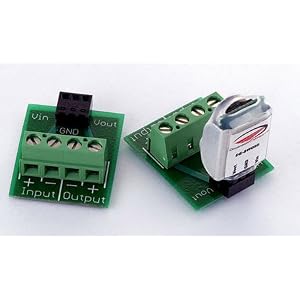
But, I'm thinking just solder wire directly to the leads, run heat-shrink all the way up the leads, and shrink it down. I'll twist the wires and put a piece of tape around them at each end so they don't un-twist, and probably cover them with split-loom.
Bottom line: We can each install them the way we want to, be it mounted in an old ICVR case or tie-wrapped to something, or connected to a breakout board vs soldered to wire to remote them. It looks like such a versatile and easily-used module that I think we have a winner. And, we should know this week.