




Vacuum Elimination and Computer Issues

Postmaster
Joined: Nov 2009
Posts: 4,575
Likes: 5
From: Broken Arrow , OK
We have a good colaboration of people here. Seems as though there is someone here who knows about whatever topic or part of the vehicle being discussed. I have a couple of areas I am stronger in than others. It's nice to be able to post a question and have someone in that area of knowledge respond. I know I appreciate it when I get answers and help. So I feel obligated to throw my $0.02 in when I am familiar with a questionable area.

pedant
Joined: Jan 2008
Posts: 23,576
Likes: 39
From: EXTREME southwest CT


FTE Legend


Joined: Jul 2010
Posts: 32,875
Likes: 48
From: Northeast, OK
Mechanical advance is usually done via weights and springs, where the mass of the weight causes it to swing out as the shaft of the distributor turns, and the further the weight swings out the more advance is given to the spark. The weights are contained by springs, and lighter springs allow the weights to swing out at lower RPM than do heavier springs.
The weights and springs are picked by engineers at the factory to give the best overall performance for the average driver with the engine in stock trim, and the advance versus RPM can be plotted as a "curve". However, modifications to the engine can frequently begat more power by the advance coming in more quickly, so the distributor is "recurved" by changing the springs.
I did that back in '69 to my brand new Super Bee by installing lighter springs from a kit sold by Crane, and that let the advance come in earlier in the RPM range, resulting in more low-end torque. All was good until it snowed and that Bee was almost not drivable because the rear wheels would spin if you even looked at the throttle. I finally gave up getting it in our driveway as it wouldn't go up the slight incline. But, the Plymouth Valiant with a Slant 6 would go up it, stop in the middle, and take off again w/o spinning the tires.
Instead of getting a set of lighter springs from someone like Crane, the pro's pulled the distributor off the engine and put it in a machine that showed what the curve was. Then they changed out the various components to get a curve that was known to produce the best power for the various engine components in place - which was usually predetermined by someone having run the engine on a dyno. Bill Vose is one of those pro's, so could tell us how it really should be done.
Posting Guru
Joined: Jan 2012
Posts: 1,410
Likes: 1
From: Dallas, GA
Distributors have two types of advance or retard built into them: Mechanical, aka centrifugal, & vacuum. The mechanical advance is primarily to achieve max power from the engine, and vacuum is primarily to get max economy.
Mechanical advance is usually done via weights and springs, where the mass of the weight causes it to swing out as the shaft of the distributor turns, and the further the weight swings out the more advance is given to the spark. The weights are contained by springs, and lighter springs allow the weights to swing out at lower RPM than do heavier springs.
The weights and springs are picked by engineers at the factory to give the best overall performance for the average driver with the engine in stock trim, and the advance versus RPM can be plotted as a "curve". However, modifications to the engine can frequently begat more power by the advance coming in more quickly, so the distributor is "recurved" by changing the springs.
I did that back in '69 to my brand new Super Bee by installing lighter springs from a kit sold by Crane, and that let the advance come in earlier in the RPM range, resulting in more low-end torque. All was good until it snowed and that Bee was almost not drivable because the rear wheels would spin if you even looked at the throttle. I finally gave up getting it in our driveway as it wouldn't go up the slight incline. But, the Plymouth Valiant with a Slant 6 would go up it, stop in the middle, and take off again w/o spinning the tires.
Instead of getting a set of lighter springs from someone like Crane, the pro's pulled the distributor off the engine and put it in a machine that showed what the curve was. Then they changed out the various components to get a curve that was known to produce the best power for the various engine components in place - which was usually predetermined by someone having run the engine on a dyno. Bill Vose is one of those pro's, so could tell us how it really should be done.
Mechanical advance is usually done via weights and springs, where the mass of the weight causes it to swing out as the shaft of the distributor turns, and the further the weight swings out the more advance is given to the spark. The weights are contained by springs, and lighter springs allow the weights to swing out at lower RPM than do heavier springs.
The weights and springs are picked by engineers at the factory to give the best overall performance for the average driver with the engine in stock trim, and the advance versus RPM can be plotted as a "curve". However, modifications to the engine can frequently begat more power by the advance coming in more quickly, so the distributor is "recurved" by changing the springs.
I did that back in '69 to my brand new Super Bee by installing lighter springs from a kit sold by Crane, and that let the advance come in earlier in the RPM range, resulting in more low-end torque. All was good until it snowed and that Bee was almost not drivable because the rear wheels would spin if you even looked at the throttle. I finally gave up getting it in our driveway as it wouldn't go up the slight incline. But, the Plymouth Valiant with a Slant 6 would go up it, stop in the middle, and take off again w/o spinning the tires.
Instead of getting a set of lighter springs from someone like Crane, the pro's pulled the distributor off the engine and put it in a machine that showed what the curve was. Then they changed out the various components to get a curve that was known to produce the best power for the various engine components in place - which was usually predetermined by someone having run the engine on a dyno. Bill Vose is one of those pro's, so could tell us how it really should be done.
I had no idea there was a machine you could put it on and actually get a curve mapped out and go from there??? cool.
With today's technology and this all done by the computer....you think there are many people around that do this? with a machine?
FTE Legend
Joined: Jul 2010
Posts: 32,875
Likes: 48
From: Northeast, OK
This is how I've always done it...trial and error!! want it to advance quicker? lighter springs and/or more weight. Advance slower?? the opposite.
I had no idea there was a machine you could put it on and actually get a curve mapped out and go from there??? cool.
With today's technology and this all done by the computer....you think there are many people around that do this? with a machine?
I had no idea there was a machine you could put it on and actually get a curve mapped out and go from there??? cool.
With today's technology and this all done by the computer....you think there are many people around that do this? with a machine?
pedant
Joined: Jan 2008
Posts: 23,576
Likes: 39
From: EXTREME southwest CT
I'd like to add to Gary's excellent synopsis that Ford Duraspark distributors have two 'slots' in the baseplate.
By flipping it around you can choose how much total centrifugal advance is available.
The slots will be numbered. 10L, 13L, whatever...
That number is one HALF the advance you will get. ie, a 13L slot will allow 26* of centrifugal advance.
You can swap plates, or even weld the slot up and adjust it with a file.
There is a formula for how many thousandths equal 1*, but I don't have it committed to memory, or right here in front of me.
By flipping it around you can choose how much total centrifugal advance is available.
The slots will be numbered. 10L, 13L, whatever...
That number is one HALF the advance you will get. ie, a 13L slot will allow 26* of centrifugal advance.
You can swap plates, or even weld the slot up and adjust it with a file.
There is a formula for how many thousandths equal 1*, but I don't have it committed to memory, or right here in front of me.
FTE Stories
Ford Trucks for Ford Truck Enthusiasts

Top 10 Most Expensive Ford Trucks Ever Sold on Bring a Trailer
Joe Kucinski
2027 Ford Super Duty Buyer's Guide (Every Model, Engine, & Package)
Brett Foote
Top 10 Ford Truck Tragedies
Joe Kucinski
AEV FXL Super Duty - the Super Duty Raptor Ford Doesn't Make
Brett Foote
Lobo Vs Lobo: Proof the F-150 Lobo Should Be Even Lower!
Michael S. Palmer
Ford's 2001 Explorer Sportsman Concept Looks For a New Home
Verdad Gallardo
10 Best Ford Truck Engines We Miss the Most!
Joe Kucinski
2026 Shelby F-150 Off-Road: Better Than a Raptor R?
Brett Foote
2027 Super Duty Carhartt Package First Look: 12 Things You NEED to Know!
Michael S. Palmer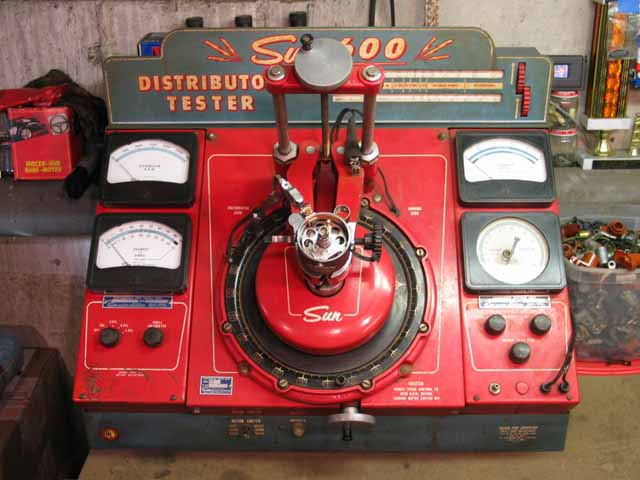
FTE Legend
Joined: Jul 2010
Posts: 32,875
Likes: 48
From: Northeast, OK
I'd like to add to Gary's excellent synopsis that Ford Duraspark distributors have two 'slots' in the baseplate.
By flipping it around you can choose how much total centrifugal advance is available.
The slots will be numbered. 10L, 13L, whatever...
That number is one HALF the advance you will get. ie, a 13L slot will allow 26* of centrifugal advance.
You can swap plates, or even weld the slot up and adjust it with a file.
There is a formula for how many thousandths equal 1*, but I don't have it committed to memory, or right here in front of me.
By flipping it around you can choose how much total centrifugal advance is available.
The slots will be numbered. 10L, 13L, whatever...
That number is one HALF the advance you will get. ie, a 13L slot will allow 26* of centrifugal advance.
You can swap plates, or even weld the slot up and adjust it with a file.
There is a formula for how many thousandths equal 1*, but I don't have it committed to memory, or right here in front of me.
Posting Guru
Joined: Jan 2012
Posts: 1,410
Likes: 1
From: Dallas, GA
Now that you show this pic, I have seen one of these. I didn't know exactly what it was for though...certainly didn't know it was to curve it?
Some of the newer electronic, aftermarket, distributors are programmable. Pretty pricy though...that's what is going into my BB Nova project
Some of the newer electronic, aftermarket, distributors are programmable. Pretty pricy though...that's what is going into my BB Nova project

Thread Starter
|
New User
Joined: Apr 2012
Posts: 8
Likes: 0
Choke
Ok guys, I have the engine running and it seems to run ok without being under power yet so, I will continue to cross my fingers.
However, I am not getting any volts to my choke and it is not opening. I chased the wire to a solenoid on the firewall that after some research I think is the problem, it's a hard to come by part damn it.
My question is, anyone have any experience with this? Where to get the part besides Ford and is there another way to deal with this. I would like to keep it original if possible though.
Thanks
However, I am not getting any volts to my choke and it is not opening. I chased the wire to a solenoid on the firewall that after some research I think is the problem, it's a hard to come by part damn it.
My question is, anyone have any experience with this? Where to get the part besides Ford and is there another way to deal with this. I would like to keep it original if possible though.
Thanks
Postmaster
Joined: Nov 2009
Posts: 4,575
Likes: 5
From: Broken Arrow , OK
From the factory the choke wire should be attached to the alt stator wire. The stator wire only puts out about 1/2 of what the alt should. So it should be around 7 volts and it should be the white wire on the alt.
Now if it is an aftermarket carb the choke may require a full 12 volts. You can pull that from any source that is powered with the key in the on position.
Now if it is an aftermarket carb the choke may require a full 12 volts. You can pull that from any source that is powered with the key in the on position.
pedant
Joined: Jan 2008
Posts: 23,576
Likes: 39
From: EXTREME southwest CT
I saw another thread about this not long ago.
The poster had photos and an Ford engineering number off the relay on the drivers side firewall.
IIRC, that person was able to run the stator wire directly to his carburetor.
Let me check my thread history and see if I can find it.
The poster had photos and an Ford engineering number off the relay on the drivers side firewall.
IIRC, that person was able to run the stator wire directly to his carburetor.
Let me check my thread history and see if I can find it.