



tires again... D vs E

Cargo Master

Joined: Jun 2008
Posts: 2,923
Likes: 33
From: Sacramento Area
It's all about the safety factor...never towing is great, but hard on the brakes from 75 and all that big beautiful Ex weight rides on those front tires...then a sudden turn left or right...
I think folks forget that scenario (one that is much more likely to happen that the odds of you towing). Make sure you account for those emergencies and you will be ok.
I think folks forget that scenario (one that is much more likely to happen that the odds of you towing). Make sure you account for those emergencies and you will be ok.
Cargo Master
Joined: Jun 2008
Posts: 2,923
Likes: 33
From: Sacramento Area

Big brakes and rotors are great, but don't really mean much if the tires are inadequate...you could actually put so much stress on the tires that they could break loose (skid) sooner, making the situation worse.
Yes, we have ABS, so that helps, but putting mega-size brakes on a car with inadequate tires could lead to LONGER stopping distances during panic braking (the tires let loose more than OEM, the ABS has to release pressure to get traction more often, then reapply once traction is detected - that all leads to longer stopping distance if the ABS does it more often than it needs to).
Now, add that additional 'brake-release-brake' cycle of the ABS under stress, then jerk the wheel in one direction...now the arc of the turn you are trying to do has become longer and more shallow (understeer). It's great that those monster brakes are working, but if the tires aren't, you won't avoid the obstacle you are trying to get around.
Think of brakes and tires like the intake and exhaust...if you put massive intake ability on an engine, add a supercharger, but try to run it through a 2" exhaust, it doesn't do much...you have to take into consideration the entire package.
Thread Starter
|
Postmaster
Joined: Oct 2005
Posts: 3,620
Likes: 3
From: WARRINGTON, PA
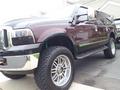
Robert, are you saying that the specific tires I selected should not be used for our trucks then?just asking? What tire do you think I should get based upon load range ad weight rating? Your help would be appreciated.
Senior User
Joined: Mar 2010
Posts: 305
Likes: 0
The D rated tire the OP plans to install has a higher load rating than the stock E and should hold up just as good or better in a extreme situation. The wider low profile tire will give better cornering and braking capability. In stock sizes the D may be a point of possible failure in extreme circumstances.
I currently have E rated 305/70-18 but think my previous wider D rated 325/65-18 I had before cornered as good or better.
I currently have E rated 305/70-18 but think my previous wider D rated 325/65-18 I had before cornered as good or better.
Thread Starter
|
Postmaster
Joined: Oct 2005
Posts: 3,620
Likes: 3
From: WARRINGTON, PA
But most tire manufacturers make it a point to say weather its a 8 ply or 10 ply on the sides on the tire. And mine say "10 ply" on the tire. ugh, what confusiuon........

Cargo Master
Joined: Jun 2008
Posts: 2,923
Likes: 33
From: Sacramento Area
Marketing, nothing more...
FTE Stories
Ford Trucks for Ford Truck Enthusiasts

Top 6 Best Deals Available on New Fords & Lincolns Right Now
Brett Foote
This Hennessey Takes the Expedition Tremor's Off-Roading Capability to the Next Level
Verdad Gallardo
Top 10 Fords at 2026 Carlisle Ford Nationals
Joe Kucinski
3 Best / 3 Worst Parts of Modern Ford Ownership
Brett Foote
10 Amazing Upgrades That Solve Common Ford Truck Owner Headaches
Pouria Savadkouei
Every 2026 Ford Engine Explained
Brett Foote
10 Ugly Ford Trucks That We Still Kinda Love
Joe Kucinski
10 Things Every Truck Owner NEEDS (2026 Edition)
Michael S. Palmer
Rezvani's Latest Post-Apocalyptic Monster Is a Ford F-150 Raptor Underneath
Verdad Gallardo
Post Fiend
Joined: Mar 2009
Posts: 11,798
Likes: 14
From: Mt. Shasta California
It's not confusing. Your tire says 10 ply rating not 10 ply. Forget about the number of plies, they go by rating now which is more accurate. Just imagine how strong a real 10 ply tire was 25+- years ago, capture that criterion, and now you have a reference for every tire that is that strong.

Thread Starter
|
Postmaster
Joined: Oct 2005
Posts: 3,620
Likes: 3
From: WARRINGTON, PA
Yeah. I have a set of the bfgs on my dodge. They are 37/12.50/17. I rarely ever drive it and the tires are junk because of dry-rot.
The 325/60/22 they say are like 37.3" tall. My toyo 325/50/22 are 34.8" tall. I think for a brand new set of bfg's for $1350 delivered, its worth it. So as long as they are taller than my toyo tires, im ok with that.
The 325/60/22 they say are like 37.3" tall. My toyo 325/50/22 are 34.8" tall. I think for a brand new set of bfg's for $1350 delivered, its worth it. So as long as they are taller than my toyo tires, im ok with that.

Laughing Gas
Joined: Aug 2002
Posts: 896
Likes: 12
From: Kenna,wv
For what its worth. Bought my 7.3 X 4wd and it had factory size Firestones. Soon after, added X codes, F350 blocks and new Nitto Terra Grapplers in a D rating 285 75 16. Looked awesome and I ran 55 lbs in them after experimenting with pressures. My X is a pavement princess so no offroading. Anyway, the tires never balanced well. They started cupping on the front and I kept them rotated every 5K. Anyway, by 21,000 miles, the tires were sawtoothed badly and I decided to replace them after having a flat. I was driving on the interstate and heard the offending flat causer ping under the right front fenderwell. I immediately headed for the shoulder and when I stopped it was flat. Put the spare on it and later plugged it at home and drove on it for 2 weeks. I ordered 10 ply BFG AT in 285 size and had them put on. When I seen the inside of the tire that had been flat, I was amazed to see 2 handfuls of rubber laying in the tire and the inner sidewalls were smooth. I was on borrowed time anyway. The BFG tires are PERFECTLY balanced (a rarity for me with my vehicles-im picky). Also, my handling dramatically improved over the terra Grapplers that were on it. I run 60 lbs in front and 55 in the rear and so far, they are wearing perfectly. Will keep an eye on them for sure but the balljoints are tight. Not sure in all cases an E ply is a must but on my diesel, I noticed a difference in handling. It is weird though that the BFG 285's look narrower than the Nitto's.

Fleet Mechanic
Joined: Sep 2002
Posts: 1,388
Likes: 2
From: Greensboro, NC
Each tire manufacturer has a different way to measure their tires as well. Take a 285/75R16 - the 285 is the cross-section or width of the tire in mm's. The 75 or sidewall 'height' is the percentage of the width. If the tread wraps slightly around the edge of the tire some manufacturers include that and some do not - which can make the tire appear to be narrower or wider depending on the type of measuring. Makes it even more confusing to really try and compare tires and how they will eventually look mounted to the wheel.
A higher sidewall measurement - no matter what the load rating is - will not handle as well as a lower profile tire of similar capabilities. Less sidewall flex means the truck uses the suspension and brakes more effectively to make that evasive maneuver.
A higher sidewall measurement - no matter what the load rating is - will not handle as well as a lower profile tire of similar capabilities. Less sidewall flex means the truck uses the suspension and brakes more effectively to make that evasive maneuver.