




coolant filter?

Moderator


Joined: Aug 2002
Posts: 6,104
Likes: 384
From: Southern California

1. Nothing substitutes a periodic flush of the radiator
2. When I drain the coolant, I place a doubled up paper towel over the funnel which filters to less than 3 microns (much better then any of the inline filters)- in terms of contaminants, the coolant is now as clean as when it came out of the original bottle. Provided it meets all the other test I do, it is reinstalled in the vehicle.
3. I have installed a magnesium anode in all overflows (same electrolysis protection used per code for all underground tanks)- Zinc anodes are available as well (JC Whitney, etc.) specifically for automotive applications and sell for about $6- they attract all the nasty stuff that destroys radiators, pumps, hoses etc and they become the sacrificial lamb- and keeps the ph of the fluid neutral. The inside of my cooling system and related components is spotless- literally!
4. I check the ph (using a swimming pool kit) - and check the alcohol content using a conventional coolant bulb type test device ($10 at any parts store)
the results.....
1. Contaminant production is eliminated by 90%+ as a result of the neutral ph maintenance
2. Contaminants that are produced are contained outside of the system flow, in the overflow at the anode. At this point I have less contaminant in my system than if I used an inline filter because we have eliminated 90% of the production and contained the residual.
3. With the paper towel, I can actually see the residual system contaminants (which you can typically count) and by most accounts visually know if a potential problem exist by the type and color of the products. The coolant is as clean as if I had opened a fresh container.
4. The system is clean and performance level known.
5. and best of all....there is absolutely no chance of a partially clogged in-line filter reducing the flow.

Senior User
Joined: Sep 2010
Posts: 306
Likes: 2
From: Southwest Desert, AZ
I built my own coolant filter rig. Learned more about my truck, which helped me and makes me think about tackling other jobs on the truck. So put down the remote and git 'er done.
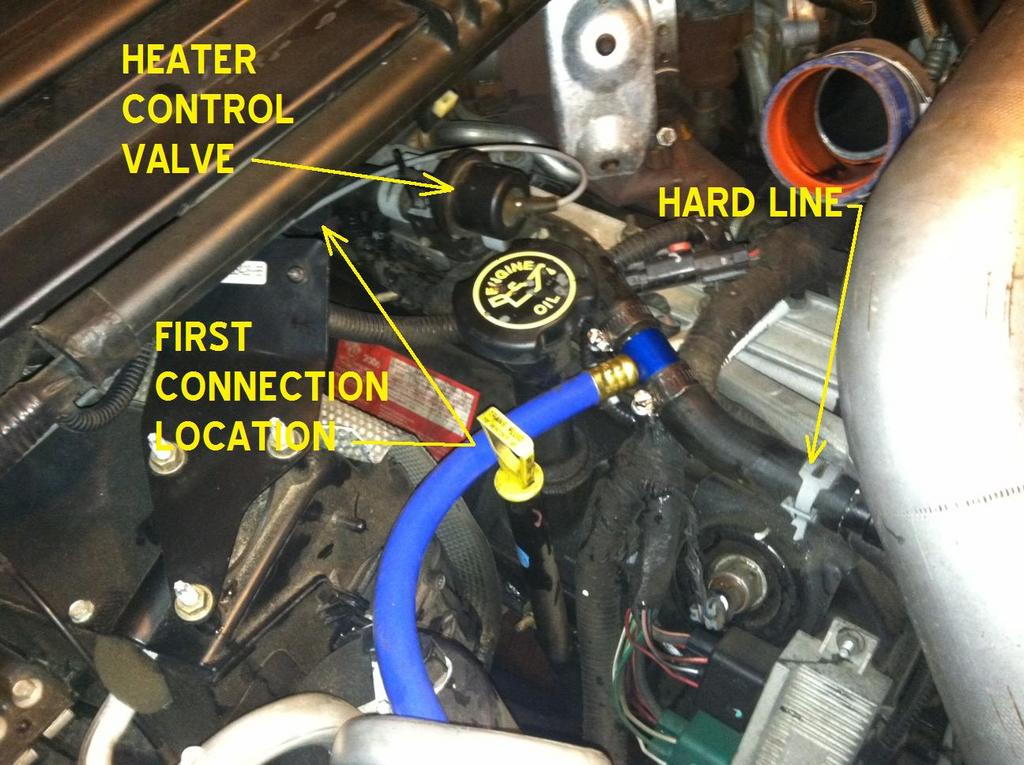
FYI Tee goes in fwd of the heater valve, input to the filter base, output to the degas bottle.
FYI Tee goes in fwd of the heater valve, input to the filter base, output to the degas bottle.

Lead Driver

Joined: Feb 2011
Posts: 8,241
Likes: 155
From: L.A. (Lower Alabama)
CRAP guys, I posted the pictures wrong! The pick with the writing on it ( the second one) is the correct install. My bad. I put mine in with the T behind the heater control valve the first time and posted some pics. Someone caught it and after a little research found it wouldn't flow coolant all the time if it's behind the valve depending on heater a/c settings. Sorry again for the mix up on the pics.

Logistics Pro
Joined: Mar 2007
Posts: 4,604
Likes: 4
From: Claremore, OK
It's really not that hard, where do you need help with the install? Your only cutting the heater hose that goes to the heater core...and the by-pass hose that comes off the top of the radiator to the degas bottle. Everything else is bolt in place.
Lead Driver
Joined: Feb 2011
Posts: 8,241
Likes: 155
From: L.A. (Lower Alabama)
My Sinister kit install looks like this(before I rerouted the hose):

Except for the hose in the back by the heater control valve:
Here's a shot of the return hose:

I didn't get a shot of the mount bracket but it was basicly remove the radiator mount nut from the bracket, hang the bracket on the stud, theres an alignment tab that sorta interlocks to keep the mount from twisting on the stud, and tighten the nut back down. I don't think it will give you any problems.
Except for the hose in the back by the heater control valve:
Here's a shot of the return hose:
I didn't get a shot of the mount bracket but it was basicly remove the radiator mount nut from the bracket, hang the bracket on the stud, theres an alignment tab that sorta interlocks to keep the mount from twisting on the stud, and tighten the nut back down. I don't think it will give you any problems.
FTE Stories
Ford Trucks for Ford Truck Enthusiasts

3 Best / 3 Worst Parts of Modern Ford Ownership
Brett Foote
10 Amazing Upgrades That Solve Common Ford Truck Owner Headaches
Pouria Savadkouei
Every 2026 Ford Engine Explained
Brett Foote
10 Ugly Ford Trucks That We Still Kinda Love
Joe Kucinski
10 Things Every Truck Owner NEEDS (2026 Edition)
Michael S. Palmer
Rezvani's Latest Post-Apocalyptic Monster Is a Ford F-150 Raptor Underneath
Verdad Gallardo
Top 10 Most Expensive Ford Trucks Ever Sold on Bring a Trailer
Joe Kucinski
2027 Ford Super Duty Buyer's Guide (Every Model, Engine, & Package)
Brett Foote
Top 10 Ford Truck Tragedies
Joe Kucinski
Tuned
Joined: Oct 2011
Posts: 269
Likes: 0
From: Albuquerque, NM
Rusty,
Couple questions.
1) Are the hoses tied down anywhere?
2) Is it necessary to disconnect the CAC tube for this installation?
I just purchased the Sinister filter system, should have it here this week, so I just wanted to prepare for the install.
Thanks.
Couple questions.
1) Are the hoses tied down anywhere?
2) Is it necessary to disconnect the CAC tube for this installation?
I just purchased the Sinister filter system, should have it here this week, so I just wanted to prepare for the install.
Thanks.
Logistics Pro
Joined: Mar 2007
Posts: 4,604
Likes: 4
From: Claremore, OK
I'm running the dieselsite filter, so mine is a little different...thou same in function. I didn't tie any of my hoses down, only where they're plumbed into something are they attached to the truck...everywhere else they're just laying in place (almost the exact same locations as his above). I didn't have to disconnect the CAC boot to install my kit. But if you move it, you gain more room to work.
Lead Driver
Joined: Feb 2011
Posts: 8,241
Likes: 155
From: L.A. (Lower Alabama)
I did end up with a loose Ziptie here.

It's hard to tell but it is very loose. you could put your finger between the two lines. just kinda keeping it from scrubing on the a/c box or lines.
Here is a pic of how the mount goes on.

Kind of an interlocking tab deal at the bottom with the one bolt holding it at the top. pretty easy.
You could install it with the CAC tube on but thers alot more room with it out of the way. The oil fill tube is right there and the trans dipstick also. I was alittle worried about the CAC tube getting hot so I went this way with the routing. the first install looked sweet, too bad it wasn't right.
It's hard to tell but it is very loose. you could put your finger between the two lines. just kinda keeping it from scrubing on the a/c box or lines.
Here is a pic of how the mount goes on.
Kind of an interlocking tab deal at the bottom with the one bolt holding it at the top. pretty easy.
You could install it with the CAC tube on but thers alot more room with it out of the way. The oil fill tube is right there and the trans dipstick also. I was alittle worried about the CAC tube getting hot so I went this way with the routing. the first install looked sweet, too bad it wasn't right.

Moderator
Joined: Aug 2002
Posts: 6,104
Likes: 384
From: Southern California
Just do a search for cathod protection/anode.....all underground fuel tanks are required by code to be protected with them. I purchased mine from...
Farwest Corrosion Control Company
1480 W. Artesia Blvd.
Gardena, CA
310-532-9524
Basically it is a block about 1" x 1" by 9" long of magnesium...I cut it down to about 2" long (so I have several for each vehicle), using a stainless steel cable & screw, I attached the magnesium to it and sunk it so to speak in the overflow can,, with a hook at the top so I can pull it out.
Here's how it works....its basically the process of electrolysis....everything has an "elecrical charge", in this case, the anode uses this to attract all the nasty stuff that causes corrosion to it...and it acts as the sacrifical lamb...it will slowly be eaten away, but that takes 10-20 years....the process then keeps the ph dead neutral so no corrosion occurs in the system to begin with.
FYI...magniseum ignites in fine particles very easily and burns very, very hot...do not inside of any building and use a hand saw....if it ignites, just let it burn until gone....water will only cause an explosion-type result.

Elder User
Joined: Jul 2003
Posts: 979
Likes: 0
From: SoCali!!
IMHO,
1. Nothing substitutes a periodic flush of the radiator
2. When I drain the coolant, I place a doubled up paper towel over the funnel which filters to less than 3 microns (much better then any of the inline filters)- in terms of contaminants, the coolant is now as clean as when it came out of the original bottle. Provided it meets all the other test I do, it is reinstalled in the vehicle.
3. I have installed a magnesium anode in all overflows (same electrolysis protection used per code for all underground tanks)- Zinc anodes are available as well (JC Whitney, etc.) specifically for automotive applications and sell for about $6- they attract all the nasty stuff that destroys radiators, pumps, hoses etc and they become the sacrificial lamb- and keeps the ph of the fluid neutral. The inside of my cooling system and related components is spotless- literally!
4. I check the ph (using a swimming pool kit) - and check the alcohol content using a conventional coolant bulb type test device ($10 at any parts store)
the results.....
1. Contaminant production is eliminated by 90%+ as a result of the neutral ph maintenance
2. Contaminants that are produced are contained outside of the system flow, in the overflow at the anode. At this point I have less contaminant in my system than if I used an inline filter because we have eliminated 90% of the production and contained the residual.
3. With the paper towel, I can actually see the residual system contaminants (which you can typically count) and by most accounts visually know if a potential problem exist by the type and color of the products. The coolant is as clean as if I had opened a fresh container.
4. The system is clean and performance level known.
5. and best of all....there is absolutely no chance of a partially clogged in-line filter reducing the flow.
1. Nothing substitutes a periodic flush of the radiator
2. When I drain the coolant, I place a doubled up paper towel over the funnel which filters to less than 3 microns (much better then any of the inline filters)- in terms of contaminants, the coolant is now as clean as when it came out of the original bottle. Provided it meets all the other test I do, it is reinstalled in the vehicle.
3. I have installed a magnesium anode in all overflows (same electrolysis protection used per code for all underground tanks)- Zinc anodes are available as well (JC Whitney, etc.) specifically for automotive applications and sell for about $6- they attract all the nasty stuff that destroys radiators, pumps, hoses etc and they become the sacrificial lamb- and keeps the ph of the fluid neutral. The inside of my cooling system and related components is spotless- literally!
4. I check the ph (using a swimming pool kit) - and check the alcohol content using a conventional coolant bulb type test device ($10 at any parts store)
the results.....
1. Contaminant production is eliminated by 90%+ as a result of the neutral ph maintenance
2. Contaminants that are produced are contained outside of the system flow, in the overflow at the anode. At this point I have less contaminant in my system than if I used an inline filter because we have eliminated 90% of the production and contained the residual.
3. With the paper towel, I can actually see the residual system contaminants (which you can typically count) and by most accounts visually know if a potential problem exist by the type and color of the products. The coolant is as clean as if I had opened a fresh container.
4. The system is clean and performance level known.
5. and best of all....there is absolutely no chance of a partially clogged in-line filter reducing the flow.