






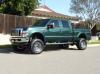


2+ tons in the bed? No problem.

Thread Starter
|
Tuned
Joined: May 2010
Posts: 434
Likes: 23
From: Somewhere in Alaska
 2+ tons in the bed? No problem.
Saturday I did some cleaning up around the house and hauled a load of random crap to the dump. I scaled in at 7550 pounds and scaled out at 6940. Sweet. 610 pounds of junk I didn't need taking up space in the yard.
Then, I drove to a local gravel pit to pick up some reject gravel to fill in some holes in my driveway. I pulled in and told the lady in the scale house what I was looking for. She said I could load all I want in my truck for $10, or they would load it for $25. Well, $15 bucks seemed like a great price to have them load it. She told me to pull around to the pile and the operator would load me up with however much I wanted... just watch my tires and suspension and waive the operator off when I had enough.
So I pulled around to the pile and the loader came over and started slowly dumping the gravel in the bed. I waived him off when I thought I had enough to fix the driveway and headed back out across the scales. The scale lady looked pretty shocked when I drove on and asked me if I knew what my empty weight was. I told her that I just scaled out empty at the dump at 6940 pounds. Her eyes got really big and she told me that I scaled loaded at 11480 pounds! I just looked at her and said "Yeah, it's a pretty heavy duty truck."
She was so concerned that she asked me to pull off the scales slowly while she watched the tires and suspension. When I got off the scales, she came out to collect my $25 and was surprised that I still had any motion in the suspension, and that the tires didn't even look like they had any load on 'em at all. She questioned my empty weight, but I had the dump ticket with me. I know both scales have to be certified, so I'm pretty confident with the listed weights.
I drove the five or six miles home with no problems. In fact, I wish the truck rode like that all the time, it was such a smooth, cushy ride. Yeah, the 4540 pounds made it squat. But I still had at least an inch and a half before it was on the bump stops. And, the tires? Seriously, those Revo-II's looked just like they do when the bed is empty. And, of course, the big gasser never even flinched. It just motored on down the road like we were going on a Sunday drive.
Gawd, I love my truck! I couldn't even TOW that much with my old Jeep. Heck, I could have loaded the TJ in the Super Duty and still not have had as much weight in the bed as I did with the gravel.
Tomorrow I'm back to hauling light loads. I figure I have just about 500 pounds of aluminum to take to the recycler. It'll fill the bed up pretty nice though. So at least it'll look like I'm working it.


Then, I drove to a local gravel pit to pick up some reject gravel to fill in some holes in my driveway. I pulled in and told the lady in the scale house what I was looking for. She said I could load all I want in my truck for $10, or they would load it for $25. Well, $15 bucks seemed like a great price to have them load it. She told me to pull around to the pile and the operator would load me up with however much I wanted... just watch my tires and suspension and waive the operator off when I had enough.
So I pulled around to the pile and the loader came over and started slowly dumping the gravel in the bed. I waived him off when I thought I had enough to fix the driveway and headed back out across the scales. The scale lady looked pretty shocked when I drove on and asked me if I knew what my empty weight was. I told her that I just scaled out empty at the dump at 6940 pounds. Her eyes got really big and she told me that I scaled loaded at 11480 pounds! I just looked at her and said "Yeah, it's a pretty heavy duty truck."
She was so concerned that she asked me to pull off the scales slowly while she watched the tires and suspension. When I got off the scales, she came out to collect my $25 and was surprised that I still had any motion in the suspension, and that the tires didn't even look like they had any load on 'em at all. She questioned my empty weight, but I had the dump ticket with me. I know both scales have to be certified, so I'm pretty confident with the listed weights.
I drove the five or six miles home with no problems. In fact, I wish the truck rode like that all the time, it was such a smooth, cushy ride. Yeah, the 4540 pounds made it squat. But I still had at least an inch and a half before it was on the bump stops. And, the tires? Seriously, those Revo-II's looked just like they do when the bed is empty. And, of course, the big gasser never even flinched. It just motored on down the road like we were going on a Sunday drive.
Gawd, I love my truck! I couldn't even TOW that much with my old Jeep. Heck, I could have loaded the TJ in the Super Duty and still not have had as much weight in the bed as I did with the gravel.
Tomorrow I'm back to hauling light loads. I figure I have just about 500 pounds of aluminum to take to the recycler. It'll fill the bed up pretty nice though. So at least it'll look like I'm working it.
More Turbo
Joined: Jul 2010
Posts: 535
Likes: 13
From: California High Desert
I just put a set of Revo IIs on my truck a few weeks ago, good to know they can hold their own. Once I take my shell off, and finish what's turning into a front-end rebuild, maybe I'll have a chance to test them out when I go pick up some paver stones. Although I probably won't load up that much weight since the place I want to get them at is 100 miles away.

FTE Leadership Emeritus
Joined: Jul 2002
Posts: 42,561
Likes: 423
From: Long Island USA

While I've done about the same thing with my truck, I gotta say, to be fair, that you need to weigh in and out on the same scale.
Lots of recyclers don't really care about how much you weigh empty or full, but the DIFFERENCE between the two. If they ever actually calibrate the darn things, who knows
Lots of recyclers don't really care about how much you weigh empty or full, but the DIFFERENCE between the two. If they ever actually calibrate the darn things, who knows
Thread Starter
|
Tuned
Joined: May 2010
Posts: 434
Likes: 23
From: Somewhere in Alaska
I hear what you're saying Art. But, up here at least, any commercial scales have to be certified by the State division of Weights and Measures to be used in commerce. And, I'm pretty sure they have to do that annually. I would be really surprised if the two scales were more than 50 pounds apart. Could be though. Next time I get a big load of dirt, I'll weigh in before I get loaded.
But, as an order of magnitude check, let's look at this: Uncompacted moist sandy soil weighs about 100 to 110 pounds per cubic foot. I'll estimate the load I had in the bed to be an average of 1 foot deep, by 5 feet wide, by 8 feet long, for a total of 40 cubic feet. That would be 4000 to 4400 pounds. If I estimate the depth at 1.1 feet, it calc's up to between 4400 and 4840 pounds. That would certainly confirm that the 4540 pounds given by using data from the two certified scales, while not guaranteed accurate, is at least reasonable.
But, as an order of magnitude check, let's look at this: Uncompacted moist sandy soil weighs about 100 to 110 pounds per cubic foot. I'll estimate the load I had in the bed to be an average of 1 foot deep, by 5 feet wide, by 8 feet long, for a total of 40 cubic feet. That would be 4000 to 4400 pounds. If I estimate the depth at 1.1 feet, it calc's up to between 4400 and 4840 pounds. That would certainly confirm that the 4540 pounds given by using data from the two certified scales, while not guaranteed accurate, is at least reasonable.
Thread Starter
|
Tuned
Joined: May 2010
Posts: 434
Likes: 23
From: Somewhere in Alaska
And yeah, I do love the Revo's. I'm looking at ordering a set for the wife's Liberty. Not E-rated, of course.
Trending Topics

Laughing Gas
Joined: May 2008
Posts: 939
Likes: 1
From: Central Kansas
But, as an order of magnitude check, let's look at this: Uncompacted moist sandy soil weighs about 100 to 110 pounds per cubic foot. I'll estimate the load I had in the bed to be an average of 1 foot deep, by 5 feet wide, by 8 feet long, for a total of 40 cubic feet. That would be 4000 to 4400 pounds. If I estimate the depth at 1.1 feet, it calc's up to between 4400 and 4840 pounds. That would certainly confirm that the 4540 pounds given by using data from the two certified scales, while not guaranteed accurate, is at least reasonable.
FTE Stories
Ford Trucks for Ford Truck Enthusiasts

Top 10 Most Expensive Ford Trucks Ever Sold on Bring a Trailer
Joe Kucinski
2027 Ford Super Duty Buyer's Guide (Every Model, Engine, & Package)
Brett Foote
Top 10 Ford Truck Tragedies
Joe Kucinski
AEV FXL Super Duty - the Super Duty Raptor Ford Doesn't Make
Brett Foote
Lobo Vs Lobo: Proof the F-150 Lobo Should Be Even Lower!
Michael S. Palmer
Ford's 2001 Explorer Sportsman Concept Looks For a New Home
Verdad Gallardo
10 Best Ford Truck Engines We Miss the Most!
Joe Kucinski
2026 Shelby F-150 Off-Road: Better Than a Raptor R?
Brett Foote
2027 Super Duty Carhartt Package First Look: 12 Things You NEED to Know!
Michael S. Palmer
Hotshot
Joined: Mar 2007
Posts: 10,101
Likes: 40
From: Pa
This is why you buy a Ford.
The weight of stone and dirt adds up fast. I got 4600lbs of coal in my 12' long tandem axle trailer last year and it filled the entire trailer and it was 3' high in the center and over 12" deep all around the side rails. If that would have been stone dirt it probably would have weighed 3 times that.
Those Revos are nice. I'm going to look at them next time because of they offer a 285/75r16 in E rating. Plus the tread design is nice. They are not cheap though but tires arn't nowdays.
The weight of stone and dirt adds up fast. I got 4600lbs of coal in my 12' long tandem axle trailer last year and it filled the entire trailer and it was 3' high in the center and over 12" deep all around the side rails. If that would have been stone dirt it probably would have weighed 3 times that.
Those Revos are nice. I'm going to look at them next time because of they offer a 285/75r16 in E rating. Plus the tread design is nice. They are not cheap though but tires arn't nowdays.
Thread Starter
|
Tuned
Joined: May 2010
Posts: 434
Likes: 23
From: Somewhere in Alaska

FTE Leadership Emeritus
Joined: Jul 2002
Posts: 42,561
Likes: 423
From: Long Island USA
Laughing Gas
Joined: May 2008
Posts: 939
Likes: 1
From: Central Kansas
I think it's 3/4"-minus crusher reject. And, our gravel typically won't even compact to 150 #/cf. More like 142 - 148 at 95% with optimum moisture content. And if you consider a 20-30% fluff factor because it's uncompacted, the numbers come in at between 99 and 118 #/cf loose load density. Again, there's no way to know for sure, but I'm pretty confident in the 4540# calc'd from the two scales. Heck, even if I say 4540# +/- 10%, I'm still over two tons. And just knowing how the truck and tires handled that much weight makes me smile.

Post Fiend
Joined: Sep 2003
Posts: 6,096
Likes: 26
From: Mesa AZ

I've run through two sets of Revos and thought they were great. My current set of Firestone Transforce AT are nearly as good. They handle the weight just as well as the Revos did but aren't as good off road. I think my next set will be Revos again. I'll get to try the Revo II this time.

Thread
Thread Starter
Forum
Replies
Last Post
flixden
2009 - 2014 F150
27
Mar 28, 2012 09:34 AM
