


Pulled the engine, need some advice...


Thread Starter
|
Mountain Pass
Joined: Sep 2007
Posts: 164
Likes: 1
From: NW Ohio

Pulled the engine, need some advice...
Backstory: I recently began to notice a slow oil leak getting worse, so I pulled the dipstick to see if the level was down. Unfortunately, I found signs of coolant in the oil. Foamy sludge was on the dipstick and in the breather. The engine, at 94k miles, has never smoked, blue or white, and hasn't suffered performance wise. I'm thinking I may have caught the problem in the early stages. So I decided to pull the motor to make it easier to work on. My plans were to have the head checked out, replace the head gasket, replace various seals, clean and paint, and finally get my manifolds and 4bbl on.
Now that it's out and I'm tearing it down, I've got a few questions, mostly to do with the head. Eventually, I want to P&P a head, just not sure I want to do it on my original. So for now I'm thinking a standard valve job and Chevy rocker arms. Would it be wise to have the screw in studs done now too? I did see wear on the end of the valve stems. How much is too much? Should I go with the over-sized valves now too?
For now, I'm keeping the stock cam. How about the lifters? I did notice more clacking in the days before I found the foam. Would that be just from the oil being thinned?
Lastly, the stock head bolts. Are they reusable, or torque-to-yield? My factory shop manuals don't mention anything.
Thanks for any help! It's great to know people that have gone down this road before!
Now that it's out and I'm tearing it down, I've got a few questions, mostly to do with the head. Eventually, I want to P&P a head, just not sure I want to do it on my original. So for now I'm thinking a standard valve job and Chevy rocker arms. Would it be wise to have the screw in studs done now too? I did see wear on the end of the valve stems. How much is too much? Should I go with the over-sized valves now too?
For now, I'm keeping the stock cam. How about the lifters? I did notice more clacking in the days before I found the foam. Would that be just from the oil being thinned?
Lastly, the stock head bolts. Are they reusable, or torque-to-yield? My factory shop manuals don't mention anything.
Thanks for any help! It's great to know people that have gone down this road before!

Postmaster
Joined: Dec 2006
Posts: 3,603
Likes: 10
From: Spokane, WA
Unless you found coolant in the oil, the symptom you describe could be nothing more than a usual result of cold starts and short trips...it's quite common coming into cooler weather.
All the operations you suggest are purely a matter of choice although the changing to screw-in studs is a good idea even on an otherwise stock rebuild.
All the operations you suggest are purely a matter of choice although the changing to screw-in studs is a good idea even on an otherwise stock rebuild.

Lead Driver


Joined: Dec 2000
Posts: 6,271
Likes: 46
From: South central, Minnesota
Yep I agree with Harte3. Unless your oil looks like chocolate milk it's most likely just condensation from short trips. I've had the same problem on a few engines.
Screw in rocker studs are a good choice.
I personally don't like to install new lifters on a used cam. If the lifters are bad I'd replace the came and lifters.
The stock head bolts aren't torque to yield so you can reuse them if you want.
Screw in rocker studs are a good choice.
I personally don't like to install new lifters on a used cam. If the lifters are bad I'd replace the came and lifters.
The stock head bolts aren't torque to yield so you can reuse them if you want.
Moderator


Joined: Dec 2007
Posts: 7,978
Likes: 97
From: Boise, Idaho

If you don't want to do a Port and Polish on your stock head, I'd recommend keeping your eye out for an 84 - 86 carbureted head. A new one might even cost the same as having screw in studs put in (which from my searching around can be a costly procedure).
They already come equipped with threaded holes instead of pressed in studs. They were designed for the newer pedestal rocker arms equipped on the EFI engines. I've only ever seen one (and purchased it for my '81), so I don't know how rare they are.

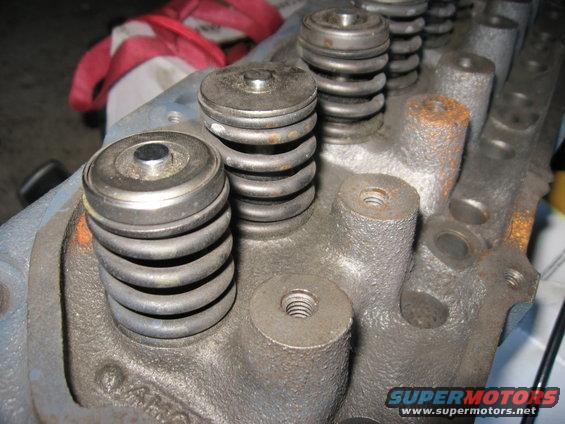
The only thing to keep in mind is the pushrod holes are round, so you'll need to switch to pedestal mount rocker arms or at least rocker arms with some form of guide plates.
They already come equipped with threaded holes instead of pressed in studs. They were designed for the newer pedestal rocker arms equipped on the EFI engines. I've only ever seen one (and purchased it for my '81), so I don't know how rare they are.
The only thing to keep in mind is the pushrod holes are round, so you'll need to switch to pedestal mount rocker arms or at least rocker arms with some form of guide plates.

Post Fiend
Joined: Dec 2007
Posts: 8,521
Likes: 16
From: Lost
Some mid-late 70's 1/2 ton fords were equipped with a dana 44 rear axle, rather than the typical 9" ford. It was a cost saving move, prior to the introduction of the ford 8.8" for 83 and newer trucks.

Elder User
Joined: Oct 2008
Posts: 708
Likes: 1
I didn't know that. Wouldn't have guessed it either. I kind of figured a 44 wouldn't hold up under the rear of a full size pickup.
Trending Topics
Moderator
Joined: Dec 2007
Posts: 7,978
Likes: 97
From: Boise, Idaho
All three of the heads I've been through on mine have been like that. I believe the thicker retainers on the exhaust valves are are designed to rotate them every time they move up and down, helping to eliminate any hot spots.
However, both head rebuilders I've spoken with have recommended removing them since they do more harm than good. I'm trying to remember their reasoning.
Lead Driver
Joined: Mar 2008
Posts: 7,150
Likes: 368
From: Near Los Angeles
All three of the heads I've been through on mine have been like that. I believe the thicker retainers on the exhaust valves are are designed to rotate them every time they move up and down, helping to eliminate any hot spots.
However, both head rebuilders I've spoken with have recommended removing them since they do more harm than good. I'm trying to remember their reasoning.
However, both head rebuilders I've spoken with have recommended removing them since they do more harm than good. I'm trying to remember their reasoning.

New User
Joined: Oct 2011
Posts: 6
Likes: 0
I've been looking and looking on this site about the chevy rocker arms and everything I read is contradicting the next thing I read about it, so I'm wondering how hard is it to put chevy rocker arms on, and is it worth my trouble? I'm going tomorrow to a junkyard to get some and experiment putting them on a junk head I got.
Lead Driver
Joined: Mar 2008
Posts: 7,150
Likes: 368
From: Near Los Angeles
I have used chevy rockers. And I feel there are a couple of things I should say that might save you some trouble and time, and ultimately money. If you are getting one or two j/y chevy rockers for fitment purposes then I would say: great. However, if you are planning on using an entire set from the j/y, then I'd say 'use at your own risk.' They have untold miles on them. They could break tomorrow, or might last forever. Due to worn surfaces they might make adjusting your valves tricky or contribute to low oil psi. IMO when building an engine there are certain parts that are ALWAYS replaced: pistons, rings, bearings, cam, lifters, oil pump, wtr pump, p.rods and rockers. Why take chances?
Something else to consider: With the C. rockers your lift to valve movement changes from Ford 1.6 to C. 1.7 or 1.73, depending on which rockers you get. What that means is that the p.rod moves closer to valve at that end. You need to have the slot type opening in the head for the p.rod, and, IMO you should have the opening enlarged a bit on the valve side, and use guide plates. After about 5k miles I could see a worn area on my p.rods where they came through the head. Yes, when the engine was not running I could see good clearance, but funny things happen when an engine is turning 2500 rpm, and the wear pattern testified to that. When the C. rockers are used you change the geometry of the v.train. IMO it is ALWAYS better to get your extra lift at the cam.
Also to consider: Can your v.springs handle the extra compression? You need to ck for coil bind when v. is fully open. How much more pressure are you putting on your v.train with that extra lift? Have you tested your springs with a meter? Are you using the oem press in studs? If so, can they handle the extra force before they pop.
What I have learned is that when you change one thing in the v.train, or pretty much in the internals of an engine, everything is affected down the line. It's kind of like building a house. If the foundation is not level, every step down the line changes to compensate.
In closing, you can buy a set of new chevy rockers for about $60 and eliminate the possibility of failure with that part. Or, you can go with an aftermarket cam. But if you choose the later, remember that lifters and cams mate for life. If you use a new cam use the 'kit', with lifters, v.springs, keepers, retainers and t. gears. And screw in studs.
Good luck.
Something else to consider: With the C. rockers your lift to valve movement changes from Ford 1.6 to C. 1.7 or 1.73, depending on which rockers you get. What that means is that the p.rod moves closer to valve at that end. You need to have the slot type opening in the head for the p.rod, and, IMO you should have the opening enlarged a bit on the valve side, and use guide plates. After about 5k miles I could see a worn area on my p.rods where they came through the head. Yes, when the engine was not running I could see good clearance, but funny things happen when an engine is turning 2500 rpm, and the wear pattern testified to that. When the C. rockers are used you change the geometry of the v.train. IMO it is ALWAYS better to get your extra lift at the cam.
Also to consider: Can your v.springs handle the extra compression? You need to ck for coil bind when v. is fully open. How much more pressure are you putting on your v.train with that extra lift? Have you tested your springs with a meter? Are you using the oem press in studs? If so, can they handle the extra force before they pop.
What I have learned is that when you change one thing in the v.train, or pretty much in the internals of an engine, everything is affected down the line. It's kind of like building a house. If the foundation is not level, every step down the line changes to compensate.
In closing, you can buy a set of new chevy rockers for about $60 and eliminate the possibility of failure with that part. Or, you can go with an aftermarket cam. But if you choose the later, remember that lifters and cams mate for life. If you use a new cam use the 'kit', with lifters, v.springs, keepers, retainers and t. gears. And screw in studs.
Good luck.