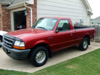
1999 Ranger 2.5 A/C Problems

Thread Starter
|
New User
Joined: Jul 2011
Posts: 12
Likes: 0
1999 Ranger 2.5 A/C Problems
Hi everyone ... New to the forums here and was hoping to get some advice.
I have a dilemma: 1999 Ford Ranger 2.5. Just got back from visiting my family (gone about a month and a half) and my A/C won't kick on. Compressor wouldn't even kick on. Jumpered the low side switch and the compressor kicked on, so I emptied a medium-sized can of r134a into her and removed the jumper. The compressor now kicks on and off about every 5 seconds, and still no cold air in the cab. When I put the pressure gauge (Walmart cheepie) up to it, for the 5 or so seconds that the compressor is on, it shows in the green at about 5 psi which indicates that I need to add refrigerant, even though I had just added plenty. When the compressor kicks off (5 seconds), the gauge moves to the red, which means "warning" in Walmart terms. I'm thinking this is the result of the pressure from the condenser not running.
Well, the compressor is at least turning on and off on its own now, so it's a start, but I'm not sure what to do next ... Is it possible that my system has a leak that I'm not detecting? Could it be a bad low side switch?
Any advice would be greatly appreciated.
Thanks in advance,
Bob
I have a dilemma: 1999 Ford Ranger 2.5. Just got back from visiting my family (gone about a month and a half) and my A/C won't kick on. Compressor wouldn't even kick on. Jumpered the low side switch and the compressor kicked on, so I emptied a medium-sized can of r134a into her and removed the jumper. The compressor now kicks on and off about every 5 seconds, and still no cold air in the cab. When I put the pressure gauge (Walmart cheepie) up to it, for the 5 or so seconds that the compressor is on, it shows in the green at about 5 psi which indicates that I need to add refrigerant, even though I had just added plenty. When the compressor kicks off (5 seconds), the gauge moves to the red, which means "warning" in Walmart terms. I'm thinking this is the result of the pressure from the condenser not running.
Well, the compressor is at least turning on and off on its own now, so it's a start, but I'm not sure what to do next ... Is it possible that my system has a leak that I'm not detecting? Could it be a bad low side switch?
Any advice would be greatly appreciated.
Thanks in advance,
Bob
Senior User
Joined: Jan 2011
Posts: 374
Likes: 0
From: Connecticut
Compressor kicks on and off
Bob,
I'm not sure how much refrigerant our systems take, but maybe it's still low. My compressor kicks on and off at about the same rate, when in park. When on AC driving down the back roads, about every 11 seconds or so. On Max AC, the interval is substantially wider, 30 seconds or more and 2 minutes isn't uncommon. The thing of it is that it blows cold regardless of the interval. It blew cold all along, but I did recharge it a couple of months ago and was able to get one R134 into the system. Now it's very cold. This is why I suspect that your system might be low. That said, it's low for a reason. I haven't done this, but you can buy a die kit that will help you pinpoint a leak if you have one. The Ford tech told me about this when I questioned him about the rapid on/off of the compressor, which is generally and indicator of a low charge. But the system blows cold and routinely condenses on the rear and side windows, and after posting here and reading others comments, I assume this to be o.k.. Do an Advanced Search here on your problem, but as another FTE member suggested, open it up to all sized trucks and vehicles. Cast a larger net and see what you get for returns.
Kevin
I'm not sure how much refrigerant our systems take, but maybe it's still low. My compressor kicks on and off at about the same rate, when in park. When on AC driving down the back roads, about every 11 seconds or so. On Max AC, the interval is substantially wider, 30 seconds or more and 2 minutes isn't uncommon. The thing of it is that it blows cold regardless of the interval. It blew cold all along, but I did recharge it a couple of months ago and was able to get one R134 into the system. Now it's very cold. This is why I suspect that your system might be low. That said, it's low for a reason. I haven't done this, but you can buy a die kit that will help you pinpoint a leak if you have one. The Ford tech told me about this when I questioned him about the rapid on/off of the compressor, which is generally and indicator of a low charge. But the system blows cold and routinely condenses on the rear and side windows, and after posting here and reading others comments, I assume this to be o.k.. Do an Advanced Search here on your problem, but as another FTE member suggested, open it up to all sized trucks and vehicles. Cast a larger net and see what you get for returns.
Kevin
Thread Starter
|
New User
Joined: Jul 2011
Posts: 12
Likes: 0
Bob,
I'm not sure how much refrigerant our systems take, but maybe it's still low. My compressor kicks on and off at about the same rate, when in park. When on AC driving down the back roads, about every 11 seconds or so. On Max AC, the interval is substantially wider, 30 seconds or more and 2 minutes isn't uncommon. The thing of it is that it blows cold regardless of the interval. It blew cold all along, but I did recharge it a couple of months ago and was able to get one R134 into the system. Now it's very cold. This is why I suspect that your system might be low. That said, it's low for a reason. I haven't done this, but you can buy a die kit that will help you pinpoint a leak if you have one. The Ford tech told me about this when I questioned him about the rapid on/off of the compressor, which is generally and indicator of a low charge. But the system blows cold and routinely condenses on the rear and side windows, and after posting here and reading others comments, I assume this to be o.k.. Do an Advanced Search here on your problem, but as another FTE member suggested, open it up to all sized trucks and vehicles. Cast a larger net and see what you get for returns.
Kevin
I'm not sure how much refrigerant our systems take, but maybe it's still low. My compressor kicks on and off at about the same rate, when in park. When on AC driving down the back roads, about every 11 seconds or so. On Max AC, the interval is substantially wider, 30 seconds or more and 2 minutes isn't uncommon. The thing of it is that it blows cold regardless of the interval. It blew cold all along, but I did recharge it a couple of months ago and was able to get one R134 into the system. Now it's very cold. This is why I suspect that your system might be low. That said, it's low for a reason. I haven't done this, but you can buy a die kit that will help you pinpoint a leak if you have one. The Ford tech told me about this when I questioned him about the rapid on/off of the compressor, which is generally and indicator of a low charge. But the system blows cold and routinely condenses on the rear and side windows, and after posting here and reading others comments, I assume this to be o.k.. Do an Advanced Search here on your problem, but as another FTE member suggested, open it up to all sized trucks and vehicles. Cast a larger net and see what you get for returns.
Kevin
I'll keep the board posted, and thanks again.
Bob
Senior User
Joined: Jan 2011
Posts: 374
Likes: 0
From: Connecticut
Use the dye
Bob,
Please post back to this thread once you've diagnosed the issue. It may be only a matter of time before I'll need the input. I thought about doing the dye if the current charge didn't do the trick, but so far...so good.
Kevin
Please post back to this thread once you've diagnosed the issue. It may be only a matter of time before I'll need the input. I thought about doing the dye if the current charge didn't do the trick, but so far...so good.
Kevin
Trending Topics

Senior User
Joined: Apr 2011
Posts: 189
Likes: 0
I read somewhere in here several times about the (i know little about the ac system and i have a bad memory) gap between the compressor and the actual spinning part of the compressor.As i understand it if the gap is to big (over time) it will cause this to happen.Im only repeating what i read here so i really dont know the why's or how's.I dont have time to look further into it at the moment but just passing it on.---maybe someone will see this and clue me in.
FTE Stories
Ford Trucks for Ford Truck Enthusiasts

Rezvani's Latest Post-Apocalytic Monster Is a Ford F-150 Raptor Underneath
Verdad Gallardo
Top 10 Most Expensive Ford Trucks Ever Sold on Bring a Trailer
Joe Kucinski
2027 Ford Super Duty Buyer's Guide (Every Model, Engine, & Package)
Brett Foote
Top 10 Ford Truck Tragedies
Joe Kucinski
AEV FXL Super Duty - the Super Duty Raptor Ford Doesn't Make
Brett Foote
Lobo Vs Lobo: Proof the F-150 Lobo Should Be Even Lower!
Michael S. Palmer
Ford's 2001 Explorer Sportsman Concept Looks For a New Home
Verdad Gallardo
10 Best Ford Truck Engines We Miss the Most!
Joe Kucinski
2026 Shelby F-150 Off-Road: Better Than a Raptor R?
Brett Foote
Thread Starter
|
New User
Joined: Jul 2011
Posts: 12
Likes: 0
Will be exploring all of these options this week when I get time ... Thanks everyone for the input. I will let the board know what I find, and in the meantime, keep the suggestions coming!
Thanks,
Bob
Thanks,
Bob


Hotshot


Joined: Jan 2004
Posts: 19,762
Likes: 1,079
From: St Louis
And sometimes it's a lot more expensive to fix what would have been easy if only it hadn't been dorked up by someone trying to fix it who didn't know their way around the system.
Senior User
Joined: Jan 2011
Posts: 374
Likes: 0
From: Connecticut
Either way, I appreciate folks from anywhere within the spectrum that take personal time to respond. It's always my decision as to whether or not I execute on given advice. And no matter, I'm smarter with the input than I would be left on my own. It is also true that I've gotten bolder on what I will attempt to do on my own given the input from here. I'm lucky though as I have alternate transportation if I screw up and bite off more than I can chew. That does weigh in the decision on whether or not I attempt a fix. I try to remain within my skill level and risk thresholds, but I will take on increasing difficulty and risk as my knowledge and experience grow.
"A man's got to know his limits!"

Logistics Pro
Joined: Jan 2002
Posts: 4,907
Likes: 39
From: suburban atlanta
Yup. You can have things get worse and cost more as Kahn and Project have pointed out. I would add, you can also have things done by 'professionals' that would make your hair stand on end. You can also have things done by 'professionals' that were not necessary, and just helped pay for their bass boat.
Sometimes a non-professional can do the diagnosis with minimal tests, and, armed with the knowledge of what they have determined is the problem, direct specific repairs or replacements to be made. Rather than depend on the acumen and honesty of the repair tech, it may behoove a customer to become informed. To do some actual learning, 'Why does the fan not come on except in position "4"?' might be a good thing. When someone answers that it needs diagnosis by their best expert, and that could take up to one hour, and it ALWAYS takes that 'up to' figure, then you can have a bit of reason in concluding that the place of business is not there to provide reasonable service at reasonable prices. They are there to maximize their income, perhaps, repeat, perhaps performing repairs that are not needed. On the other hand, if you are unwilling to 'bet the farm' that you know the problem after your diagnosis, then you should have no problem paying someone with more experience and knowledge to determine the course of action.
So, if you have gained knowledge by using your own time, then you should have certainty when asking that they specifically replace the LPCO switch or the blower resistor pack. If they demur, and will not do repairs that way, find someone who twiddles wrenches for a living and will do specified repairs.
So, learn. Use the knowledge. Know your limits, but don't be cowed by "all that stuff". We all started by knowing very little, as I will freely admit. The hard thing is telling someone who is a 'pro' that they are doing a test incorrectly, or that they have failed to open the valve to the recovery machine to allow it to vacuum down the system. Being able to point out their error without making them your instant enemy is hard. On the other hand, when they want to sell you new ball joints after performing a "safety inspection", and either are ignorant, or want to make some quick money, and you tell them they did the test wrong, and honest shop will admit their mistake, a dishonest shop will run you out of there. Personally, I don't care any more if I insult the techs. I will tell them that you have to support the lower arm while checking free play, rather than cow around hoping they will do it right. If you know something, don't stand there and let them run you over.
/lecture mode
tom
Sometimes a non-professional can do the diagnosis with minimal tests, and, armed with the knowledge of what they have determined is the problem, direct specific repairs or replacements to be made. Rather than depend on the acumen and honesty of the repair tech, it may behoove a customer to become informed. To do some actual learning, 'Why does the fan not come on except in position "4"?' might be a good thing. When someone answers that it needs diagnosis by their best expert, and that could take up to one hour, and it ALWAYS takes that 'up to' figure, then you can have a bit of reason in concluding that the place of business is not there to provide reasonable service at reasonable prices. They are there to maximize their income, perhaps, repeat, perhaps performing repairs that are not needed. On the other hand, if you are unwilling to 'bet the farm' that you know the problem after your diagnosis, then you should have no problem paying someone with more experience and knowledge to determine the course of action.
So, if you have gained knowledge by using your own time, then you should have certainty when asking that they specifically replace the LPCO switch or the blower resistor pack. If they demur, and will not do repairs that way, find someone who twiddles wrenches for a living and will do specified repairs.
So, learn. Use the knowledge. Know your limits, but don't be cowed by "all that stuff". We all started by knowing very little, as I will freely admit. The hard thing is telling someone who is a 'pro' that they are doing a test incorrectly, or that they have failed to open the valve to the recovery machine to allow it to vacuum down the system. Being able to point out their error without making them your instant enemy is hard. On the other hand, when they want to sell you new ball joints after performing a "safety inspection", and either are ignorant, or want to make some quick money, and you tell them they did the test wrong, and honest shop will admit their mistake, a dishonest shop will run you out of there. Personally, I don't care any more if I insult the techs. I will tell them that you have to support the lower arm while checking free play, rather than cow around hoping they will do it right. If you know something, don't stand there and let them run you over.
/lecture mode
tom
Senior User
Joined: Jan 2011
Posts: 374
Likes: 0
From: Connecticut
Well stated!
Yup. You can have things get worse and cost more as Kahn and Project have pointed out. I would add, you can also have things done by 'professionals' that would make your hair stand on end. You can also have things done by 'professionals' that were not necessary, and just helped pay for their bass boat.
Sometimes a non-professional can do the diagnosis with minimal tests, and, armed with the knowledge of what they have determined is the problem, direct specific repairs or replacements to be made. Rather than depend on the acumen and honesty of the repair tech, it may behoove a customer to become informed. To do some actual learning, 'Why does the fan not come on except in position "4"?' might be a good thing. When someone answers that it needs diagnosis by their best expert, and that could take up to one hour, and it ALWAYS takes that 'up to' figure, then you can have a bit of reason in concluding that the place of business is not there to provide reasonable service at reasonable prices. They are there to maximize their income, perhaps, repeat, perhaps performing repairs that are not needed. On the other hand, if you are unwilling to 'bet the farm' that you know the problem after your diagnosis, then you should have no problem paying someone with more experience and knowledge to determine the course of action.
So, if you have gained knowledge by using your own time, then you should have certainty when asking that they specifically replace the LPCO switch or the blower resistor pack. If they demur, and will not do repairs that way, find someone who twiddles wrenches for a living and will do specified repairs.
So, learn. Use the knowledge. Know your limits, but don't be cowed by "all that stuff". We all started by knowing very little, as I will freely admit. The hard thing is telling someone who is a 'pro' that they are doing a test incorrectly, or that they have failed to open the valve to the recovery machine to allow it to vacuum down the system. Being able to point out their error without making them your instant enemy is hard. On the other hand, when they want to sell you new ball joints after performing a "safety inspection", and either are ignorant, or want to make some quick money, and you tell them they did the test wrong, and honest shop will admit their mistake, a dishonest shop will run you out of there. Personally, I don't care any more if I insult the techs. I will tell them that you have to support the lower arm while checking free play, rather than cow around hoping they will do it right. If you know something, don't stand there and let them run you over.
/lecture mode
tom
Sometimes a non-professional can do the diagnosis with minimal tests, and, armed with the knowledge of what they have determined is the problem, direct specific repairs or replacements to be made. Rather than depend on the acumen and honesty of the repair tech, it may behoove a customer to become informed. To do some actual learning, 'Why does the fan not come on except in position "4"?' might be a good thing. When someone answers that it needs diagnosis by their best expert, and that could take up to one hour, and it ALWAYS takes that 'up to' figure, then you can have a bit of reason in concluding that the place of business is not there to provide reasonable service at reasonable prices. They are there to maximize their income, perhaps, repeat, perhaps performing repairs that are not needed. On the other hand, if you are unwilling to 'bet the farm' that you know the problem after your diagnosis, then you should have no problem paying someone with more experience and knowledge to determine the course of action.
So, if you have gained knowledge by using your own time, then you should have certainty when asking that they specifically replace the LPCO switch or the blower resistor pack. If they demur, and will not do repairs that way, find someone who twiddles wrenches for a living and will do specified repairs.
So, learn. Use the knowledge. Know your limits, but don't be cowed by "all that stuff". We all started by knowing very little, as I will freely admit. The hard thing is telling someone who is a 'pro' that they are doing a test incorrectly, or that they have failed to open the valve to the recovery machine to allow it to vacuum down the system. Being able to point out their error without making them your instant enemy is hard. On the other hand, when they want to sell you new ball joints after performing a "safety inspection", and either are ignorant, or want to make some quick money, and you tell them they did the test wrong, and honest shop will admit their mistake, a dishonest shop will run you out of there. Personally, I don't care any more if I insult the techs. I will tell them that you have to support the lower arm while checking free play, rather than cow around hoping they will do it right. If you know something, don't stand there and let them run you over.
/lecture mode
tom