


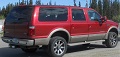

Bushwacker project

Thread Starter
|
Posting Guru
Joined: Dec 2007
Posts: 1,265
Likes: 0
From: Metro Detroit, MI.
All right back from the car show, and grandfather recovering quickly (all movement is back.
Here's what I did today:
Mounted the rear for fitment.
Trimmed the front and rear to fit the contours.
Cut the small front piece that would stop the door from opening.
 [/URL]
 [/URL]
 [/URL]
As far as the piece that was cut from the front section on the rear flare, I'm going to find a piece of plastic and mold it to the curve instead of the spray foam. The idea of all the moisture is scaring me way to much. As you can see from previous posts already have an issue with the doors.
Here's what I did today:
Mounted the rear for fitment.
Trimmed the front and rear to fit the contours.
Cut the small front piece that would stop the door from opening.
[/URL][/URL][/URL]As far as the piece that was cut from the front section on the rear flare, I'm going to find a piece of plastic and mold it to the curve instead of the spray foam. The idea of all the moisture is scaring me way to much. As you can see from previous posts already have an issue with the doors.
Fleet Mechanic


Joined: Oct 2010
Posts: 1,407
Likes: 155
From: Milwaukee, WI
You can use the rear piece from the XLT. It is much smaller than the cladding. May even be the same part as the shortbed XLT, you'll have to ask your parts guy
Thread Starter
|
Posting Guru
Joined: Dec 2007
Posts: 1,265
Likes: 0
From: Metro Detroit, MI.
Wow, two days in a row I get to work on something. It's amazing.
Alright today I continued on cutting and fab work for the rear pieces on both sides. I mounted the rear piece all by itself and was thinking about what I could use to seal the opening. I asked earlier about it in a previous thread, but I'm worried about the moisture back behind to put a foam sealer. I got the idea of acrylic. I went to the store and got a few pieces, and after I found out what the cost was I'm using it and not F'ing up.
Here are some pictures:
 [/url] Picture above: Passenger side with flare fitted and front section cut.
 [/url] Picture above: again passenger side flare fitted and front section cut off.
 [/url] Picture above: formed piece of acrylic with contoured to the body line for a nice fitment and stability.
 [/url] Same as above different angle. The gap/lip is due to me not wanting to heat the acrylic and form it. There are way to many curves and angle's. For added security I plan on screwing a 90 degree bracket from the inside of the acrylic to the bottom of the flare. You will only see it if the door opens or you look underneath.
 [/url] Plain and simple, 90 degree glued and contoured.
Alright today I continued on cutting and fab work for the rear pieces on both sides. I mounted the rear piece all by itself and was thinking about what I could use to seal the opening. I asked earlier about it in a previous thread, but I'm worried about the moisture back behind to put a foam sealer. I got the idea of acrylic. I went to the store and got a few pieces, and after I found out what the cost was I'm using it and not F'ing up.
Here are some pictures:
[/url] Picture above: Passenger side with flare fitted and front section cut.[/url] Picture above: again passenger side flare fitted and front section cut off. [/url] Picture above: formed piece of acrylic with contoured to the body line for a nice fitment and stability.[/url] Same as above different angle. The gap/lip is due to me not wanting to heat the acrylic and form it. There are way to many curves and angle's. For added security I plan on screwing a 90 degree bracket from the inside of the acrylic to the bottom of the flare. You will only see it if the door opens or you look underneath.[/url] Plain and simple, 90 degree glued and contoured.
Last edited by officer131; Jul 30, 2011 at 05:39 PM. Reason: added info
Thread Starter
|
Posting Guru
Joined: Dec 2007
Posts: 1,265
Likes: 0
From: Metro Detroit, MI.
I'm bouncing around the idea of mocking up some LED side markers and just fitting them in there. Depending on cost, because parts guy ed sells the pieces for $20 each which seems reasonable. Even buying them new I would still have to cut the new ones to fit.
Thread Starter
|
Posting Guru
Joined: Dec 2007
Posts: 1,265
Likes: 0
From: Metro Detroit, MI.
Today I was able to get a few hours of work done on my project.
I started by sanding down my surface rust spots as you can see in the pictures posted above. Thanks Michigan and your salty winters. I coated the spots with primer. No pictures, sorry I think everyone knows what metal and primer look like together.
I finished off by filling what appeared to be small openings on the flares where I put the acrylic in. Trying to make the best connection as possible.
Trying to research it, but is the epoxy stuff paintable? It doesn't say on the package.
I started by sanding down my surface rust spots as you can see in the pictures posted above. Thanks Michigan and your salty winters. I coated the spots with primer. No pictures, sorry I think everyone knows what metal and primer look like together.
I finished off by filling what appeared to be small openings on the flares where I put the acrylic in. Trying to make the best connection as possible.
Trying to research it, but is the epoxy stuff paintable? It doesn't say on the package.
Thread Starter
|
Posting Guru
Joined: Dec 2007
Posts: 1,265
Likes: 0
From: Metro Detroit, MI.
Besides taking apart and fixing my kids powerwheel, I did manage to paint the rear flare sections. I am going to wait and see the fitment with the small cut out pieces before forming the acrylic/painting them.
pictures speak for themselves.
 [/url]
 [/url]
Out of all the background clutter, my grandfather still knows were everything is.
pictures speak for themselves.
[/url][/url]Out of all the background clutter, my grandfather still knows were everything is.

FTE Chapter Leader


Joined: Feb 2004
Posts: 14,904
Likes: 76
From: Wayland, MI

FTE Stories
Ford Trucks for Ford Truck Enthusiasts

Top 10 Fords at 2026 Carlisle Ford Nationals
Joe Kucinski
3 Best / 3 Worst Parts of Modern Ford Ownership
Brett Foote
10 Amazing Upgrades That Solve Common Ford Truck Owner Headaches
Pouria Savadkouei
Every 2026 Ford Engine Explained
Brett Foote
10 Ugly Ford Trucks That We Still Kinda Love
Joe Kucinski
10 Things Every Truck Owner NEEDS (2026 Edition)
Michael S. Palmer
Rezvani's Latest Post-Apocalyptic Monster Is a Ford F-150 Raptor Underneath
Verdad Gallardo
Top 10 Most Expensive Ford Trucks Ever Sold on Bring a Trailer
Joe Kucinski
2027 Ford Super Duty Buyer's Guide (Every Model, Engine, & Package)
Brett Foote
Because racetruck
Joined: Apr 2007
Posts: 2,786
Likes: 104
From: Monterey Bay, CA
Don't know if you guys knew or not but Bushwacker has OE style fender flares for the Excursion now. I just stumbled across them the other day. No pocket style yet but its a step in the right direction. Riffraff Diesel: 'OE' Style Flares
Thread Starter
|
Posting Guru
Joined: Dec 2007
Posts: 1,265
Likes: 0
From: Metro Detroit, MI.
Knowing my luck, Bushwacker wil come out with the pocket style ones by the time I finish. Pocket style gets the aggressive look and another .5" of coverage. They look plain to be, but yes a positive step in the right direction.
Today I put the nuts and bolts on as they are decorative pieces. Also put the strip of rubber on the flare prior to mounting. Pictures below are the flare mounted on every angle.
Pic below: Painted passenger flare in front of a 1940 Bantam roadster.
 [/url]
Pic below: Flare mounted.
 [/url]
Pic below: side view. You can see the added piece as I attempted to countour it to the body.
 [/url]
Pic below: Side view. Sweet, almost there.
 [/url]
Pic below: Driver side, and a closer view of the added piece for stability. In the corner of the window is my Michigan chapter logo.
 [/url]
Pic below: passenger side. Since Bushwacker didn't make the pockets for the Ex, I had to buy the F250 ones. The direction say a little of trimming, but there was more than expected. As you can see there is a little gap near the body contour. Luckily the rubber helped out a bit.
 [/url]
Pic below: Driver side. Again contour and rubber helped out. This side had a better fitment than the other.
 [/url]
I am in the process of making a game plan to tackle the cut pieces to complete the curve into the doors. Having a hard time with what will work to hold the piece onto the door with limited mounting spots. I was thinking of boxing the piece in. I would do that by forming a piece of acrylic to the body flat and epoxy that between the two pieces that would be vertical to the body. It make sense to me, hopefully you understand or have a better idea. I'm open to listen.
Today I put the nuts and bolts on as they are decorative pieces. Also put the strip of rubber on the flare prior to mounting. Pictures below are the flare mounted on every angle.
Pic below: Painted passenger flare in front of a 1940 Bantam roadster.
[/url]Pic below: Flare mounted.
[/url]Pic below: side view. You can see the added piece as I attempted to countour it to the body.
[/url]Pic below: Side view. Sweet, almost there.
[/url]Pic below: Driver side, and a closer view of the added piece for stability. In the corner of the window is my Michigan chapter logo.
[/url]Pic below: passenger side. Since Bushwacker didn't make the pockets for the Ex, I had to buy the F250 ones. The direction say a little of trimming, but there was more than expected. As you can see there is a little gap near the body contour. Luckily the rubber helped out a bit.
[/url]Pic below: Driver side. Again contour and rubber helped out. This side had a better fitment than the other.
[/url]I am in the process of making a game plan to tackle the cut pieces to complete the curve into the doors. Having a hard time with what will work to hold the piece onto the door with limited mounting spots. I was thinking of boxing the piece in. I would do that by forming a piece of acrylic to the body flat and epoxy that between the two pieces that would be vertical to the body. It make sense to me, hopefully you understand or have a better idea. I'm open to listen.
Thread Starter
|
Posting Guru
Joined: Dec 2007
Posts: 1,265
Likes: 0
From: Metro Detroit, MI.
Thanks. Grandpa is back to his stubbern self and told the doctors he was over medicated. All movement is back, just has to work on the strength part.
Thread Starter
|
Posting Guru
Joined: Dec 2007
Posts: 1,265
Likes: 0
From: Metro Detroit, MI.
Finally back into the swing of things......well kind of. Today I sanded down the lower door panels to remove the rust and for repairs.
I also made a template for what I will call the butt plate for the cut pieces. The piece I made is what I will be connecting the piece (bushwacker) to the door panel (3m tape, or some sort of glue). What I did was take a piece of cardboard, place it against the door (opened) and cut a pattern. I then took a piece of 2x4 and transfered it onto the wood. I used the bandsaw and cut the piece of wood to the curvature of the door. Lastly, I took the formed piece of wood and started to lay the acrylic over top and used some heat to bend it. That way I will the the maximum amount of surface to adhear to the door.
I will post pictures later.
I also made a template for what I will call the butt plate for the cut pieces. The piece I made is what I will be connecting the piece (bushwacker) to the door panel (3m tape, or some sort of glue). What I did was take a piece of cardboard, place it against the door (opened) and cut a pattern. I then took a piece of 2x4 and transfered it onto the wood. I used the bandsaw and cut the piece of wood to the curvature of the door. Lastly, I took the formed piece of wood and started to lay the acrylic over top and used some heat to bend it. That way I will the the maximum amount of surface to adhear to the door.
I will post pictures later.