


Flat Front Springs?

Thread Starter
|
Senior User
Joined: Jan 2010
Posts: 224
Likes: 1
From: Davis, CA
Flat Front Springs?
I have been working so hard lately to get the wiring finished on my 51 F1 to get the motor running without any voltage drops or short, that i have not really looked at the front suspension. I thought that the steering was poor due to old tires....replaced. Then the steering box...but now I think that it is the drag link. This evening I was under the truck to bleed the "brakes" (not!) and realized that the front springs are flat. This is not ideal, right? I have a 1968 302 with a 1989 M2R2 Thunderbird transmission. Is this set up sooooo heavy to flatten the front springs? Are they shot, overloaded or at risk of breaking like this? Whot do others do with heavy motors?
I am going to get new drums for the front because they are are way over tolerance and hope that this improves the braking. However, Should I be concerned about the springs? Can this be affecting the steering?
Thanks for your input. I will try to get pictures tomorrow AM.
Ciao,
Steve
I am going to get new drums for the front because they are are way over tolerance and hope that this improves the braking. However, Should I be concerned about the springs? Can this be affecting the steering?
Thanks for your input. I will try to get pictures tomorrow AM.
Ciao,
Steve

Lead Driver


Joined: Apr 2002
Posts: 8,813
Likes: 13
From: Littleton, New Hampshire
The 302 is actually lighter than a flathead so I doubt the sagging springs are due to extra weight. The original springs didn't have much arch to them anyway. As long as they aren't bottoming out it won't hurt anything.
What kind of steering problems are you having?
What kind of steering problems are you having?
Thread Starter
|
Senior User
Joined: Jan 2010
Posts: 224
Likes: 1
From: Davis, CA
The steering is just very loose. When I turn the wheel, the pitman arm rotates, but the drag link seems to be taking up slack before the tire turns. I hope that it is just the drag link to be rebuilt, but I am picking up another steering box tomorrow just in case. Thanks

Fleet Owner


Joined: Jul 2004
Posts: 27,291
Likes: 1,055
From: NM
The drag link has easily adjustable/replaceable wear parts, but if the ball end of the pitman or the spindle are worn, that is more of a problem. Very easy to disassemble.
The springs should not be flat, they could be just sagging but you could also have a cracked leaf or two. It isn't always obvious, but if you lift by the frame and look closely you may be able to see.
The springs should not be flat, they could be just sagging but you could also have a cracked leaf or two. It isn't always obvious, but if you lift by the frame and look closely you may be able to see.
Thread Starter
|
Senior User
Joined: Jan 2010
Posts: 224
Likes: 1
From: Davis, CA
Pics!
Here are pics of my truck:
Right Front spring pic 1

Right Front Spring Pic 2

Stance of Truck


Does the stance appear stock? What is your opinion of the resting spring condition?
Thanks, Steve
Right Front spring pic 1
Right Front Spring Pic 2
Stance of Truck
Does the stance appear stock? What is your opinion of the resting spring condition?
Thanks, Steve

Hotshot


Joined: Oct 2009
Posts: 16,172
Likes: 4,772
From: Burbank, WA
I'd say that is about typical, and nothing I'd worry about until I had my other real issues sorted out, (ie; drag link, etc) unless you are having problems with them bottoming out on a regular basis.
Fleet Owner
Joined: Jul 2004
Posts: 27,291
Likes: 1,055
From: NM
Trending Topics

Lead Driver
Joined: Dec 2004
Posts: 7,669
Likes: 13
From: San Jose, CA
FTE Stories
Ford Trucks for Ford Truck Enthusiasts

Top 10 Most Expensive Ford Trucks Ever Sold on Bring a Trailer
Joe Kucinski
2027 Ford Super Duty Buyer's Guide (Every Model, Engine, & Package)
Brett Foote
Top 10 Ford Truck Tragedies
Joe Kucinski
AEV FXL Super Duty - the Super Duty Raptor Ford Doesn't Make
Brett Foote
Lobo Vs Lobo: Proof the F-150 Lobo Should Be Even Lower!
Michael S. Palmer
Ford's 2001 Explorer Sportsman Concept Looks For a New Home
Verdad Gallardo
10 Best Ford Truck Engines We Miss the Most!
Joe Kucinski
2026 Shelby F-150 Off-Road: Better Than a Raptor R?
Brett Foote
2027 Super Duty Carhartt Package First Look: 12 Things You NEED to Know!
Michael S. Palmer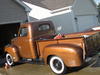
Senior User
Joined: Jan 2011
Posts: 369
Likes: 1
From: Indiana
Eh, mine looked like that, but they would bottom out on any and everything...they were REALLY shot. When I pulled em, it did not take much to bottom them out with just my weight, so I can only imagine with the weight of the truck it was no good.
With my new packs (hodgepodge of old and another set of old front springs) I have the same ride height with good support, TONS more travel (its amazing what a few inches of suspension feels like when you had none before), and much improved steering. My steering was also sloppy as sin, so I can feel for ya. 90% of the slop I now have I attest to still aging parts and it's a 60+ year old design with probably 35yr old parts, and it is still fairly tight. Most of my steering fun comes from the bias tires following the road, so I tend to wander a little.
With my new packs (hodgepodge of old and another set of old front springs) I have the same ride height with good support, TONS more travel (its amazing what a few inches of suspension feels like when you had none before), and much improved steering. My steering was also sloppy as sin, so I can feel for ya. 90% of the slop I now have I attest to still aging parts and it's a 60+ year old design with probably 35yr old parts, and it is still fairly tight. Most of my steering fun comes from the bias tires following the road, so I tend to wander a little.
Thread Starter
|
Senior User
Joined: Jan 2010
Posts: 224
Likes: 1
From: Davis, CA
Update on the Front suspension:
I just replaced the front shocks with Napa Response and the ride quality is sooooo much better. The steering is also much smoother and responsive. I can not wait to change the rear shocks.
Another thing is that the stance is a bit higher in the front. This likely helped with the steering as well.
Is shock failure a cause for broken or fatigued springs?
Thanks,
Steve
I just replaced the front shocks with Napa Response and the ride quality is sooooo much better. The steering is also much smoother and responsive. I can not wait to change the rear shocks.
Another thing is that the stance is a bit higher in the front. This likely helped with the steering as well.
Is shock failure a cause for broken or fatigued springs?
Thanks,
Steve
Hotshot
Joined: Oct 2009
Posts: 16,172
Likes: 4,772
From: Burbank, WA
Having bad shocks certainly doesn't do anything any good, but I wouldn't consider that a "cause" for springs breaking. That's more an issue of overloading, or constant or consistent driving in poor conditions, ie; off road/farmer fields/bad roads, etc., imho.
