





stroker kit for my 460

Thread Starter
|
Freshman User
Joined: Oct 2010
Posts: 43
Likes: 0
From: oh
 stroker kit for my 460
alright i am looking to find a stroker kit for my 460 to a 545 i plan to bore it .030 over the motor originally came out of a 1977 Ford Lincoln. than going to put it in my 78 rigged up pos bronco that i have. i need help doing this i would like to get 800h.p. out of it if not more. please help me when you can i would really appresiate it. i found a kit but idk if its going to fit... 
460/545 Ford "Street Fighter" Stroker Kit
tell me if that will work if so thanks but if its not what i am looking for please send me something thanks
460/545 Ford "Street Fighter" Stroker Kit
tell me if that will work if so thanks but if its not what i am looking for please send me something thanks

Freshman User
Joined: Apr 2009
Posts: 42
Likes: 1
From: Copiah County
Can you get 800+ horsepower? Jon Kaase seems to think it's possible. (click on the text to go to his web site; scroll down until you get to the part where he says "a 514-521 will make 800HP.")
Just FYI: starting with a foundation of cheap parts, figure a final cost of about $100 per horsepower when you're done.
"Fast, Cheap, Good: pick any two."
Just FYI: starting with a foundation of cheap parts, figure a final cost of about $100 per horsepower when you're done.
"Fast, Cheap, Good: pick any two."
Thread Starter
|
Freshman User
Joined: Oct 2010
Posts: 43
Likes: 0
From: oh
Trending Topics
Freshman User
Joined: Apr 2009
Posts: 42
Likes: 1
From: Copiah County
541 in the blender, hit frappe!
Izit fer mud-boggin'? If'n it is, then yer good ta go -- but with stock D0VE heads, I dunno how yer gonna spin it fast enough fer 800 horsechowder.
Out of stock heads, there's no way you're gonna get 100 pervent VE at 7766 rpm, and that's what it's gonna take to make 800 horsepower. Of course, you could maybe get lucky and make 110 percent VE at 7062 rpm. Yeah, right!
You building a grenade?
Out of stock heads, there's no way you're gonna get 100 pervent VE at 7766 rpm, and that's what it's gonna take to make 800 horsepower. Of course, you could maybe get lucky and make 110 percent VE at 7062 rpm. Yeah, right!
You building a grenade?
FTE Stories
Ford Trucks for Ford Truck Enthusiasts

10 Ugly Ford Trucks That We Still Kinda Love
Joe Kucinski
10 Things Every Truck Owner NEEDS (2026 Edition)
Michael S. Palmer
Rezvani's Latest Post-Apocalyptic Monster Is a Ford F-150 Raptor Underneath
Verdad Gallardo
Top 10 Most Expensive Ford Trucks Ever Sold on Bring a Trailer
Joe Kucinski
2027 Ford Super Duty Buyer's Guide (Every Model, Engine, & Package)
Brett Foote
Top 10 Ford Truck Tragedies
Joe Kucinski
AEV FXL Super Duty - the Super Duty Raptor Ford Doesn't Make
Brett Foote
Lobo Vs Lobo: Proof the F-150 Lobo Should Be Even Lower!
Michael S. Palmer
Ford's 2001 Explorer Sportsman Concept Looks For a New Home
Verdad Gallardo
Freshman User
Joined: Oct 2008
Posts: 28
Likes: 0
If you plan on running bone stock doves stick with the 460 doves will be way maxed out stock for a 557. Id reccomend staying 460 n just put big valves ie 225 n 176 in the doves with a lunati voodoo cam weind stealth 8012 intake n good headers just built one just like it n its putting down 500 hp. Good luck any questions I can help with pm me
Freshman User
Joined: Apr 2009
Posts: 42
Likes: 1
From: Copiah County
Hoodwinked?
Hey, Bullwinkle460!
I think we've been hoodwinked: one minute, bigforddan asks, "i can still use the aluminum 360 valve heads cant i?" (05-12-2011, 11:04 AM) and the next, he indicates, "lol just want just stock dove lincoln heads with the roller rockers" (07-05-2011, 09:57 PM) to achieve his 800-horsepower goal.
I can only guess that by "aluminum 360 valve heads", he's referring to the Blue Thunder aluminum 3.60 heads, which fit the small block Ford (Windsor & Boss 302, and Cleveland); surely, he doesn't mean 360-valve heads. I know, there's a tendency to say, "Oh, he meant to indicate Blue Thunder's aluminum Thor heads," but we can't reasonably assume that, now can we?
Regardless whether he discovered the error or simply decided to work with what he has (or thinks he might be able to get), now he's moved on to the D0VE heads, which as you suggest should support 500+ out of a 460 without much difficulty, but bigforddan indicated he's shooting for 800 horsepower (05-11-2011, 09:00 PM).
In a 545 (05-11-2011, 09:00 PM), that's slightly more than 89.59 horsepower per liter; in a 466, that's roughly 104.72 horsepower per liter. If we accept the limitations of the factory heads, I don't see how he's going to get there (without building a grenade) if he doesn't use either forced induction or a pretty huge shot of nitrous.
From the progress of this thread, I feel reasonably confident that either (a) the build itself is a hoax or, (b) at the very least, bigforddan lacks the skills and equipment required to reliably assemble the valvetrain. In other words, if the build isn't a hoax, and if bigforddan doesn't simply purchase a built engine, he is in my opinion very unlikely to have an engine that will survive long enough to make 800 horsepower.
Just for clarity: I'm not saying anything bad about bigforddan:
People talk trash all the time, and it usually leads to warped perceptions about what is possible -- perceptions that aren't at all helped by gurus that have "daily-driven on the street" cars powered by 1200+ horsepower 427 SOHC engines. In the 1980s, I was researching a naturally-aspirated 391-inch "302W" that I hoped would make at least 600 horsepower around 6400 rpm (requiring a BMEP of 190.1 psi at that output -- a very high value for a naturally-aspirated 2-valves-per-cylinder engine burning gasoline in a "warm" street car), I spoke with a guy at Ford who operated such a Cammer; he assured me it was a daily driver -- but his commute was 1.5 miles each way, and he had the operating budget of a small city.
The point is this: what is within the realm of streetability for any particular person is not necessarily within the bounds of reason for another. In the Deep South, daily one-way commutes of more than 30 miles are the rule, rather than the exception; when he asked how many miles per week I drove my car, I responded "300." He was flabbergasted, and replied to this effect: "Is that per week, or per month?" I thought, "Houston, we have a problem."
He couldn't wrap his head around the idea of driving a hotrod on the street 300 miles per week any more than I could wrap my head around the idea of a 1200-horsepower, supercharged, poked & stroked Cammer going down the road on meats that were little different from grooved slicks and bike tires. That didn't make either of us a nutcase: it just meant that our realities were determined by profoundly different operational considerations.
I think Bullwinkle460 is right to suggest a much more conservative peak power level: a 500+ horsepower 460 is a fairly easy build, and it has more grunt than most vehicle operators can handle -- but if it proves to be not too much, then the operator can learn to drive it at its limit before moving up to higher levels of power.
I think we've been hoodwinked: one minute, bigforddan asks, "i can still use the aluminum 360 valve heads cant i?" (05-12-2011, 11:04 AM) and the next, he indicates, "lol just want just stock dove lincoln heads with the roller rockers" (07-05-2011, 09:57 PM) to achieve his 800-horsepower goal.
I can only guess that by "aluminum 360 valve heads", he's referring to the Blue Thunder aluminum 3.60 heads, which fit the small block Ford (Windsor & Boss 302, and Cleveland); surely, he doesn't mean 360-valve heads. I know, there's a tendency to say, "Oh, he meant to indicate Blue Thunder's aluminum Thor heads," but we can't reasonably assume that, now can we?
Regardless whether he discovered the error or simply decided to work with what he has (or thinks he might be able to get), now he's moved on to the D0VE heads, which as you suggest should support 500+ out of a 460 without much difficulty, but bigforddan indicated he's shooting for 800 horsepower (05-11-2011, 09:00 PM).
In a 545 (05-11-2011, 09:00 PM), that's slightly more than 89.59 horsepower per liter; in a 466, that's roughly 104.72 horsepower per liter. If we accept the limitations of the factory heads, I don't see how he's going to get there (without building a grenade) if he doesn't use either forced induction or a pretty huge shot of nitrous.
From the progress of this thread, I feel reasonably confident that either (a) the build itself is a hoax or, (b) at the very least, bigforddan lacks the skills and equipment required to reliably assemble the valvetrain. In other words, if the build isn't a hoax, and if bigforddan doesn't simply purchase a built engine, he is in my opinion very unlikely to have an engine that will survive long enough to make 800 horsepower.
People talk trash all the time, and it usually leads to warped perceptions about what is possible -- perceptions that aren't at all helped by gurus that have "daily-driven on the street" cars powered by 1200+ horsepower 427 SOHC engines. In the 1980s, I was researching a naturally-aspirated 391-inch "302W" that I hoped would make at least 600 horsepower around 6400 rpm (requiring a BMEP of 190.1 psi at that output -- a very high value for a naturally-aspirated 2-valves-per-cylinder engine burning gasoline in a "warm" street car), I spoke with a guy at Ford who operated such a Cammer; he assured me it was a daily driver -- but his commute was 1.5 miles each way, and he had the operating budget of a small city.
The point is this: what is within the realm of streetability for any particular person is not necessarily within the bounds of reason for another. In the Deep South, daily one-way commutes of more than 30 miles are the rule, rather than the exception; when he asked how many miles per week I drove my car, I responded "300." He was flabbergasted, and replied to this effect: "Is that per week, or per month?" I thought, "Houston, we have a problem."
He couldn't wrap his head around the idea of driving a hotrod on the street 300 miles per week any more than I could wrap my head around the idea of a 1200-horsepower, supercharged, poked & stroked Cammer going down the road on meats that were little different from grooved slicks and bike tires. That didn't make either of us a nutcase: it just meant that our realities were determined by profoundly different operational considerations.
I think Bullwinkle460 is right to suggest a much more conservative peak power level: a 500+ horsepower 460 is a fairly easy build, and it has more grunt than most vehicle operators can handle -- but if it proves to be not too much, then the operator can learn to drive it at its limit before moving up to higher levels of power.
Freshman User
Joined: Oct 2008
Posts: 28
Likes: 0
I remember thinking wait a sec I thought he had aluminum heads then I just glossed over it tried wrapping my head around trying to use stock heads on a stroker let alone a big 557. That's why I gave him option to pm me so I could help him id rather help him than see him waste all that money for a motor that might put out 550hp when he could pocket a lot n save up for a better motor.
Freshman User
Joined: Apr 2009
Posts: 42
Likes: 1
From: Copiah County
My Ridiculously Long Post
I remember thinking wait a sec I thought he had aluminum heads then I just glossed over it tried wrapping my head around trying to use stock heads on a stroker let alone a big 557. That's why I gave him option to pm me so I could help him id rather help him than see him waste all that money for a motor that might put out 550hp when he could pocket a lot n save up for a better motor.
A small block Ford should be bulletproof below 2000 horsepower, right? I mean, isn't about 1600 horsepower on the street about where you start looking to switch to a big block (right about the upper limit for the Small Block Chevy on the street) -- and, even though it's a Ford, a big block is pretty much required if you're sustaining more than 2000 horsepower for hours at a time (like in offshore powerboat racing) unless you want to spend a lot of time and money on the block doing things like improving the oiling system -- right? LOL -- Who was that guy?
Fortunately, I got schooled by some gearheads that appreciated my interest and intelligence (In those days, I could absorb information like a nearly-dry sponge absorbs water.) -- but I was reluctant to let go of my prejudice: I had witnessed some spectacular performances by Fords that simply dominated whatever task to which they were put. To the best of my knowledge and belief, there was in those days in Mississippi no engine dynamometer -- and the only chassis dynos in the state were designed for heavy trucks:
Horsepower numbers were things you got out of magazines: no one claimed any particular horsepower, except a few SBC operators who would offer that their headers probably added 15 horsepower over the advertised power displayed on their Turbo-Fire air-cleaner label. Of course, if you didn't happen to notice the aftermarket intake that had been painted to match the rest of the engine -- or any of the other subtle clues that the only stock part of the engine was the paint -- well, so much the better for them.
Apparently there is some truth to the saying that racing in a car is quite different from racing on a dynamometer. The general rule was therefore, "if you've got a vehicle that is consistently quicker and faster than others, then you've got more horsepower than the other rides -- and if your ride is a lot quicker and faster than theirs, then you've got a lot more horsepower than they. The converse is also true." It seems almost scientific, doesn't it? However, even if we ignore differences of weight and weight distribution, and chassis design and aerodynamics and all sorts of other factors (including driving ability), we are still left with the questions, "how much is more," and "how much is a lot more" -- and if we can somehow conclude an answer to those, we still need a representative value for the reference engine's output.
Suddenly, people are making guesses about guesses that are based on yet other guesses -- and in some cases, merely on wishes! Especially during the "Lingenfelter era," car magazines didn't help: his ubiquitous dyno queens rocked the pages with stunning numbers from his Chevies -- which upon installation always seemed to result in vehicles having acceleration about equal to that of similarly designed and configured vehicles of comparable weight having engines that made only 65-75 percent as much power.
For a long time, I feared my pet project would turn into a dyno queen. There were plenty of hot Bowties in central Mississippi -- 383 and 434 small blocks were common, as were big blocks in 460-, 496- and 540-cube varieties -- and hot Mopars from 340 through 512-inch wedges and a few elephants that were larger than the original 426 cubes (one of the hardcore racers claimed 528 inches, but knowledgeable others said it was bigger). I never knew of anyone claiming an engine larger than its actual displacement, but some wouldn't bother concealing what they really had: for them, it was more of a "put up or shut up" sort of thing. The hardest part for a noobie was separating the BS from the truth; there was lots of the former, with just enough of the latter to disguise the smell.
Oh, that's another thing: I've seen guys go without groceries to buy VP so they could drive their car on cruise nights and to the track and back; others ran alcohol (presumably, methanol) but most ran premium pump gas with some sort of octane booster. You could tell what they were burning by the smell of the exhaust.
The most radical cars only came out when money (lots of Franklins -- definitely not "chump change") was at stake; I never knew where the people got those cars or the budgets to support them, but it was credibly suggested to me that the source of the money was illicit -- and that's all I needed to know to make me want to avoid that crowd. Plus, there were some bona fide violent nutballs in there, and racing should just be about learning things and having a good time -- about improving oneself and his or her automobile.
Competition, in my humble opinion, ends where the other guy's lane begins -- and regardless the outcome of the race, be happy for the winner; if the winner was someone else, that just means either you underestimated the opponent's potential or you overestimated your own, or something went wrong that caused you to deliver a suboptimal performance. Unless someone tampered with your auto, there's nothing to be angry about: you take your lumps and you get smarter along the way.
I never saw any fights at the track, but I was occasionally ushered from the premises by those interested in my welfare and their own, simply because they didn't want us to become collateral damage -- and as far as I know, apart from a couple of unassisted crashes, there were never any serious injuries at the track. On the other hand, the thugs had a reputation for avenging their losses with lethal force; if they were (or pretended to be) particularly embarrassed or otherwise insulted, they would often go for the family of the party that had (in their minds) caused the offense. Like I said: seriously violent nutcases.
Despite the high-dollar hardware, Ford was very poorly represented: one guy had a '67 'Stang with Shelby fiberglass up front and a genuine 427 Tunnel-Port under the hood; depending on who was talking, his mill was anywhere from the original 425-or-so inches to something in the high 480s. I figured the guy that drove it was too heavily into OE stuff to go extreme with his mods, so it was most likely either right at 7 liters, or it might have been a 458 (.030-over 427, with a 428 crank). Though the '67 body just doesn't do it for me, I'll never forget the lively crackle of that car's exhaust: it had the most attitude of anything out there -- despite a rock-steady idle and the fact that it was naturally aspirated, it huffed as if it had a really large, overdriven Rootes blower on it, and it growled as if it were alive.
And there was a guy with a 557 Pinto race car that had a tag and a valid inspection sticker (I've got no idea how he managed that) which always seemed to be on Pro Stock sized slicks and skinny-pennies; he tried to pass it off as a 496 whenever people balked at the idea it was a 466, but I knew a guy that had been there when the parts were ordered. Still, he got lots of action, but those cars were way, way out of the league in which I wanted to play: they were race cars compromised only by the added weight of a tag and inspection sticker. I think most of those never had post-transformation (from streetable vehicle to race car) mufflers of any sort, and they were trailered to and from the racing venue.
After a romance with the Boss 429 (that never progressed beyond a romance), I briefly considered the 460 with SCJ heads; in the end, I determined it was simply too heavy for what I wanted. From there, I toyed with the idea of building a Boss 351, but too many people indicated the 351C block was fragile and likely to disintegrate above 450-or-so horsepower; those that had managed to get it to survive had poured far more money into it than I felt their results justified, so I was stumped:
The 427 FE was as rare as hen's teeth and the 351W seemed to combine the poor heads of the smaller Windsors with the weight of the Cleveland. Even after decent heads emerged for the 351W, real performance intakes for it were hand-crafted; below that level were 289/302 intakes adapted with spacers to fit the 351W, and below that were "high performance" RV-style intakes for the 351W. Yikes!
I had started with the idea of building a Boss 351 in a Boss 302-size envelope; I discovered with some effort that I could go to something like 363 cubes with the 4V Cleveland heads, but that was pushing the piston limits awfully hard. I had seen a 1.000-inch tall SBC piston, and I was convinced I could run something like that with Windsor heads -- which would let me go to 391 cubes using a 3.6-inch stroke and a 5.4 rod. I actually toyed with the notion of using aftermarket VW rods (5.394 stock length) sized for either a Porsche or SBC crankpin and using the SBC wristpin. Alas for a long time, there weren't any Windsor heads that flowed well enough. I had begun looking into the possibility of using steel tubing (as they did in the old days with hotrod VW heads) when decent aluminum pieces started to come onto the scene.
I think I spoke with Rick at TFS about doing a set for me that would match stock Boss 302 ports (I had a Cross Boss manifold and D0ZX-9510-A carb that I really wanted to use), but everyone I spoke with about that idea -- from Ford to aftermarket guys, to Parnelli Jones and AJ Foyt and a number of other truly great legends of motorsport (when I was searching for 255-inch Foyt/Coyote Indy engines that I discovered went to Ermie Immerso shortly before his car appeared in a magazine) -- recommended a single Holley, Q-jet or T-quad on a "normal" single- or dual-plane intake. I seem to recall only one mention of a ram-box intake: everyone I spoke with seemed to think the Autolite inline wasn't worth my time. Aah, but it was beautiful, and for the most part, just a pair of 2V carbs sharing a common top and base.
I realize I'm babbling now (and have been for several paragraphs) -- and I'm babbling about stuff related to small-block stuff, in a thread started about a 545-inch BBF build -- but I'm just having so much fun recalling all this; I hope the readers don't mind. My call to AJ Foyt was, in retrospect, hilarious -- but I probably ended up testing the patience of the AJ Foyts with whom I spoke, as I hadn't followed his family and I simply assumed (wrongly) there was only one (there were three), and it took a bit to sort-out on the other end to whom exactly ought to be handed the call. The confusion was amplified when I asked about the existence of the Ford/Foyt/Coyote Indy engines, as someone else had inquired "at most" only a few days earlier about the same engines and parts.
I can't recall the list of people to whom I was referred, but each legend referred me to another, gave me a phone number and some basic information to go on, and I followed the leads as diligently as if I were an investigative reporter. The trail led me to Ermie Immerso -- who, if I correctly recall, less than 72 hours earlier -- had beaten me to the purchase. While my vision was different from his, I am happy that he put together a magazine-quality ride using them. I can't remember what happened to the left-overs; they were, as I recall, mismatched and unsorted in boxes, with no guarantees that enough good parts were available to complete a single running engine -- and with that sort of uncertainty, I couldn't justify a trip to Cali just to look at what very well might have been some pricey, historic junk (or $10k for a somewhat gaudy centerpiece for my living room). Yes, there have been times that I've questioned that decision, but I think now that I chose best for me.
It is important to realize that, while I didn't want to monopolize the time of any of the superstars who were then still very active in the sport, I was surprised to find them eager to hear my ideas (perhaps because I was interested in something so obsolete). Well, one thing led to another, and in all but one case (and I can't recall to whom I was then speaking), we had a delightful conversation -- it was focused on business, but we talked about theory and design and, for a moment, I felt as if I was part of the Inner Circle:
I had spoken with men who have likely forgotten more about the substantive part of motorsports than I will ever know: they were (and I believe, yet are) very greatly ahead of me in knowledge and experience, and they addressed me with all the courtesy and respect due a peer and with all the sincerity and cordiality due a friend, such that I felt genuinely welcome.
I suppose that isn't such a big deal to people who regularly get to talk about ideas with others, but the folks I've encountered in my neck of the woods are contentious and spiteful; they'd rather talk about each other than about things, and with but two exceptions, I've not discovered anyone in my locale competent to discuss ideas. I'm not saying that such others don't exist, but I'm saying that I haven't discovered them. In all fairness, I have been somewhat prejudiced against efforts towards such discovery, simply by what I have already unearthed. Those racers seemed every bit gentlemen -- well-bred; refined; polite, elegant -- and I think that's what really distinguishes the men at the top of the sport. Anyone can be a jerk, but not everyone has class; without reservation, those guys have class.
Back at the proverbial drawing-board, I applied myself to writing a computer program that would help me to develop my engine- and car-building ideas. It wasn't anything super-sophisticated, but it was remarkably better than what almost all my potential competitors were using; about that time, I met a guy that had won in SCCA competition driving a car he had built, who was a quick thinker and a remarkable storehouse of information. He eventually built a roller-cammed 512-inch "440" for his Pro Street Challenger, for which I designed two sets of pistons and for which I engineered the unibody-to-frame interface and several other mundane (to me, anyway) aspects of the powertrain and vehicle.
The first piston design was "too complex" for the folks at Kittler to machine from the blanks we had, so I had to whip-up something in literally only a few minutes, because of the rest of my schedule. They flowed the heads, and offset-welded a half-inch stroker from a steel 440 crank, cut the second design pistons, shot-peened the pre-polished rods and balanced the reciprocating assembly. Unfortunately, the customer assumed all the work had been done correctly, and on the car's second partial launch (the line to the transmission cooler blew on the first attempt), the crank came out of the block: the cause was attributed to improper machining (an apparent lack of fillets on the crankpins). Both attempts had been made on street tires, after the engine had warmed to operating temperature, etc.
I can't remember how the whole matter was ultimately resolved, but I seem to recall having been told that Kittler "made it right," so kudos for good business practices on both sides, and especially for good record-keeping on the part of the customer. No, it wasn't as simple as calling the shop and saying, "I want my money back!" Think about it: there's probably countless guys that get buyer's remorse, who really want their money back on the one-off custom kit they just unloaded their wallets to get, and they probably come up with "you messed up" stories that ultimately don't have merit, but that cause all manner of frustration to the custom shops that try to satisfy the fickle demands of buyers. This time, though, the evidence was incontrovertible.
Custom shops generally trade on reputation, so they usually get things right; however, their workers are human, too -- and when something goes wrong in a 650+ horsepower big block, things get very ugly very quickly. The solution isn't to bad-mouth the shop or to harass the shop or to attempt to inconvenience the shop so that the owner understands first-hand the level of grief and frustration that is disturbing you. Rather, the solution is found in the civil presentation of your evidence and negotiation with one of the shop's agents.
Trust me: from the shop's owner (or owners), all the way down to the poor schmuck that goofed, the shop (and those people, individually and personally) really do feel your pain. The cost for them to not make things right is simply too great. As long as your demands are reasonable, and reasonably provable through your records (and the hard parts, if applicable), you'll be satisfied.
The customer's first engine had cost about $12,000 in parts (including machine work, but not including any of the costs of engineering and assembly or the costs of at least two 430-mile round trips to Kittler -- the first, to drop off the parts; the second, to pick them up -- or any of the other costs involved) which, by any reasonable standard, is a fairly expensive grenade; however, some of it was salvageable and (for around $10,000 additional) a second engine was built (with an offset-welded, half-inch stroker steel 440 crank machined by the local NAPA). Who'd have guessed that NAPA had a guy that could do that sort of work? For what it's worth (no pun intended), I figure the change to the second piston design cost big horsepower, but the car still ran like a scalded ape.
I knew I was looking for a moral, and that's it -- and it puts me back on-track with the big-inch theme of this thread: my erstwhile pal had sunk close to $23k in parts, despite using reworked junkyard parts for his block and heads, connecting rods and crankshaft and all sorts of other "minor" kit. If we add-in the costs of engineering and assembly, travel and miscellaneous, the price very likely tops $30k. Sure, that's technically two builds to get one engine, but even without that, the cost would have been near $20k -- not for the whole car, but merely for the engine. There was pretty easily another $35k in the car. Could you do more for less with a BBF? Hmm. Using junkyard parts? No way. Maybe with aluminum heads and a tightly-controlled budget, but not with straight junkyard parts.
Of course, if you own your own shop and write off the work, then that doesn't apply -- but I'd say a BBF ("460") build based on a 4.25- or 4.50-inch crank, using cheap parts, would be pretty close in terms of price. Technically, a half inch stroker 460 would use a 4.35-inch crank, but where are you going to find an OE Ford steel 460 crank -- so it isn't exactly an apples-to-apples comparison, but its fairly close. For premium parts, you could probably double that price.
It is often stated, "Speed costs money: how fast do you want to go?" A variation on that theme is, "Fast; Reliable; Cheap <-- Pick any two." Those aphorisms can be a bit nebulous to us lunkheads: sometimes, we need specifics. Without a plan, you won't know where to begin, and that means you will consistently overshoot your budget until you have either gone bust or spent your engine's weight in gold. The biggest problem with most plans is that they don't allow any room at all for mistake; as I detailed in the foregoing, a simple mistake that slips through unnoticed during engineering, machining or assembly can be absolutely devastating in its consequence. As Murphy observed, "Poop happens."
If you don't have the money to do it over, you probably shouldn't do it the first time: something as inconceivable as a broken crank can end a marriage.

Post Fiend
Joined: Nov 2009
Posts: 7,669
Likes: 2
800 is do-able from a stock block. Rob (monsterbaby) made over 900 on his A-head 528
800 is do-able from PROPERLY prep'd D0VE heads. Karl (k_jett) made over 700 on his D0VE head 466.
these are both dyno confirmed builds NOT guesses by their brothers poolboys friends dad.
A 545, 12-12.5:1 comp, with a good solid roller cam, either FRPP CJs P51s TFS Streets with a little work, a single plane intake -preferably a TFS 4500 Track Heat and a 1150 Dominator will make 800hp/7000rpm no problem.
You could also use A-heads and the intake but would not be absolutely necessary for 800hp.
Regardless of head used it wont be anywhere near streetable OR make enough vacuum for power brakes OR like to idle for long periods/go slow OR use pump gas OR be cheap. Furthermore, you will need to upgrade your transmission, drivelines and axles to handle the torque.
Id plan on this being 10-12k build
800 is do-able from PROPERLY prep'd D0VE heads. Karl (k_jett) made over 700 on his D0VE head 466.
these are both dyno confirmed builds NOT guesses by their brothers poolboys friends dad.
A 545, 12-12.5:1 comp, with a good solid roller cam, either FRPP CJs P51s TFS Streets with a little work, a single plane intake -preferably a TFS 4500 Track Heat and a 1150 Dominator will make 800hp/7000rpm no problem.
You could also use A-heads and the intake but would not be absolutely necessary for 800hp.
Regardless of head used it wont be anywhere near streetable OR make enough vacuum for power brakes OR like to idle for long periods/go slow OR use pump gas OR be cheap. Furthermore, you will need to upgrade your transmission, drivelines and axles to handle the torque.
Id plan on this being 10-12k build
Post Fiend
Joined: Nov 2009
Posts: 7,669
Likes: 2
I
I think I spoke with Rick at TFS about doing a set for me that would match stock Boss 302 ports (I had a Cross Boss manifold and D0ZX-9510-A carb that I really wanted to use), but everyone I spoke with about that idea -- from Ford to aftermarket guys, to Parnelli Jones and AJ Foyt and a number of other truly great legends of motorsport (when I was searching for 255-inch Foyt/Coyote Indy engines that I discovered went to Ermie Immerso shortly before his car appeared in a magazine) -- recommended a single Holley, Q-jet or T-quad on a "normal" single- or dual-plane intake. I seem to recall only one mention of a ram-box intake: everyone I spoke with seemed to think the Autolite inline wasn't worth my time. Aah, but it was beautiful, and for the most part, just a pair of 2V carbs sharing a common top and base.
I think I spoke with Rick at TFS about doing a set for me that would match stock Boss 302 ports (I had a Cross Boss manifold and D0ZX-9510-A carb that I really wanted to use), but everyone I spoke with about that idea -- from Ford to aftermarket guys, to Parnelli Jones and AJ Foyt and a number of other truly great legends of motorsport (when I was searching for 255-inch Foyt/Coyote Indy engines that I discovered went to Ermie Immerso shortly before his car appeared in a magazine) -- recommended a single Holley, Q-jet or T-quad on a "normal" single- or dual-plane intake. I seem to recall only one mention of a ram-box intake: everyone I spoke with seemed to think the Autolite inline wasn't worth my time. Aah, but it was beautiful, and for the most part, just a pair of 2V carbs sharing a common top and base.
You mean like these?
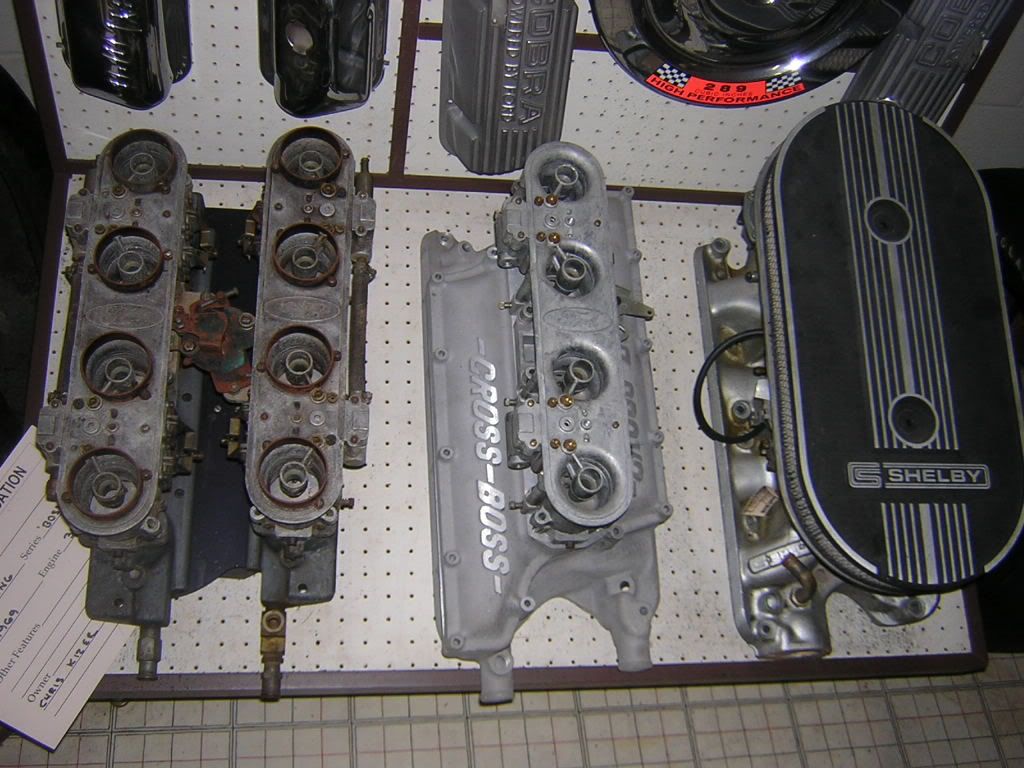
Left: Bud Moore intake with dual D0XZ-9510-B 1450cfm each
Center: NOS Crossboss with a NOS D0XZ-9510-A 875cfm
Right: NOS Boss 302 2x4 with 600cfm carbs - Shelby script where all others Ive seen are COBRA. I was told it could be a prototype for the handful of 69 Shelbys that were scheduled to get a Boss 302 engine
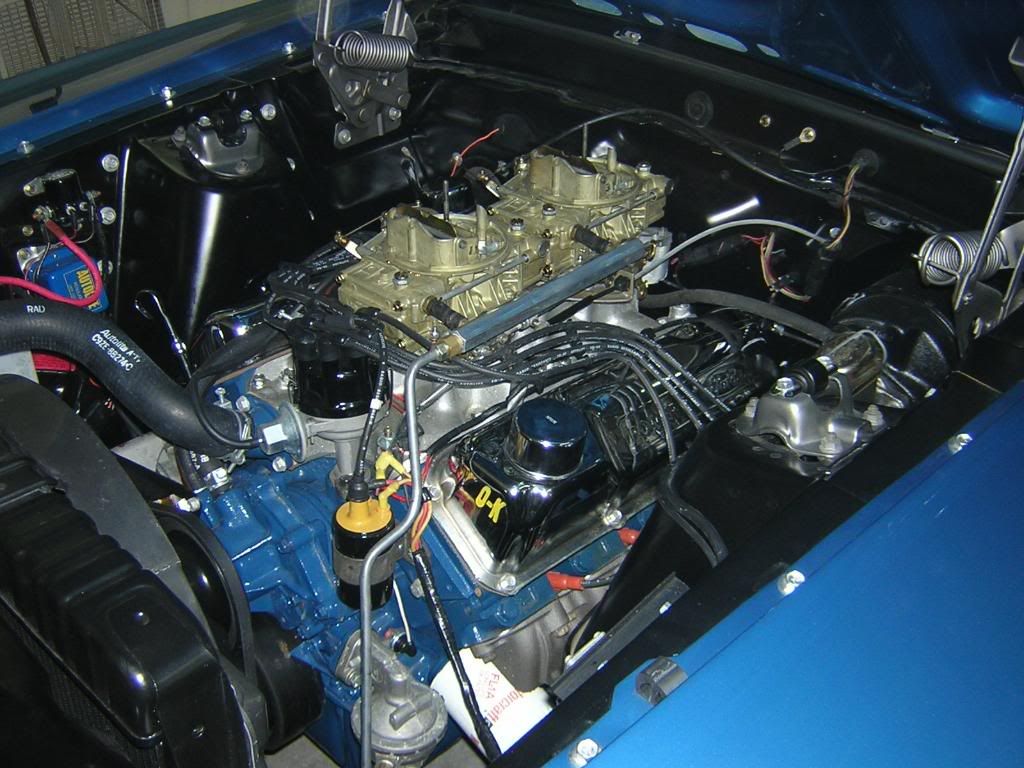
Its "used" now
Freshman User
Joined: Oct 2008
Posts: 28
Likes: 0
Very nice post wireflight and your right so many people over look the details and focus on just a number that's written on paper that number really ain't worth a damn if the motor don't perform and that's what its all about I am familar with kjets build from the 460ford.com forums and I'm quite aware that doves fully ported n prepped right will support 800+ hp I was making an assumption based on the term stock heads meaning no port work or valve work and I hope he hasn't been discouraged and put off on his quest to build a killer bbf. Hopefully he comes back and we can fully help him get on track and get his motor built