


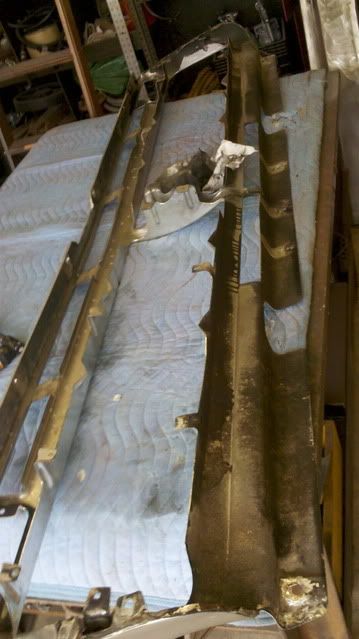
Factory undercoating ?


Ford Parts Specialist
Joined: Nov 2006
Posts: 88,826
Likes: 785
From: Simi Valley, CA

New trucks are awesome to me (66 year old geezer, whose 'so-so' mechanical skills ended when "Arthur" arrived). But...
May not be awesome to a 30 something year old that has vast mechanical skills and can fix just about anything on old rolling piles of misery.
I'm assuming that's about what you age is, since we've met.
May not be awesome to a 30 something year old that has vast mechanical skills and can fix just about anything on old rolling piles of misery.
I'm assuming that's about what you age is, since we've met.

Post Fiend
Joined: Jan 2006
Posts: 5,037
Likes: 9
From: Kasson, Minnesota
And hey, some signs are thicker than aftermarket sheetmetal.


Lead Driver
Joined: May 2007
Posts: 6,993
Likes: 15
From: Costa Mesa, CA
New trucks are awesome to me (66 year old geezer, whose 'so-so' mechanical skills ended when "Arthur" arrived). But...
May not be awesome to a 30 something year old that has vast mechanical skills and can fix just about anything on old rolling piles of misery.
I'm assuming that's about what you age is, since we've met.
May not be awesome to a 30 something year old that has vast mechanical skills and can fix just about anything on old rolling piles of misery.
I'm assuming that's about what you age is, since we've met.
And you were pretty dang close on the age Bill - I turned 31 in February.
That's why I've rhino lined the floor (inside and underside) of the cab and the entire underside and inside of my bed. I've also cut out the inner rear wheel braces and made my own out of angle iron for support so nothing gets trapped in the wheel wells. I also had the inside of the bed sides rhino lined. The sprayer couldn't get everything, but under the rhino lining is some chassis saver paint. Maybe I'll regret doing all of that and something will come up and rust more than ever. But right now it works and looks good.
And hey, some signs are thicker than aftermarket sheetmetal.
And hey, some signs are thicker than aftermarket sheetmetal.
Ford Parts Specialist
Joined: Nov 2006
Posts: 88,826
Likes: 785
From: Simi Valley, CA
I get a few of the creature comforts that come in new cars trucks, but not many of them. Add in the fact that it takes a computer to work on half of the new BS and I am turned off.
I like the old trucks you can fix on the side of the road with a screwdriver and 2 wrenches. These trucks stopped being built in 1979.
I like the old trucks you can fix on the side of the road with a screwdriver and 2 wrenches. These trucks stopped being built in 1979.
Prior to 1980, you can look up every fuel and emission related part in parts catalogs as EZ as pie, lotsa luck doing this jazz beginning in 1980.
EVERYTHING emission related (includes computers and other related electronic crap) and some fuel related parts has to be looked up in Calibration Code parts lists, and...
While there are application charts for each specific year vehicle, there could be as many as THIRTY calibration parts lists for each specific year vehicle with one specific engine and et cetera...I kid you not!
1980/89 light truck parts catalog has over 800 of these fracatta calibration code parts lists, the 1980/88 car parts catalog has over 600.
I used to fix all my old piles, and besides the 80 something Ford products I've owned, add 60 Packards to the list of the 331 + piles of misery I've owned since 1956.
I'd pay real money to watch you try 'n fix a 1955/56 Packard w/Ulcer-Matic and/or with Torsion Level suspension...even if you have the shop manual and a factory rep was standing by.
These cars were complicated mechanical terds, that even the factory couldn't fix.

Lead Driver
Joined: May 2007
Posts: 6,993
Likes: 15
From: Costa Mesa, CA
Fixed it for ya, and the same applies to passenger cars.
Prior to 1980, you can look up every fuel and emission related part in parts catalogs as EZ as pie, lotsa luck doing this jazz beginning in 1980.
EVERYTHING emission related (includes computers and other related electronic crap) and some fuel related parts has to be looked up in Calibration Code parts lists, and...
While there are application charts for each specific year vehicle, there could be as many as THIRTY calibration parts lists for each specific year vehicle with one specific engine and et cetera...I kid you not!
1980/89 light truck parts catalog has over 800 of these fracatta calibration code parts lists, the 1980/88 car parts catalog has over 600.
I used to fix all my old piles, and besides the 80 something Ford products I've owned, add 60 Packards to the list of the 331 + piles of misery I've owned since 1956.
I'd pay real money to watch you try 'n fix a 1955/56 Packard w/Ulcer-Matic and/or with Torsion Level suspension...even if you have the shop manual and a factory rep was standing by.
These cars were complicated mechanical terds, that even the factory couldn't fix.
Prior to 1980, you can look up every fuel and emission related part in parts catalogs as EZ as pie, lotsa luck doing this jazz beginning in 1980.
EVERYTHING emission related (includes computers and other related electronic crap) and some fuel related parts has to be looked up in Calibration Code parts lists, and...
While there are application charts for each specific year vehicle, there could be as many as THIRTY calibration parts lists for each specific year vehicle with one specific engine and et cetera...I kid you not!
1980/89 light truck parts catalog has over 800 of these fracatta calibration code parts lists, the 1980/88 car parts catalog has over 600.
I used to fix all my old piles, and besides the 80 something Ford products I've owned, add 60 Packards to the list of the 331 + piles of misery I've owned since 1956.
I'd pay real money to watch you try 'n fix a 1955/56 Packard w/Ulcer-Matic and/or with Torsion Level suspension...even if you have the shop manual and a factory rep was standing by.
These cars were complicated mechanical terds, that even the factory couldn't fix.
 and 2 - I'll be the 1st to admit I'm a fabricator - NOT a mechanic.
BUT, these trucks are so simple a monkey with a wrench could fix them so I can too. The simplicity of them is a big part of the reason I love them. The fact that Ford never did the same thing twice and had 392 different frames, 1,236 different engines and did all sorts of weir things on 1-2 trucks only is a big reason I don't

Thread
Thread Starter
Forum
Replies
Last Post







