


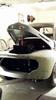

Very cool scale car

Thread Starter
|
Postmaster
Joined: Mar 2008
Posts: 3,593
Likes: 2
From: Prairieville, La

Very cool scale car
Hey guys, gals, and some in between,
I do not really post in here, but I am a voyeur.
I like the trucks and craftsmanship you all have. I thought you may like this little car I found on craigslist the other day.
1936 ford coupee mini replica
I do not really post in here, but I am a voyeur.
I like the trucks and craftsmanship you all have. I thought you may like this little car I found on craigslist the other day.
1936 ford coupee mini replica

Fleet Owner


Joined: Jul 2004
Posts: 27,294
Likes: 1,055
From: NM
I'm curious how he modified the Toy diff to work on a chain-drive engine? I'd like to build a car like that but that is one of the many hang-ups. Now many rear-drive cars in that size. Servicar diff's are rare and not that strong.
Fleet Mechanic

Joined: Apr 2008
Posts: 1,373
Likes: 6
From: Moore (or less), OK.
It looks like the engine is mounted parallel with the frame instead of perpendicular to it. There is probably a flange machined that converts from the sprocket to a drive shaft coupling.
I had a Mercedes that used large rubber discs instead of u-joints and I imagine some thing like that could be modified or adapted to eliminate a lot of the vibration in the drive line and facilitate the connection.
I had a Mercedes that used large rubber discs instead of u-joints and I imagine some thing like that could be modified or adapted to eliminate a lot of the vibration in the drive line and facilitate the connection.
Thread Starter
|
Postmaster
Joined: Mar 2008
Posts: 3,593
Likes: 2
From: Prairieville, La
Is a ninja chain driven? I am not sure about the crotch rockets, but my VTX and some Yamahas are shaft driven.
Trending Topics
Fleet Mechanic
Joined: Apr 2008
Posts: 1,373
Likes: 6
From: Moore (or less), OK.
FTE Stories
Ford Trucks for Ford Truck Enthusiasts

Rezvani's Latest Post-Apocalytic Monster Is a Ford F-150 Raptor Underneath
Verdad Gallardo
Top 10 Most Expensive Ford Trucks Ever Sold on Bring a Trailer
Joe Kucinski
2027 Ford Super Duty Buyer's Guide (Every Model, Engine, & Package)
Brett Foote
Top 10 Ford Truck Tragedies
Joe Kucinski
AEV FXL Super Duty - the Super Duty Raptor Ford Doesn't Make
Brett Foote
Lobo Vs Lobo: Proof the F-150 Lobo Should Be Even Lower!
Michael S. Palmer
Ford's 2001 Explorer Sportsman Concept Looks For a New Home
Verdad Gallardo
10 Best Ford Truck Engines We Miss the Most!
Joe Kucinski
2026 Shelby F-150 Off-Road: Better Than a Raptor R?
Brett Foote
Ford Parts Specialist
Joined: Nov 2006
Posts: 88,826
Likes: 785
From: Simi Valley, CA

Hey guys, gals, and some in between,
I do not really post in here, but I am a voyeur.
I like the trucks and craftsmanship you all have. I thought you may like this little car I found on craigslist the other day.
1936 ford coupee mini replica
I do not really post in here, but I am a voyeur.
I like the trucks and craftsmanship you all have. I thought you may like this little car I found on craigslist the other day.
1936 ford coupee mini replica
It's not a Coupe' (pronounced coo-pay, coops are for chickens!) ... where's the roof? This is an example of what hot rodders did to 1928/31 Model A's or Deuce Roadsters.


Lead Driver


Joined: Dec 2000
Posts: 6,293
Likes: 47
From: South central, Minnesota
That's just a "modified" legends race car. Nothing 36 Ford Coupe about it. And the only good use for a sbc is on a the end of a chain. With the other end connected to a boat, as in an anchor!
And the only good use for a sbc is on a the end of a chain. With the other end connected to a boat, as in an anchor!

Roast em' if you got 'em
Joined: Mar 2005
Posts: 21,997
Likes: 9,885
From: Rio Rancho, NM
My guess is its a modified Legends car. I had a buddy racing these for awhile. I guess its a fairly inexpensive way to get into racing. Everytime he came into the pits I kept waiting for all the clowns to start getting out of it
Legends Information
Bobby
LOL...looks like fordman75 and I were posting at the same time
Legends Information
Bobby
LOL...looks like fordman75 and I were posting at the same time
Fleet Owner
Joined: Jul 2004
Posts: 27,294
Likes: 1,055
From: NM
It looks like the engine is mounted parallel with the frame instead of perpendicular to it. There is probably a flange machined that converts from the sprocket to a drive shaft coupling.
I had a Mercedes that used large rubber discs instead of u-joints and I imagine some thing like that could be modified or adapted to eliminate a lot of the vibration in the drive line and facilitate the connection.
I had a Mercedes that used large rubber discs instead of u-joints and I imagine some thing like that could be modified or adapted to eliminate a lot of the vibration in the drive line and facilitate the connection.
Senior User
Joined: Oct 2003
Posts: 291
Likes: 0
From: Oregon

Thread
Thread Starter
Forum
Replies
Last Post
jason867
Indiana Chapter
0
Jun 19, 2008 02:37 PM
wreckhaul
Manitoba / Saskatchewan Chapter
76
Nov 6, 2007 09:29 PM
78sharpshooter
1987 - 1996 F150 & Larger F-Series Trucks
15
Jun 11, 2007 09:33 PM
