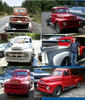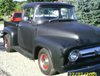


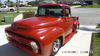

Introducing myself

Hotshot


Joined: Oct 2004
Posts: 15,882
Likes: 88
From: Durham NC
The cabs on the F1 and F3 are identical only the fenders are different (bigger wheel openings) so you have a primary and parts truck or two project trucks! Congrats and welcome!
You left coasters don't know what rust is, just ask a NE enthusiast about rust.
You left coasters don't know what rust is, just ask a NE enthusiast about rust.

Thread Starter
|
Cross-Country

Joined: Dec 2010
Posts: 88
Likes: 1
From: Central Valley, CA
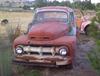
Thanks for the welcome everyone. AXracer thanks you saved me some research on the F3 parts I an only buying the F3 if I can get it for the right price and my finances agree LOL
Lead Driver
Joined: Dec 2004
Posts: 7,669
Likes: 13
From: San Jose, CA
Welcome to the forum. Looks like you have a good starting point.
Let me correct AXRacer. The F3 is a heavy duty 3/4 ton, while the F1 is a 1/2 ton. Not only do the fenders have a wider wheel opening on the F3, the bed is also completely different on the F3 than on the F1. The F2/F3 beds are wider and longer than F1 beds. Thus, none of the bed parts, including the fenders and tailgate, as well as the entire bed, will interchange with the F1. The frame is also longer on the F3 than on the F1, and the rear ends are different. Moreover, the running boards are longer on the F3 than on the F1. The wheels and hubs are also 6 or 8 lug.
So, the only parts you'll be able to use from the F3 on the F1 are the cab, grille, hood, lower gravel pan, upper latch panel, and front suspension (without the hubs) and steering.
If you can get the F3 for a couple of hundred $$, then do it. You'll be able to part it out on the internet to fund your F1 project.
Lastly, the spare bed and fenders are from a 51/52 F1. The bed, fenders and tailgate are slightly different between the 48-50 and 51-52 model group years. Next time you're at the truck, take a look at the beds closely. You'll spot the differences. 48-50 F1 beds had curved stake pockets and a stamped in design in the bedsides. The tailgate also had the latch through the top roll. To accomodate for the raised bedsides, the rear fenders were notched on the backside to follow the contour of the bedsides. Sometime in mid-50, Ford changed the truck design. Starting in 1951, the beds had square stake pockets, flat bedsides and the tailgate latch was positioned below the top roll on the tailgate. Since the countour on the bedsides was eliminated for the 1951 production, the fenders were now flat on the backside (and not notched like in 1948-50).
We encourage you to ask questions. There's a lot to learn about these trucks and the subtle differences. We're still coming up with new information and differences. Before you rush out to buy another truck or parts for your project, do the research and ask questions here. This will save you a lot of time and money.
The most important thing is to have fun with your project and build the truck the way you want.
Let me correct AXRacer. The F3 is a heavy duty 3/4 ton, while the F1 is a 1/2 ton. Not only do the fenders have a wider wheel opening on the F3, the bed is also completely different on the F3 than on the F1. The F2/F3 beds are wider and longer than F1 beds. Thus, none of the bed parts, including the fenders and tailgate, as well as the entire bed, will interchange with the F1. The frame is also longer on the F3 than on the F1, and the rear ends are different. Moreover, the running boards are longer on the F3 than on the F1. The wheels and hubs are also 6 or 8 lug.
So, the only parts you'll be able to use from the F3 on the F1 are the cab, grille, hood, lower gravel pan, upper latch panel, and front suspension (without the hubs) and steering.
If you can get the F3 for a couple of hundred $$, then do it. You'll be able to part it out on the internet to fund your F1 project.
Lastly, the spare bed and fenders are from a 51/52 F1. The bed, fenders and tailgate are slightly different between the 48-50 and 51-52 model group years. Next time you're at the truck, take a look at the beds closely. You'll spot the differences. 48-50 F1 beds had curved stake pockets and a stamped in design in the bedsides. The tailgate also had the latch through the top roll. To accomodate for the raised bedsides, the rear fenders were notched on the backside to follow the contour of the bedsides. Sometime in mid-50, Ford changed the truck design. Starting in 1951, the beds had square stake pockets, flat bedsides and the tailgate latch was positioned below the top roll on the tailgate. Since the countour on the bedsides was eliminated for the 1951 production, the fenders were now flat on the backside (and not notched like in 1948-50).
We encourage you to ask questions. There's a lot to learn about these trucks and the subtle differences. We're still coming up with new information and differences. Before you rush out to buy another truck or parts for your project, do the research and ask questions here. This will save you a lot of time and money.
The most important thing is to have fun with your project and build the truck the way you want.
Thread Starter
|
Cross-Country
Joined: Dec 2010
Posts: 88
Likes: 1
From: Central Valley, CA
51panelman very interesting, I will hopefully get the truck here in the next week or so after getting the tires home I found out that even though they are pretty weathered the tubes were protected well enough so they will hold air to get the truck on and off the trailer. The OE bed has a steel floor and the extra one had a wood floor which is why he bought it. didnt some of the later 1950 trucks come with the wood floors, I prefer that style and the bed will end up with that floor either way correct or not. Waiting to get truck home to get a really good look at it and start asking questions LOL
Fleet Mechanic
Joined: Aug 2010
Posts: 1,994
Likes: 3
From: Morgan Hill, CA

FTE Stories
Ford Trucks for Ford Truck Enthusiasts

Top 6 Best Deals Available on New Fords & Lincolns Right Now
Brett Foote
This Hennessey Takes the Expedition Tremor's Off-Roading Capability to the Next Level
Verdad Gallardo
Top 10 Fords at 2026 Carlisle Ford Nationals
Joe Kucinski
3 Best / 3 Worst Parts of Modern Ford Ownership
Brett Foote
10 Amazing Upgrades That Solve Common Ford Truck Owner Headaches
Pouria Savadkouei
Every 2026 Ford Engine Explained
Brett Foote
10 Ugly Ford Trucks That We Still Kinda Love
Joe Kucinski
10 Things Every Truck Owner NEEDS (2026 Edition)
Michael S. Palmer
Rezvani's Latest Post-Apocalyptic Monster Is a Ford F-150 Raptor Underneath
Verdad Gallardo

Posting Guru
Joined: Jul 2006
Posts: 1,276
Likes: 0
From: Westminster,Md
Welcome tazcliff! A yard clean-up is a small price to pay for the truck...
You would probably be asked to clean it up later anyhow..so you may be ahead of the game...Good Luck! And have some fun!
You would probably be asked to clean it up later anyhow..so you may be ahead of the game...Good Luck! And have some fun!