


351 for towing?

Thread Starter
|
Junior User
Joined: Oct 2010
Posts: 60
Likes: 0
351 for towing?
I'm looking at a 1997 f250 with a 351. I don't know the gear ratio.
When I googled it there was a tow capacity of anywhere from 6k to 10k lbs. Anyone using a similar truck that can tell me realistic towing capacity? I'm not looking to tow everyday, but I don't want to run something into the ground. When I do tow it will usually be between 5k and 8k.
Also- if anyone knows of any popular issues to look out for, please feel free to let me know. I'm unfamiliar with Ford's gas engines.
Thanks!
When I googled it there was a tow capacity of anywhere from 6k to 10k lbs. Anyone using a similar truck that can tell me realistic towing capacity? I'm not looking to tow everyday, but I don't want to run something into the ground. When I do tow it will usually be between 5k and 8k.
Also- if anyone knows of any popular issues to look out for, please feel free to let me know. I'm unfamiliar with Ford's gas engines.
Thanks!
Hotshot


Joined: Jul 2002
Posts: 14,285
Likes: 12
From: Bend,OR
Where do you live? and what is it that you would be towing that weights 8k?
A diesal will always make a better tow vehicle, get better mileage doing it and last far longer being worked in such a manner.
A diesal will always make a better tow vehicle, get better mileage doing it and last far longer being worked in such a manner.

Senior User
Joined: Sep 2010
Posts: 107
Likes: 0
From: Phoenix, AZ
Here is an old "Rule of Thumb" that I have used for decades, and it is still useful today with regard to towing capacities:
Multiply the engine CID by 30 to get the maximum GCVW (gross combined weight) if you are towing in mountainous terrain. If you are primarily towing on flat land, or have an F250 or above, then you can go to 35 times the CID of the engine. This assumes the use of a weight distributing hitch.
With your example, I would look at about 10,500# to 12,000# gross combined weight.
I hope this helps.
Multiply the engine CID by 30 to get the maximum GCVW (gross combined weight) if you are towing in mountainous terrain. If you are primarily towing on flat land, or have an F250 or above, then you can go to 35 times the CID of the engine. This assumes the use of a weight distributing hitch.
With your example, I would look at about 10,500# to 12,000# gross combined weight.
I hope this helps.
Thread Starter
|
Junior User
Joined: Oct 2010
Posts: 60
Likes: 0
kemicalburns... I know a deisel is a better tower- i have a 7.3L f350 now. I want to downsize and go to a gas engine for multiple reasons, Including that I don't use the truck for long distances when i do use it and it's not worth putting a deisel through it. Also, i have a mechanic friend who always helps me out with my other cars, but he doesn't 'do' deisels. So a gas engine would be cost effective for me to maintain.
AZ bill- so an f250 standard cab long bed has a curb weight of about 5K? (I think?) That would leave me with between 5k and 7k towing depending on terrain,etc.
Hmmmm....seems like dinky stuff for an f250.
Maybe I'm spoiled being able to hook up to anything and just go with my 7.3L.
AZ bill- so an f250 standard cab long bed has a curb weight of about 5K? (I think?) That would leave me with between 5k and 7k towing depending on terrain,etc.
Hmmmm....seems like dinky stuff for an f250.
Maybe I'm spoiled being able to hook up to anything and just go with my 7.3L.
Hotshot
Joined: Jul 2002
Posts: 14,285
Likes: 12
From: Bend,OR
have you taken the 97 for a test drive yet. how many miles are on it? might consider having the ford dealership look it over. an hours worth of shop labor could save you from a vehicle with problems.
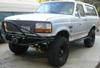
I tow a 5500lb rv trailer with my bronco, it does fine and gets 8-10mpg regardless of flat or hilly terrain. the F250 would do a better job being longer and probably stock. my bronco is not and thats hindering its towing ability.
I tow a 5500lb rv trailer with my bronco, it does fine and gets 8-10mpg regardless of flat or hilly terrain. the F250 would do a better job being longer and probably stock. my bronco is not and thats hindering its towing ability.
Senior User
Joined: Sep 2010
Posts: 107
Likes: 0
From: Phoenix, AZ
02f350gurl:
That 30 to 35 pounds per cubic inch rule of thumb is fairly generic, and based on basic factors that the tow vehicle is completely stock, without an auxillary transmission cooler, and not properly geared for towing. Now, if you add a transmission cooler (HIGHLY recommended), and are more or less geared for towing (like most f250s), you could go to 40 pounds per cubic inch, or 14,000#. Again, I prefer to error on the conservative side when towing, especially if in mountainous terrain, but I have towed a GCWR of around 13,000# with a 351W in an F250 set up to tow, and I had no problems with major mountain passes (Siskiyou Summit northbound in Oregon is a good example; 6% upgrade for 6-7 miles, followed by 6% downgrade for 6-7 miles).
The two big things this rule of thumb was based upon were more or less the engines at the time this formula was developed (1970s), and the then standard braking system that STILL used drum brakes on all four corners. Today, you have much better disc brakes up front or at all four corners. Even though this is a vast improvement, I still feel that the one factor that this formula addresses, engine torque output based on engine displacement, has not improved over the years; in fact, I see the torque curves of many newer overhead cam gas engines being WORSE than the earlier pushrod engines.
In case you are wondering, this formula was developed by people that I knew that were at the time working for a major RV magazine publisher, who were doing the research for this formula as part of performance reviews of various tow vehicles at the time. At the time, I was a young pup of 10, and thought that if they could make it a simple rule like I have stated, it would be easy for most people to use and understand.
I hope this clears up any questions you may have.
Bill
That 30 to 35 pounds per cubic inch rule of thumb is fairly generic, and based on basic factors that the tow vehicle is completely stock, without an auxillary transmission cooler, and not properly geared for towing. Now, if you add a transmission cooler (HIGHLY recommended), and are more or less geared for towing (like most f250s), you could go to 40 pounds per cubic inch, or 14,000#. Again, I prefer to error on the conservative side when towing, especially if in mountainous terrain, but I have towed a GCWR of around 13,000# with a 351W in an F250 set up to tow, and I had no problems with major mountain passes (Siskiyou Summit northbound in Oregon is a good example; 6% upgrade for 6-7 miles, followed by 6% downgrade for 6-7 miles).
The two big things this rule of thumb was based upon were more or less the engines at the time this formula was developed (1970s), and the then standard braking system that STILL used drum brakes on all four corners. Today, you have much better disc brakes up front or at all four corners. Even though this is a vast improvement, I still feel that the one factor that this formula addresses, engine torque output based on engine displacement, has not improved over the years; in fact, I see the torque curves of many newer overhead cam gas engines being WORSE than the earlier pushrod engines.
In case you are wondering, this formula was developed by people that I knew that were at the time working for a major RV magazine publisher, who were doing the research for this formula as part of performance reviews of various tow vehicles at the time. At the time, I was a young pup of 10, and thought that if they could make it a simple rule like I have stated, it would be easy for most people to use and understand.
I hope this clears up any questions you may have.
Bill

Senior User
Joined: Aug 2009
Posts: 236
Likes: 1
the chassiz/brakes will handle that much of a load behind it without breaking a sweat. I've pulled upwards of 25000 lbs behind an F250. (diesel)
The 351 will be slow and/or hard on gas pulling 8k but it'll do it. fwiw.
A lot of the 351 trucks especially later on with the E4OD have 4:10 gear ratio. I even have one in my yard thats a 4:10 with a C6 trans. I could only imagine how bad on gas driving that one on the road towing something would be.
The 351 will be slow and/or hard on gas pulling 8k but it'll do it. fwiw.
A lot of the 351 trucks especially later on with the E4OD have 4:10 gear ratio. I even have one in my yard thats a 4:10 with a C6 trans. I could only imagine how bad on gas driving that one on the road towing something would be.
Trending Topics

Lead Driver


Joined: Dec 2000
Posts: 6,298
Likes: 47
From: South central, Minnesota
A 351W will handle towing 8K without a problem. I use to have a light duty F250 with a 5.0L and I towed 10K pounds multiple times with it. It didn't like big hills but it pulled it. Right now I've got a 96 E250 with a 5.8L and it handles 8K pounds without even working hard. I had a 91 E350 with a 5.8L a few years back and it hauled 14K pounds without any issues.
FTE Stories
Ford Trucks for Ford Truck Enthusiasts

Top 6 Best Deals Available on New Fords & Lincolns Right Now
Brett Foote
This Hennessey Takes the Expedition Tremor's Off-Roading Capability to the Next Level
Verdad Gallardo
Top 10 Fords at 2026 Carlisle Ford Nationals
Joe Kucinski
3 Best / 3 Worst Parts of Modern Ford Ownership
Brett Foote
10 Amazing Upgrades That Solve Common Ford Truck Owner Headaches
Pouria Savadkouei
Every 2026 Ford Engine Explained
Brett Foote
10 Ugly Ford Trucks That We Still Kinda Love
Joe Kucinski
10 Things Every Truck Owner NEEDS (2026 Edition)
Michael S. Palmer
Rezvani's Latest Post-Apocalyptic Monster Is a Ford F-150 Raptor Underneath
Verdad Gallardo
Posting Guru
Joined: Oct 2001
Posts: 1,777
Likes: 0
From: Culpeper, Virginia
To the OP, I run a 351w with 4.10 gears, pulling about the same loads you do. Mostly near 6.5k but close enough. It will pull it fine, won't pull as good as the diesel, but it's get the job done.
I just redid the exhaust and it made a huge difference, poke around it really helps the 351 motor to get a free flowing exhuast. The 4.10's help too.
Mine came as you said, E4OD and 4.10's. Truthfully if you calculate it out, it costs virtually no more to run 87 octane verse dizzle pulling the same load. Maybe a few bucks more for the traveled distance, but it's not like a dizzle is knocking back 20mpg while the gasser is knocking back 5mpg.
On a recent 4 wheeling trip, my buddy pulling with a 02' 7.3 got right around 13mpg for the trip.
I got right at 10mpg. Our Jeeps are identical, trailers are same, trucks are close enough. I used just about $13 more in fuel.
Just sayin', at times a part time puller can be gas and still be fine on the pocket book. If I pulled heavy or more often, I'd go back to a dizzel. Sometimes I even miss the smell..........
I just redid the exhaust and it made a huge difference, poke around it really helps the 351 motor to get a free flowing exhuast. The 4.10's help too.
On a recent 4 wheeling trip, my buddy pulling with a 02' 7.3 got right around 13mpg for the trip.
I got right at 10mpg. Our Jeeps are identical, trailers are same, trucks are close enough. I used just about $13 more in fuel.
Just sayin', at times a part time puller can be gas and still be fine on the pocket book. If I pulled heavy or more often, I'd go back to a dizzel. Sometimes I even miss the smell..........
Senior User
Joined: Aug 2009
Posts: 236
Likes: 1
To the OP, I run a 351w with 4.10 gears, pulling about the same loads you do. Mostly near 6.5k but close enough. It will pull it fine, won't pull as good as the diesel, but it's get the job done.
I just redid the exhaust and it made a huge difference, poke around it really helps the 351 motor to get a free flowing exhuast. The 4.10's help too.
Mine came as you said, E4OD and 4.10's. Truthfully if you calculate it out, it costs virtually no more to run 87 octane verse dizzle pulling the same load. Maybe a few bucks more for the traveled distance, but it's not like a dizzle is knocking back 20mpg while the gasser is knocking back 5mpg.
On a recent 4 wheeling trip, my buddy pulling with a 02' 7.3 got right around 13mpg for the trip.
I got right at 10mpg. Our Jeeps are identical, trailers are same, trucks are close enough. I used just about $13 more in fuel.
Just sayin', at times a part time puller can be gas and still be fine on the pocket book. If I pulled heavy or more often, I'd go back to a dizzel. Sometimes I even miss the smell..........
I just redid the exhaust and it made a huge difference, poke around it really helps the 351 motor to get a free flowing exhuast. The 4.10's help too.
Mine came as you said, E4OD and 4.10's. Truthfully if you calculate it out, it costs virtually no more to run 87 octane verse dizzle pulling the same load. Maybe a few bucks more for the traveled distance, but it's not like a dizzle is knocking back 20mpg while the gasser is knocking back 5mpg.
On a recent 4 wheeling trip, my buddy pulling with a 02' 7.3 got right around 13mpg for the trip.
I got right at 10mpg. Our Jeeps are identical, trailers are same, trucks are close enough. I used just about $13 more in fuel.
Just sayin', at times a part time puller can be gas and still be fine on the pocket book. If I pulled heavy or more often, I'd go back to a dizzel. Sometimes I even miss the smell..........
I'm a proponent for this philosophy as well. I had the diesel, it towed awesome, but for moderate loads like the OP is going to be pulling, they dont shine that much over the gassers. Little more power, and little better fuel economy, but that can come at a big price. I only have gasser's now, and unless i start towing a whole lot more, and more weight, I wont own them diesels again.
I liked them but, right truck for the right purpose.

Thread
Thread Starter
Forum
Replies
Last Post
eseec
1980 - 1986 Bullnose F100, F150 & Larger F-Series Trucks
59
Jul 25, 2012 09:55 AM
applied
1968-Present E-Series Van/Cutaway/Chassis
22
Oct 29, 2006 09:55 AM
