
The End is Coming for the American V8, But Ford’s Performance Future Remains Bright
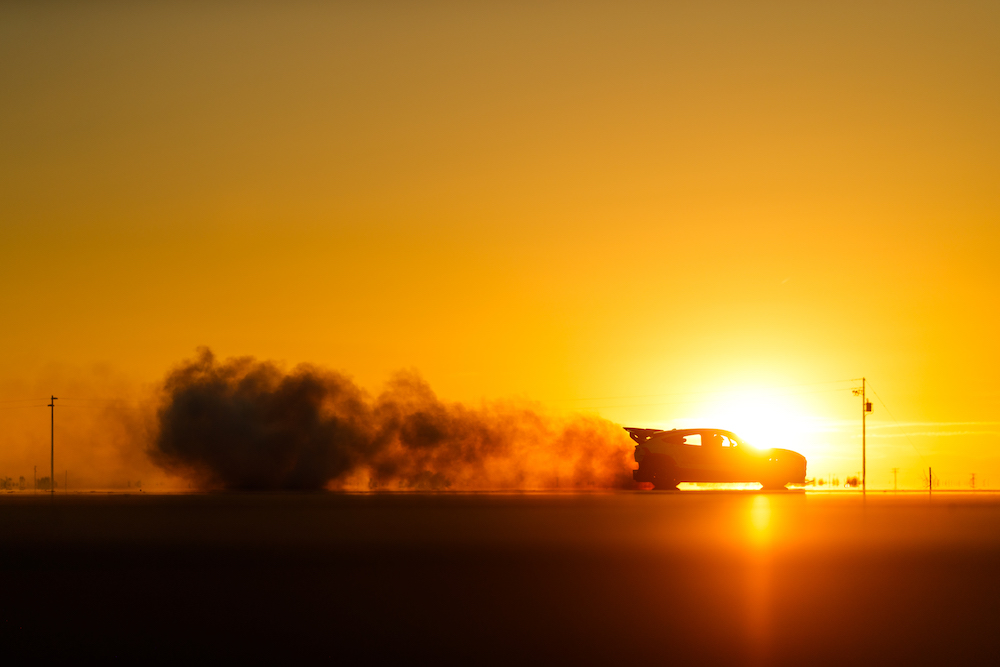
Emissions laws curbed the Muscle Car era, but Ford trucks and Mustangs show no signs of slowing in an all-electric future.
As an ’80s kid, we looked at the halcyon days of the 1960s as the pinnacle of American Performance. Between the rise of the pony car and a then-new trend of off-roading in “sport utility vehicles,” American cars and trucks — Mustangs and Broncos especially — were faster and more stylish than ever before.
Then emissions laws and a global energy crisis ruined all the fun.
Smog abated, acid rain fell no more, and the Ozone Layer started to heal. But Ford’s performance specs took two to three decades to fully recover. Computerized fuel-mapping, cutting-edge catalytic converters, and decades of aerodynamic, handling, and braking advancements ushered us into an unparalleled performance era.

By becoming more EFFICIENT, Ford trucks and Mustangs also became more POWERFUL.
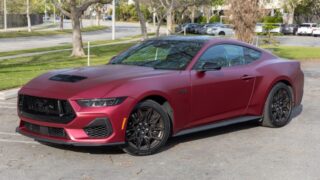
Sure, Ford designers still chase nostalgic cues, but everything else has improved. We live in a time where base Mustangs and Camaros out-perform ’60s muscle cars. Where you can buy a Ford Super Duty with 1,050 ft.-lbs. of torque or a Mustang with 760 hp right off the showroom floor. And where Ford will soon sell a Bronco with OEM 35″ tires and beadlock-capable wheels.
And modern Fords can actually turn and stop, and is more reliable and leagues safer than anything cooked up in the 1960s.
Progress is glorious.
But the End is Nigh

While we have plenty of — some argue way too many — fossil fuels to burn, emissions standards are rising again globally. And, with states like California threatening to ban gas-powered engine sales by 2035, what we currently define as the sights and sounds of America’s Sportscar is about to change.
Dramatically so.
But unlike 50 years ago, manufacturers are already pivoting. They will be ready for The End. Ford will soon release an all-electric Mustang-branded crossover and F-150. GM recently moved the Corvette design team under its EV division, promising an “all-electric future.” They also debuted a new plant to build an all-electric Hummer.
And this is just the beginning.
The Last Glorious Dying Breath of the American V8
My colleagues and I have talked to folks who work for the American auto manufacturers at length; you can watch one such conversation in the video above, which I hosted for RacingJunk.com’s No Shows No Problem virtual trade show about the industry’s future. (Todd Hoevener, Director, Tech Strategy & Advanced Product Creation, Ford Motor Company, attended and his comments are fascinating.)
Make no mistake, the V8 will remain the heart of our Ford trucks and Mustangs as long as it’s legally possible. Ford told me directly that they know how important the Coyote and Godzilla are to their core customer base. The Shelby GT500 Mustang has never been more powerful, and hopefully, we’ll see that power in the Raptor soon. GM often develops entire engine platforms for the Corvette before spreading the wealth. And Dodge stuffs Hellcats into, well, everything.
I personally love the V8 more than any engine type in history. I own three. The sound. The power curve. The feeling. Pushrods, dual-overhead cams, flat-plane cranks, hemispherical cylinder heads, you name the V8, and I ADORE it.
But we’re about to see the end of the V8 here in America.

Not today. Not next year or even this decade, mind you. There’s still time for one last generation or two of great American V8s.
But sooner than we’d all like, the V8 simply won’t be able to meet regulations. (Mr. Hoevener described this to me in the above video as “engineers running out of physics.”) Or perhaps it simply won’t remain economically feasible to make V8s for relatively low-volume sports cars if Ford isn’t ALSO selling hundreds of thousands of trucks and SUVs with a similar engine.
Think of it like this; the last American V8s may simply be handmade exotic variants for trims like Shelby.
The Apocalypse Ain’t All Bad

Pardon the tangent here, but while we most commonly use the word “apocalypse” — especially in entertainment — to warn against a great destructive event, the original Greek meaning translates closer to “The Great Revealing.”
In other words, unlike the 1970s, Ford performance isn’t going to wither and die as the industry transitions and evolves into an electric future. If Tesla’s Ludicrous Mode or Ford’s Mach-E or CobraJet 1400 projects are indicators, the future looks bright and bloody FAST.

In fact, the Ford trucks and Ford Mustangs will likely become more capable than ever. All-wheel drive acceleration. Instant torque. Less routine maintenance. Lower center of gravity. And radical design possibilities. (We’ll no longer have to worry whether or not a heavy engine will smash through a firewall and crush the driver’s legs during a collision.)
What I’m starting to see is that Ford’s future is simply going to reveal the company’s imagination and engineering capabilities. If the rise of the LS and modular V8s inspired shops and enthusiasts to pick up a laptop to learn tuning, imagine a future where folks learn to navigate high-voltage electrical systems so they can add more batteries.
Regardless, the future’s still going to be fun with buckets of torque on tap.
IF We Can Figure Out How to Make It All Work

Despite change hovering, perhaps ominously to some, on the horizon, it’s important to point out that this is going to be a relatively slow transition. When we see federal and state regulations changing, when we see manufacturers experimenting and pivoting, we’re mostly talking about NEW vehicle sales.
California may be able to ban gasoline-engine-vehicle sales in 2035, but that will still leave over a century of gasoline-powered Ford F-150s, Broncos, and Mustangs than need dino-juice. And no one’s going to ban used car sales.
Therefore, it’s going to take DECADES for most of the gasoline-powered cars and trucks to age out of service, leaving behind a smaller pool of collectible classics maintained by enthusiasts. Just like today. (The next decade may be a great time to snap up the greatest gas guzzlers of the 21st Century for your collection.) And, by the way, I’m not as well versed in the future of diesel engines, but suspect they will face a completely different timeline.
In other words, don’t panic.

We’re not flipping a light switch; we’re blowing up an air mattress… by hand… with a very small pump. This next evolution is going to be slow and gradual and will require MASSIVE improvements and societal advancements.
(And we’ll probably see more hybrids drivetrain options — like the PowerBoost — between now and the all-electric Ford future.)

For example, auto manufacturers need to increase battery range while decreasing mass and improving charging times. Then we need to expand our charging networks. Figure out recycling. And find a way to manage and harvest the rare materials required for batteries.
And then there’s public perception.
Range anxiety may be less of a problem for weekend toys, but it’s going to be a HUGE factor in convincing truck owners to buy an EV. They need to tow tons over mountains. Long haul. Run for hours at sites, and then drive home. Families want to drive and camp across the country. And it’s not just a rural versus urban debate, either. We need to figure out how to charge vehicles for people who don’t have a dedicated parking space.
2020 Already Showed Us the Future

Earlier this year I saw the future in Los Angeles and it was beautiful.
In a city known for endless gridlock and hazy days, the world came to a stop for a global pandemic. Amidst a health crisis and crushing economic plunge, an odd thing happened. The skies cleared. The city quieted. And Los Angeles set a record for spring days with clean air.
While an all-electric Ford can’t solve metropolitan traffic, we saw what a sprawling city of 15 million people would look like, sound like, and smell like if no one drove petrol-powered vehicles.
50 years ago, the world pivoted to defeat acid rain and smog. The costs were steep, and enthusiasts lost decades worth of Ford performance. Today, we face a similar, and perhaps larger, challenge. To clean our air and water and see if these changes slow or prevent cataclysmic global climate shifts.
But unlike the 1970s, we don’t need to cancel all the fun.
Photos: Ford Motor Company
Join the Ford Truck Enthusiasts forums now!

You must be logged in to post a comment.