


how meany km before oil change


Postmaster
Joined: Jun 2006
Posts: 2,647
Likes: 0
From: Fulltime RVer

Well I've been finding some UOA reports from people using a "bypass" filter showing surpassingly high ppm readings for wear metals ...if you use a "bypass" filter please post your UOAs!
Someday I'll do a comprehensive thread on UOA ...including the mechanics of how UOA is done ...and how UOA readings can be used to estimate engine wear and air filter performance ...but for now consider the picture below which depicts "Iron wear mass" entering the "crankcase oil mass" ...and the oil mass then circulating through a "full-flow" filter and through a "bypass" filter.
For the sake of using some numbers assume that for a 16 qt 7.3L each 50-mile interval traveled gives 10 passes through the "full-flow" filter and 1 pass through the "bypass" filter ...but for the time being I'm assuming the oil supply is only being cleaned by a standard FL-1995 "full-flow" filter.

The concentrations of wear metals measured by a UOA spectrometer have particle diameters less than 15 microns in size ...and typically 67% of these "micron size particles" have diameters less than 5 microns ...and 26% have diameters between 5 microns and 10 microns ...and 7% have diameters between 10 microns and 15 microns.
A "full-flow" oil filter can't actually filter these "micron size particles" in the conventional sense of having small enough pores in its media to block them ...because the filter would rapidly plug-up and go into its bypass mode giving no oil filtration at all ...and this "bypass condition" corresponds to the 0% Filtered ppm "red curve" in the graph below.
However for each pass through a "full-flow" oil filter a few of the "micron size particles" can either "stick" to the filter media or stick to larger size "debris" already on the filter media ...and if 0.2% stick for each pass through the filter ...then 2% of the Iron mass in the oil is filtered out over the course of each 50-mile interval traveled ...and that assumption is used for the 2% Filtered ppm "blue curve" in the graph below.
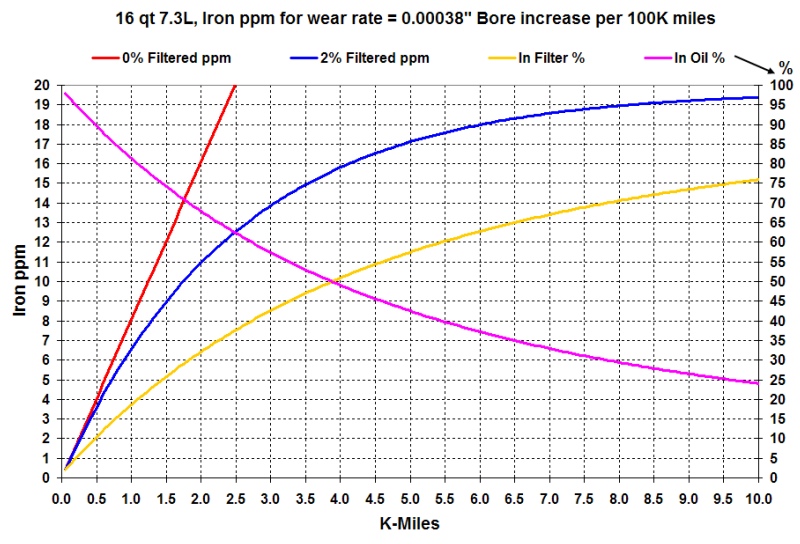
Here's an overview of some of the aspects of the analysis that I'm still refining by looking at 7.3L UOA reports done at various mileages ...in the above graph a higher wear rate combined with a higher flirtation efficiency ...or a lower wear rate combined with a lower flirtation efficiency are also possibilities for generating the "blue curve" in the graph.
Also the wear rate isn't constant versus miles traveled as I've assumed in the graph ...because as the concentrations of the various "abrasive particles" in the oil supply increase ...the wear rate also increases ...and this means the blue curve actually increases more at higher mileage than the one shown ...and this is why shorter OCIs produce less total wear!
The constant wear rate assumed in the above graph causes a uniform Bore increase of 0.00038" over the full length of the Stroke for each 100K miles traveled ...and this wear rate causes a total Iron mass of 11.3 u-lbm to be shed from the cylinder walls for each 50-mile interval traveled ...but the actual wear of the cylinder walls isn't uniform ...because the wear occurs mostly in the vicinity of TDC ...and a lesser amount in the vicinity of BDC ...and an even lesser amount in the mid-range portion of the Stroke!
Now here's how I can make a case for why "synthetic oil" might need to be changed more frequently than "conventional oil" ...especially if the switch to synthetic was made on a high-mileage engine! Synthetic oil has a more aggressive "detergent action" ...and this means that more wear causing "abrasive particles" remain suspended in the oil supply as opposed to sticking to the filter media and/or accumulating in nooks and crannies in the engine!
In the old days before detergent oil arrived on the scene you could pull the dipstick and find perfectly clean oil no matter how long it'd been since the last oil change ...in fact I think the old Cushman motor scooter didn't even have an oil filter ...it just let all the crud coat the inside of the engine where it presumably didn't do any harm ...because it didn't flow between the clearance spaces separating moving parts!
Someday I'll do a comprehensive thread on UOA ...including the mechanics of how UOA is done ...and how UOA readings can be used to estimate engine wear and air filter performance ...but for now consider the picture below which depicts "Iron wear mass" entering the "crankcase oil mass" ...and the oil mass then circulating through a "full-flow" filter and through a "bypass" filter.
For the sake of using some numbers assume that for a 16 qt 7.3L each 50-mile interval traveled gives 10 passes through the "full-flow" filter and 1 pass through the "bypass" filter ...but for the time being I'm assuming the oil supply is only being cleaned by a standard FL-1995 "full-flow" filter.
The concentrations of wear metals measured by a UOA spectrometer have particle diameters less than 15 microns in size ...and typically 67% of these "micron size particles" have diameters less than 5 microns ...and 26% have diameters between 5 microns and 10 microns ...and 7% have diameters between 10 microns and 15 microns.
A "full-flow" oil filter can't actually filter these "micron size particles" in the conventional sense of having small enough pores in its media to block them ...because the filter would rapidly plug-up and go into its bypass mode giving no oil filtration at all ...and this "bypass condition" corresponds to the 0% Filtered ppm "red curve" in the graph below.
However for each pass through a "full-flow" oil filter a few of the "micron size particles" can either "stick" to the filter media or stick to larger size "debris" already on the filter media ...and if 0.2% stick for each pass through the filter ...then 2% of the Iron mass in the oil is filtered out over the course of each 50-mile interval traveled ...and that assumption is used for the 2% Filtered ppm "blue curve" in the graph below.
Here's an overview of some of the aspects of the analysis that I'm still refining by looking at 7.3L UOA reports done at various mileages ...in the above graph a higher wear rate combined with a higher flirtation efficiency ...or a lower wear rate combined with a lower flirtation efficiency are also possibilities for generating the "blue curve" in the graph.
Also the wear rate isn't constant versus miles traveled as I've assumed in the graph ...because as the concentrations of the various "abrasive particles" in the oil supply increase ...the wear rate also increases ...and this means the blue curve actually increases more at higher mileage than the one shown ...and this is why shorter OCIs produce less total wear!
The constant wear rate assumed in the above graph causes a uniform Bore increase of 0.00038" over the full length of the Stroke for each 100K miles traveled ...and this wear rate causes a total Iron mass of 11.3 u-lbm to be shed from the cylinder walls for each 50-mile interval traveled ...but the actual wear of the cylinder walls isn't uniform ...because the wear occurs mostly in the vicinity of TDC ...and a lesser amount in the vicinity of BDC ...and an even lesser amount in the mid-range portion of the Stroke!
Now here's how I can make a case for why "synthetic oil" might need to be changed more frequently than "conventional oil" ...especially if the switch to synthetic was made on a high-mileage engine! Synthetic oil has a more aggressive "detergent action" ...and this means that more wear causing "abrasive particles" remain suspended in the oil supply as opposed to sticking to the filter media and/or accumulating in nooks and crannies in the engine!
In the old days before detergent oil arrived on the scene you could pull the dipstick and find perfectly clean oil no matter how long it'd been since the last oil change ...in fact I think the old Cushman motor scooter didn't even have an oil filter ...it just let all the crud coat the inside of the engine where it presumably didn't do any harm ...because it didn't flow between the clearance spaces separating moving parts!

Post Fiend
Joined: Mar 2007
Posts: 26,966
Likes: 50
From: Texas
Don't take too long Gene. I've never had a good grasp on those UOA's. I am expecting one back next week, but that's probably too soon for your thread, but I'll be happy to share it if you want conventional oil with just a FL 1995.
Postmaster
Joined: Jun 2006
Posts: 2,647
Likes: 0
From: Fulltime RVer
I need all the data I can get ...so just start a thread to discuss your UOA and send me a link ...or email me your UOA report ...and also be on the lookout for measurements of Bore wear on engines being rebuilt ...I'll bet that's the first thing that's measured by rebuilders to see if the block needs to be bored out to the next oversize!
Post Fiend
Joined: Mar 2007
Posts: 26,966
Likes: 50
From: Texas
Bore measurements will be a tougher one. I don't recall seeing too many threads with those in them. Most comment on how the cross hatching is still visible after x number of miles. The ones getting bored seem to mostly be .030, but I think that has to do more with what is available than what is needed.

Thread
Thread Starter
Forum
Replies
Last Post




