


Tow #'s help


Thread Starter
|
Freshman User
Joined: Mar 2013
Posts: 44
Likes: 0
From: Carlisle, PA
Tow #'s help
I posted this over in towing and it was suggested I post in the F150 forum since it is specific to them.
Looking at buying my first truck and need some help with Towing. We're planning to get an RV in a year or 2 and I want it to do it right the first time!
Looking at a 2011 F150 Supercrew Ecoboost with Max Tow. According to the Payload on the door jamb it's 1850 lbs and Ford says it can tow 11,200 lbs.
Now we've been looking at RV's for a few years now and like these:
Jayco 33RLDS
Jayco 26RKS
Lacrosse 323RST
Lacrosse 327RES
Prowler 30PRLS
Outback 316RL
All have gross weights between 8,400 lbs and 10,300 lbs. and about 30-36ft. I worked up a spreadsheet based on 10 and 15% tongue weight and it looks like at 10% we're good as we have 820 and 1010 payload left. At 15% it gets a lot closer and in some cases only 300 lbs.
Is this doable and with a Weight Distributing hitch would it make sense or should we be looking elsewhere?
Also the #'s I came up with on young weight are much different that the RV brochures. Is that normal?
Looking at buying my first truck and need some help with Towing. We're planning to get an RV in a year or 2 and I want it to do it right the first time!
Looking at a 2011 F150 Supercrew Ecoboost with Max Tow. According to the Payload on the door jamb it's 1850 lbs and Ford says it can tow 11,200 lbs.
Now we've been looking at RV's for a few years now and like these:
Jayco 33RLDS
Jayco 26RKS
Lacrosse 323RST
Lacrosse 327RES
Prowler 30PRLS
Outback 316RL
All have gross weights between 8,400 lbs and 10,300 lbs. and about 30-36ft. I worked up a spreadsheet based on 10 and 15% tongue weight and it looks like at 10% we're good as we have 820 and 1010 payload left. At 15% it gets a lot closer and in some cases only 300 lbs.
Is this doable and with a Weight Distributing hitch would it make sense or should we be looking elsewhere?
Also the #'s I came up with on young weight are much different that the RV brochures. Is that normal?

Senior User
Joined: Jun 2005
Posts: 332
Likes: 2
I posted this over in towing and it was suggested I post in the F150 forum since it is specific to them.
Looking at buying my first truck and need some help with Towing. We're planning to get an RV in a year or 2 and I want it to do it right the first time!
Looking at a 2011 F150 Supercrew Ecoboost with Max Tow. According to the Payload on the door jamb it's 1850 lbs and Ford says it can tow 11,200 lbs.
Now we've been looking at RV's for a few years now and like these:
Jayco 33RLDS
Jayco 26RKS
Lacrosse 323RST
Lacrosse 327RES
Prowler 30PRLS
Outback 316RL
All have gross weights between 8,400 lbs and 10,300 lbs. and about 30-36ft. I worked up a spreadsheet based on 10 and 15% tongue weight and it looks like at 10% we're good as we have 820 and 1010 payload left. At 15% it gets a lot closer and in some cases only 300 lbs.
Is this doable and with a Weight Distributing hitch would it make sense or should we be looking elsewhere?
Also the #'s I came up with on young weight are much different that the RV brochures. Is that normal?
Looking at buying my first truck and need some help with Towing. We're planning to get an RV in a year or 2 and I want it to do it right the first time!
Looking at a 2011 F150 Supercrew Ecoboost with Max Tow. According to the Payload on the door jamb it's 1850 lbs and Ford says it can tow 11,200 lbs.
Now we've been looking at RV's for a few years now and like these:
Jayco 33RLDS
Jayco 26RKS
Lacrosse 323RST
Lacrosse 327RES
Prowler 30PRLS
Outback 316RL
All have gross weights between 8,400 lbs and 10,300 lbs. and about 30-36ft. I worked up a spreadsheet based on 10 and 15% tongue weight and it looks like at 10% we're good as we have 820 and 1010 payload left. At 15% it gets a lot closer and in some cases only 300 lbs.
Is this doable and with a Weight Distributing hitch would it make sense or should we be looking elsewhere?
Also the #'s I came up with on young weight are much different that the RV brochures. Is that normal?
i think you're at the limit with those weights, i'd consider the 6.2 motor or a diesel.

Elder User
Joined: Sep 2013
Posts: 502
Likes: 0
From: Hillsboro, OR
Towing is not just about pulling a load.
Good or bad, the only way to know how you feel about towing is to do it.
Mistakes and doubts can be very expensive.
I had a 2011 F150 and towed a 30 foot 6200 lb TT for 2 years.
The truck handled the TT well yet I never really felt like I had full control over it.
I purposefully smashed the brakes and yanked it around corners. I stomped on the throttle at all speeds. I am a firm believer in knowing how a rig handles b4 getting into "a situation". I think it would suck to jump on the brakes in a corner and have no idea where you are going to end up. I smashed the brakes in corners on purpose to see what would happen.
Ask the members here how many times they smoked the RV tires on a corner when braking.
Ask the members here how many times they smoked the RV tires on a corner when stomping on the throttle.
What are you prepared to do if 9000 lbs of trailer slides onto the gravel shoulder at 65 mph?
AND you have stupid drivers doing stupid things getting on or off the highway or running stop lights or passing over double yellow lines or hitting the brakes because they missed a turn or driving below the speed limit or...
You could pull an RV for a few months or years and feel comfortable with it...
then an unsigned curve or panic stop could make you crap your pants or kill your family.
Payload? I went from 1500 lbs to 3400 lbs with the F350.
Payload does not include the driver. An empty truck with a full tank of fuel is curb weight. You need to order an F150 to get what you need.
I suggest that you talk to the fleet sales manager at your local dealership.
I would not tow a TT more than 32 feet long or more than 7000 lbs with an F150.
Good or bad, the only way to know how you feel about towing is to do it.
Mistakes and doubts can be very expensive.
I had a 2011 F150 and towed a 30 foot 6200 lb TT for 2 years.
The truck handled the TT well yet I never really felt like I had full control over it.
I purposefully smashed the brakes and yanked it around corners. I stomped on the throttle at all speeds. I am a firm believer in knowing how a rig handles b4 getting into "a situation". I think it would suck to jump on the brakes in a corner and have no idea where you are going to end up. I smashed the brakes in corners on purpose to see what would happen.
Ask the members here how many times they smoked the RV tires on a corner when braking.
Ask the members here how many times they smoked the RV tires on a corner when stomping on the throttle.
What are you prepared to do if 9000 lbs of trailer slides onto the gravel shoulder at 65 mph?
AND you have stupid drivers doing stupid things getting on or off the highway or running stop lights or passing over double yellow lines or hitting the brakes because they missed a turn or driving below the speed limit or...
You could pull an RV for a few months or years and feel comfortable with it...
then an unsigned curve or panic stop could make you crap your pants or kill your family.
Payload? I went from 1500 lbs to 3400 lbs with the F350.
Payload does not include the driver. An empty truck with a full tank of fuel is curb weight. You need to order an F150 to get what you need.
I suggest that you talk to the fleet sales manager at your local dealership.
I would not tow a TT more than 32 feet long or more than 7000 lbs with an F150.

Fleet Mechanic


Joined: Mar 2013
Posts: 1,729
Likes: 80
From: New Jersey
However, I stepped up to a F250 on the basis as my wife and I are going to be looking next year when it comes to travel trailers. Our old F150 was not going to take us to that level. When we decided to purchase a new ride, we went to an F250 over the F150 only because the package we would have wanted would have been new. We were not in that position to purchase a new truck nor did I want that kind of payment either. However, if I tossed 10,000 pounds behind the truck, I would not be a bit concerned towing it. Same with the F150 if it was properly equipped F150 as well.
Boss Gasser makes a good points as well. Is in line with what I'm saying. He just said it better than I could.


Super Moderator

Joined: Aug 2003
Posts: 25,479
Likes: 742
From: Isanti, MN

A weight distributing hitch is going to be a requirement, whether you use an F150 or heavier truck. But that's not a bad thing, they aren't very expensive and only take a couple of minutes to set up.
You're going to find lots of people who will tell you that you NEED a Super Duty, but my experience has been the opposite. I bought my F150 because it was the only half ton truck that got respectable fuel economy while being able to pull 11,000 lbs. The photo in my sig is my F150 pulling my enclosed 28' car hauler; my truck has pulled it with weights between 4,500-12,000 lbs. Stability has always been outstanding, but I carefully loaded the trailer so my tongue weight was in the proper range. Most trailer instability is caused by improper loading, and you can band-aid that with sway control or a bigger truck or simply load it right to begin with.
Here's my truck with 9,000 lbs in tow:
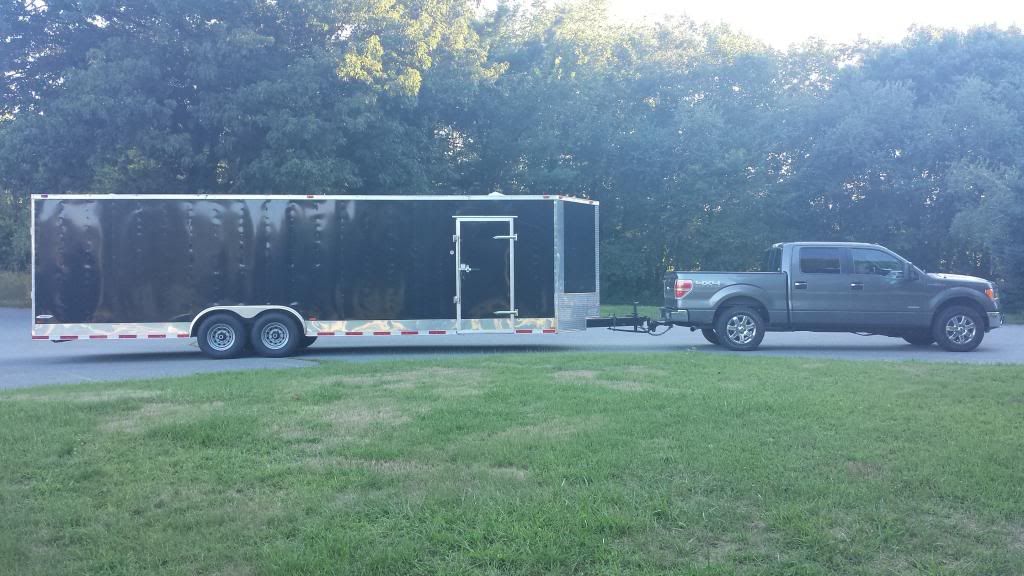
I don't tow fast on the highway for the sake of fuel economy; typically cruise around 62 MPH or so. Fuel economy while towing is awful, but that's to be expected. Typically between 8-9 MPG.
You should check out THIS THREAD. Six months ago a bunch of us from FTE met in Ohio to do some towing comparisons between Super Duties and my F150. My little F150 was the fastest up the hill with a HEAVY trailer. In all, three other FTE members, all Super Duty owners, drove my truck with the trailer and had nothing but good things to say about how it handled. And that trailer was a good bit heavier than any of the RVs you're looking at.
This F150 you're looking at should fit the bill nicely.
Don't agree with you here at all. The 6.2L engine, when offered in an F150, lowers available payload by nearly 300 lbs. My uncle has a max tow 6.2L truck and his max payload is only 1,250 lbs. Mine is 1,789.
You're going to find lots of people who will tell you that you NEED a Super Duty, but my experience has been the opposite. I bought my F150 because it was the only half ton truck that got respectable fuel economy while being able to pull 11,000 lbs. The photo in my sig is my F150 pulling my enclosed 28' car hauler; my truck has pulled it with weights between 4,500-12,000 lbs. Stability has always been outstanding, but I carefully loaded the trailer so my tongue weight was in the proper range. Most trailer instability is caused by improper loading, and you can band-aid that with sway control or a bigger truck or simply load it right to begin with.
Here's my truck with 9,000 lbs in tow:

I don't tow fast on the highway for the sake of fuel economy; typically cruise around 62 MPH or so. Fuel economy while towing is awful, but that's to be expected. Typically between 8-9 MPG.
You should check out THIS THREAD. Six months ago a bunch of us from FTE met in Ohio to do some towing comparisons between Super Duties and my F150. My little F150 was the fastest up the hill with a HEAVY trailer. In all, three other FTE members, all Super Duty owners, drove my truck with the trailer and had nothing but good things to say about how it handled. And that trailer was a good bit heavier than any of the RVs you're looking at.
This F150 you're looking at should fit the bill nicely.
Don't agree with you here at all. The 6.2L engine, when offered in an F150, lowers available payload by nearly 300 lbs. My uncle has a max tow 6.2L truck and his max payload is only 1,250 lbs. Mine is 1,789.
Elder User
Joined: Sep 2013
Posts: 502
Likes: 0
From: Hillsboro, OR
"Don't agree with you here at all. The 6.2L engine, when offered in an F150, lowers available payload by nearly 300 lbs. My uncle has a max tow 6.2L truck and his max payload is only 1,250 lbs. Mine is 1,789."
I agree with your not agreeing.
You have to be very careful with Ford's payload ratings. A heavy engine can get you a lower payload or a higher payload.
I had to order my truck.
One man states stability is outstanding and another states stability is questionable.
Mistakes and doubts can be very expensive.
I agree with your not agreeing.
You have to be very careful with Ford's payload ratings. A heavy engine can get you a lower payload or a higher payload.
I had to order my truck.
One man states stability is outstanding and another states stability is questionable.
Mistakes and doubts can be very expensive.
Fleet Mechanic
Joined: Mar 2013
Posts: 1,729
Likes: 80
From: New Jersey
Hi,
Tom, 28 foot with a variable in weight from 4000-12000 pounds. Difference being the ability to move that weight around in the trailer. You do not have that luxury in a travel trailer. Most of the weight within is fixed to the structure. Many of these trailers always have pass throughs in the front and people wind up putting everything but the kitchen sink in them. This can make the trailer tongue heavy. I generally feel as a rule of thumb is think a higher tongue weigh. With a TT I go with a 15% factor (It is easier to figure in the head as well as safety margin.) even though it will probably be around the 10-12% mark.
Thank you for chiming in since I know your position on the subject.
Tom, 28 foot with a variable in weight from 4000-12000 pounds. Difference being the ability to move that weight around in the trailer. You do not have that luxury in a travel trailer. Most of the weight within is fixed to the structure. Many of these trailers always have pass throughs in the front and people wind up putting everything but the kitchen sink in them. This can make the trailer tongue heavy. I generally feel as a rule of thumb is think a higher tongue weigh. With a TT I go with a 15% factor (It is easier to figure in the head as well as safety margin.) even though it will probably be around the 10-12% mark.
Thank you for chiming in since I know your position on the subject.
Trending Topics
Super Moderator
Joined: Aug 2003
Posts: 25,479
Likes: 742
From: Isanti, MN
Tom, 28 foot with a variable in weight from 4000-12000 pounds. Difference being the ability to move that weight around in the trailer. You do not have that luxury in a travel trailer. Most of the weight within is fixed to the structure. Many of these trailers always have pass throughs in the front and people wind up putting everything but the kitchen sink in them. This can make the trailer tongue heavy. I generally feel as a rule of thumb is think a higher tongue weigh. With a TT I go with a 15% factor (It is easier to figure in the head as well as safety margin.) even though it will probably be around the 10-12% mark.
At that point you decide how you load the trailer. Weight loaded behind the trailer axles levers weight off the tongue, and the opposite is true for weight loaded forward of the axles. A couple hundred pounds can be adjusted relatively easily in my opinion.


Junior User
Joined: Feb 2007
Posts: 83
Likes: 0
My 2013 quad Eco Max tow, with payload pkg can tow 11,100 lbs. 3120 payload. I do pull a 30 ft copper canyon fifth wheel. I was pulling that with an 2011 but recently traded. I have yet to pull with the 13 but the 13 has a better tow package than the 11 so im not concerned. I always put a majority of supplies in the rear of camper to adjust wait on tongue. I never had a problem with too much weight.

Laughing Gas
Joined: Oct 2005
Posts: 1,058
Likes: 1
From: South Jersey
A Max Tow F-150 SuperCrew will tow well into the 9000# range fine if the weight distribution is set properly, the payload is not over the limit, the trailer's load is distributed properly (including the load in the bed), and all safety checks are done (tire pressures, etc). Aftermarket suspension tweaks like on Tom's rear leaf springs or installing airbags is icing on the cake. And as for recommending a 6.2 V8 over a 3.5 Ecoboost V6 is just an opinion. They both will do the job fine. My TT has a GVWR of 9500#, and my Max Tow F-150 tows very stable, so as far as my real world opinion goes, there should be no issues with towing. Just keep in mind that these are 150's and not F-2 or 350's.

Posting Guru
Joined: Feb 2005
Posts: 2,295
Likes: 2
My theory has always been that, when you push something to the limit, you leave little margin of error when something goes wrong. And, when something goes wrong is exactly the time you don't want to be worrying about what's going to happen.
Your lower-end trailers would be do-able with the F150 and max tow. The Heavy Payload package would be even better, if you can find one. This assumes the truck is set up well. Upgrading to LT or LT E-range tires, possibly adding airbags, etc.
At the top end, you're at 10,300. Is that wet or dry? Water adds up quickly at 8.3lbs/gal. And that certainly doesn't include everything else you will carry... dishes, food, other accessories. You can easily add 1,000lbs. 5lbs at a time and never realize it.
Other factors to consider:
How much are you going to tow and where? If this is a once-a-year pull, maybe the 150 is tolerable. If you're going to be a full-time RVer, you might want to upgrade.
Are you planning on pulling long hills, especially at high altitude? Forced induction (either an Ecoboost 150 or a PSD 6.7 Super Duty) has a huge benefit here.
Do you intend to make the truck a daily driver when you aren't pulling? If so, the 150 is going to be a lot more pleasant to drive.
On the flip side of that - if the truck isn't a daily driver and you consider a PSD SD, keep in mind that they don't like to sit too long. Plan to drive it at least once a week.
When you step up to the SD, the maintenance gets a little more expensive. When you go to a diesel, it gets a lot more expensive. And they are known for failing in expensive ways.
Just some things to think about. I'd be on the fence too.
Your lower-end trailers would be do-able with the F150 and max tow. The Heavy Payload package would be even better, if you can find one. This assumes the truck is set up well. Upgrading to LT or LT E-range tires, possibly adding airbags, etc.
At the top end, you're at 10,300. Is that wet or dry? Water adds up quickly at 8.3lbs/gal. And that certainly doesn't include everything else you will carry... dishes, food, other accessories. You can easily add 1,000lbs. 5lbs at a time and never realize it.
Other factors to consider:
How much are you going to tow and where? If this is a once-a-year pull, maybe the 150 is tolerable. If you're going to be a full-time RVer, you might want to upgrade.
Are you planning on pulling long hills, especially at high altitude? Forced induction (either an Ecoboost 150 or a PSD 6.7 Super Duty) has a huge benefit here.
Do you intend to make the truck a daily driver when you aren't pulling? If so, the 150 is going to be a lot more pleasant to drive.
On the flip side of that - if the truck isn't a daily driver and you consider a PSD SD, keep in mind that they don't like to sit too long. Plan to drive it at least once a week.
When you step up to the SD, the maintenance gets a little more expensive. When you go to a diesel, it gets a lot more expensive. And they are known for failing in expensive ways.
Just some things to think about. I'd be on the fence too.
Laughing Gas
Joined: Oct 2005
Posts: 1,058
Likes: 1
From: South Jersey
We also have to keep in mind that if these trucks are going to be weekend or occasional haulers, a heavy duty truck may be way more truck for the occasional tow, and every day vehicles the rest of the time. To tow often, a Superduty would be the way to go for trailers at the upper weight end of an F-150.
Elder User
Joined: Sep 2013
Posts: 502
Likes: 0
From: Hillsboro, OR
"Boss Gasser makes a good points as well. Is in line with what I'm saying. He just said it better than I could."
Thank you.
Tom, I agree with some of your posts and you have shown that your truck can do what it is specced to do when pulling a load in a straight line.
However, when you state...
"At that point you decide how you load the trailer. Weight loaded behind the trailer axles levers weight off the tongue, and the opposite is true for weight loaded forward of the axles. A couple hundred pounds can be adjusted relatively easily in my opinion."
I must express my complete disagreement.
An RV can be very difficult to balance because of storage, cabinets and slide outs.
When in doubt, a TT must be loaded tongue heavy rather than tongue light.
More often than not payload becomes the ruling factor on most trucks.
itguy08,
There is some excellent advice given in this thread.
Thank you.
Tom, I agree with some of your posts and you have shown that your truck can do what it is specced to do when pulling a load in a straight line.
However, when you state...
"At that point you decide how you load the trailer. Weight loaded behind the trailer axles levers weight off the tongue, and the opposite is true for weight loaded forward of the axles. A couple hundred pounds can be adjusted relatively easily in my opinion."
I must express my complete disagreement.
An RV can be very difficult to balance because of storage, cabinets and slide outs.
When in doubt, a TT must be loaded tongue heavy rather than tongue light.
More often than not payload becomes the ruling factor on most trucks.
itguy08,
There is some excellent advice given in this thread.
Thread Starter
|
Freshman User
Joined: Mar 2013
Posts: 44
Likes: 0
From: Carlisle, PA
Thanks all. Lots to think about on this one and the thought for the wife and I is to go with this F150 as it's very nice and appears to be well taken care of. Based on some of the responses in the towing forum we're leaning to looking at smaller RV's since I've never towed anything and a 35' unit may be a little much at first.
For my calculations I was taking the GVWR of the trailer as printed in the brochure and * .10 and .15 to get the tongue weight. With so many unknowns that felt like the best #'s to use and the most realistic.
I was thinking 250/350 but with these weights I'm looking at a 6.2 or V10 and the ones I've found are either crazy expensive of jacked up and tuned. There is a nice 2011 F250 King Ranch at a local Ford dealer but it was an ex-manufacturer car with 113k. I've driven a 250 at the Carlisle All Ford a couple years ago and it felt like it should come with a Zip code!
Diesel is out because of the spectacular way they can fail and that this won't be a DD. Probably drive it once a month to work for a week. The almost 80 mile commute would be crazy in fuel. It can get painful in the car and it gets 20-25 MPG.
For my calculations I was taking the GVWR of the trailer as printed in the brochure and * .10 and .15 to get the tongue weight. With so many unknowns that felt like the best #'s to use and the most realistic.
I was thinking 250/350 but with these weights I'm looking at a 6.2 or V10 and the ones I've found are either crazy expensive of jacked up and tuned. There is a nice 2011 F250 King Ranch at a local Ford dealer but it was an ex-manufacturer car with 113k. I've driven a 250 at the Carlisle All Ford a couple years ago and it felt like it should come with a Zip code!
Diesel is out because of the spectacular way they can fail and that this won't be a DD. Probably drive it once a month to work for a week. The almost 80 mile commute would be crazy in fuel. It can get painful in the car and it gets 20-25 MPG.

Moderator


Joined: Jul 2011
Posts: 6,509
Likes: 662
From: Sioux Falls Area
if you've decided on the f150, then i'd let the truck dictate the size of the toy.
using the max GVWR of the trailer, and 15% tongue weight is the most conservative approach.
if possible, see if you can take your potential new toy to the scales with your truck. that would help you make sure that you are being realistic in your purchase.
my thinking on this would be, with your payload of 1850, and 15% of that weight on the tongue, it puts you about 300lbs away from your max. I'd be fine with that. Yes, you are theoretically at the max (which is fine IMO), but you also have some built in fudge factor. you may not load it up that heavy, and you may have less than 15% on the tongue. if either of those are true, then you are fine.
even a meere 1000lbs less in the trailer gains you another 150lbs headroom on the truck. and every 1% gains you another 100lbs headroom on the truck as well.
an initial trip to the scale, dry before purchase, will put you in the ballpark. a trip to the scale loaded up will confirm if you need to make some final adjustments.
just my thoughts.
using the max GVWR of the trailer, and 15% tongue weight is the most conservative approach.
if possible, see if you can take your potential new toy to the scales with your truck. that would help you make sure that you are being realistic in your purchase.
my thinking on this would be, with your payload of 1850, and 15% of that weight on the tongue, it puts you about 300lbs away from your max. I'd be fine with that. Yes, you are theoretically at the max (which is fine IMO), but you also have some built in fudge factor. you may not load it up that heavy, and you may have less than 15% on the tongue. if either of those are true, then you are fine.
even a meere 1000lbs less in the trailer gains you another 150lbs headroom on the truck. and every 1% gains you another 100lbs headroom on the truck as well.
an initial trip to the scale, dry before purchase, will put you in the ballpark. a trip to the scale loaded up will confirm if you need to make some final adjustments.
just my thoughts.