


dumping fuel?

Thread Starter
|
Senior User
Joined: Jul 2009
Posts: 177
Likes: 0
dumping fuel?
i have an offy dp intake new and a holley 390 new, the problem is i have a bog whenever i accelerate hard after changing gears. i have upgraded to a .40 shooter with hollow screw and i currently have the blue cam on it. jets are 51's. cyls 3 and 4 are getting the majority of the pump shot it seems, because those plugs compared to the others are black. Others are i would say normal to on the starved side of fuel. Im figuring thats the reason why its bogging. I do have an wideband af gauge installed in one of my header collectors and when it bogs the gauge spikes to 18 which is super lean, i dont want to drive the truck too much like this so if anyone got any ideas on how to disperse the fuel more evenly your help would be greatly appreciated. and the carb is mounted on top a 2in spacer with the primaries facing the valve cover, the way the flange is thats the only way i can mount it.
lastly every morning when i come out to start the truck i pump the pedal a few times and the choke wont close, I have to take the air cleaner off and put pressure on it and it will click and when i blip the throttle it will close automatically like its supposed to.. Is it too tight too loose?
lastly every morning when i come out to start the truck i pump the pedal a few times and the choke wont close, I have to take the air cleaner off and put pressure on it and it will click and when i blip the throttle it will close automatically like its supposed to.. Is it too tight too loose?
Moderator


Joined: Dec 2007
Posts: 7,987
Likes: 104
From: Boise, Idaho

This bog is when you accelerate hard? How is it under normal, every day driving?
If it's under hard acceleration, it may be that your secondary spring is too stiff, so your secondaries are coming on too late.
Since you have a wideband, what is your A/F under normal cruise at, say, 60mph?
As for the fuel dispersal, that's confusing and sounds incredibly extreme. On my two 300s (one with a 390 on an Offy DP and one with a 600 on an Offy C), the dispersal is a light tan on 1 & 6, med tan on 2 & 5, and a golden tan on 3 & 4. The difference is hardly noticeable. I'm scratching my head as to why yours is such an extreme difference.
Lastly, are you sure everything is sealed up? No intake or vacuum leaks? I had a 40 shooter on mine because mine kept bogging (spiking lean). Found my intake gasket was leaking, as well as my throttle shafts (used carb) and when I fixed it, a lot of bog went away and I was able to downsize to a 31 shooter.
If it's under hard acceleration, it may be that your secondary spring is too stiff, so your secondaries are coming on too late.
Since you have a wideband, what is your A/F under normal cruise at, say, 60mph?
As for the fuel dispersal, that's confusing and sounds incredibly extreme. On my two 300s (one with a 390 on an Offy DP and one with a 600 on an Offy C), the dispersal is a light tan on 1 & 6, med tan on 2 & 5, and a golden tan on 3 & 4. The difference is hardly noticeable. I'm scratching my head as to why yours is such an extreme difference.
Lastly, are you sure everything is sealed up? No intake or vacuum leaks? I had a 40 shooter on mine because mine kept bogging (spiking lean). Found my intake gasket was leaking, as well as my throttle shafts (used carb) and when I fixed it, a lot of bog went away and I was able to downsize to a 31 shooter.
Thread Starter
|
Senior User
Joined: Jul 2009
Posts: 177
Likes: 0
ya as soon as i change gears and if i dont ease into the gas it bogs then once the bogs over the truck will go and i can mash the pedal to the floor and it will go fairly decent. at 60 mph the af gauge reads 17 which is lean as hell but when i let off the gas a little and coast it drops down to about 12 13.
i also have my vac advance to full vac, i heard ppl doing this is was wondering if its a bad idea. thanks
i also have my vac advance to full vac, i heard ppl doing this is was wondering if its a bad idea. thanks
Moderator
Joined: Dec 2007
Posts: 7,987
Likes: 104
From: Boise, Idaho
What's your elevation where you're at?
First off, I'm envious of your wideband O2 setup!! =P
So, at cruise it's lean, and then when you let off the gas and coast, it goes rich? That is odd. I don't think the advance has anything to do with it, although if you want to test it, remove the vac line to the advance all together and cap it off and then give it a drive. It shouldn't affect fuel mixture though.
I'm almost wondering if something inside the carb is wrong, like a bad seal on the powervalve, or the like. Aka: from the factory. I remember my brother was going CRAZY trying to diagnose the problem with his 4bbl for months, finally to find out that the powervalve hole was drilled in crooked, causing gas to leak around it. It was a factory defect.
First off, I'm envious of your wideband O2 setup!! =P
So, at cruise it's lean, and then when you let off the gas and coast, it goes rich? That is odd. I don't think the advance has anything to do with it, although if you want to test it, remove the vac line to the advance all together and cap it off and then give it a drive. It shouldn't affect fuel mixture though.
I'm almost wondering if something inside the carb is wrong, like a bad seal on the powervalve, or the like. Aka: from the factory. I remember my brother was going CRAZY trying to diagnose the problem with his 4bbl for months, finally to find out that the powervalve hole was drilled in crooked, causing gas to leak around it. It was a factory defect.
Thread Starter
|
Senior User
Joined: Jul 2009
Posts: 177
Likes: 0
im about 1000 ft above sea level, ya idle its rich bouncing between 11 and 12. cruise on hwy with pressure on the gas pedal its lean as hell. let off its rich, i have a cam in it now, nothing too crazy, my vac use to be at 18hg and now it can only just make 15hg at idle i assume its just the cam. i sprayed around for vac leaks and didnt find any, i double ck tomorrow.

Postmaster
Joined: Dec 2006
Posts: 3,603
Likes: 10
From: Spokane, WA
One...do you have heat to the intake manifold? If not, get that done. Whether it be a DP or C the manifold must be heated to provide atomization otherwise the fuel "falls out" of suspension and ends up laying on the floor of the manifold. Two...remove the spacer between the carb and manifold and try that. On a DP it is not necessary and merely increases plenum volume that can result in soggy performance. Three...the #40 squirter and hollow screw seem to be overkill. I don't know of any that have used anything larger than a #37. Idle will be rich...normal and the AF gauge showing a rich condition on deceleration may be normal. Headers might be contributing to the lean cruise condition...they can tend to make an engine run leaner.
Thread Starter
|
Senior User
Joined: Jul 2009
Posts: 177
Likes: 0
how would i heat the manifold, its not designed for it? i put the spacer on because it did the same thing before with my clifford, im game for trying the heated manifold but how can i do it. also explain how headers can make it run lean
Trending Topics
Thread Starter
|
Senior User
Joined: Jul 2009
Posts: 177
Likes: 0
i found a thread on how to make the plate for the bottom. what size and thread pitch are the bolts for the plate. As far as a gasket goes should i use the stock gasket they sell for the stock intake and exhaust manifold, or should i just use high temp rtv.
FTE Stories
Ford Trucks for Ford Truck Enthusiasts

3 Best / 3 Worst Parts of Modern Ford Ownership
Brett Foote
10 Amazing Upgrades That Solve Common Ford Truck Owner Headaches
Pouria Savadkouei
Every 2026 Ford Engine Explained
Brett Foote
10 Ugly Ford Trucks That We Still Kinda Love
Joe Kucinski
10 Things Every Truck Owner NEEDS (2026 Edition)
Michael S. Palmer
Rezvani's Latest Post-Apocalyptic Monster Is a Ford F-150 Raptor Underneath
Verdad Gallardo
Top 10 Most Expensive Ford Trucks Ever Sold on Bring a Trailer
Joe Kucinski
2027 Ford Super Duty Buyer's Guide (Every Model, Engine, & Package)
Brett Foote
Top 10 Ford Truck Tragedies
Joe Kucinski
Moderator
Joined: Dec 2007
Posts: 7,987
Likes: 104
From: Boise, Idaho
https://www.ford-trucks.com/forums/9...-please-4.html
Check out that thread, there's some info on using a heated spacer from the 60s V8s. It works very well.
I tried a stock gasket and had "ok" success. I've been very pleased with the Mr. Gasket #260.
Check out that thread, there's some info on using a heated spacer from the 60s V8s. It works very well.
I tried a stock gasket and had "ok" success. I've been very pleased with the Mr. Gasket #260.
Moderator
Joined: Dec 2007
Posts: 7,987
Likes: 104
From: Boise, Idaho
I know, I was just offering a different suggestion that is pretty easy to implement.
Are you talking about a plate like this?

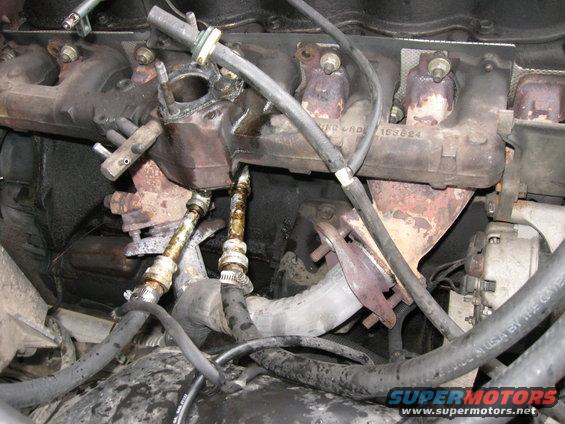
Not sure on the bolt size, but I believe it's the same as the stock manifold. You may even be able to use the stock bolts.
Are you talking about a plate like this?
Not sure on the bolt size, but I believe it's the same as the stock manifold. You may even be able to use the stock bolts.
Postmaster
Joined: Dec 2006
Posts: 3,603
Likes: 10
From: Spokane, WA
I used a spacer on mine at one time...found it redundant and it probably was insulating the carb from needed heat too. The bores in the DP are rather deep already and probably maintain a good columnar flow through the carb which I suspect one does not get with the Clifford or Offy C. I suggest getting heat to the manifold before any other changes are made especially since you have an AFR gauge that will help define the results of any changes made. I have read where headers might (operative term is "might") cause a leaner running condition. This might be due to the different scavenging characteristics of headers v stock log exhaust. One might not even know the difference without an AFR meter like you have. And, without running an AFR meter on the stock set up how would one know if there is any difference? Any modifications from stock are bound to cause changes...after all, we are looking to change some things in performance which may require adjustments in timing, ignition curve of the dizzy, tuning the carb, etc., which means establishing new "norms" for the engine. Actually, the engine establishes the new "norms" and we tune to what it "likes" and not some arbitrary number a book or manual is telling us. It's all part of the fun of back yard hot rodding
Moderator
Joined: Dec 2007
Posts: 7,987
Likes: 104
From: Boise, Idaho
I used some make-your-own-gasket from an autoparts store. Be sure to get one made for coolant and won't saturate.
Then, I coated all the threads of the pipes, and the gasket, with Indian Head Gasket Shellac. Messy, messy, messy sticky nasty stuff. But that means it's good.
Then, I coated all the threads of the pipes, and the gasket, with Indian Head Gasket Shellac. Messy, messy, messy sticky nasty stuff. But that means it's good.
Thread Starter
|
Senior User
Joined: Jul 2009
Posts: 177
Likes: 0
i was at the gas station tonight filling up and iv developed this new problem since its been getting colder here in pa, when i come up to a stop light and i press the clutch in and the rpms drop the engine goes super lean to the point where it wants to stall, while refueling i popped the hood and the spacer was ice cold, so im figuring im having some carb icing going on because after you drive the truck for a good 30 mins it doesnt do it as bad. I want to keep the spacer but i am in the process of making a plate for the bottom of the intake to run coolant to. my question is will this be enough because up here it easily gets down to the single digits in the winter and i need this truck to run day in day out. should i also go back to the stock air cleaner and run some drier tubing down to the header to get some heat that way, only problem is iv read about with too much heat you sacrifice power and can end up with a enriched a/f ratio than you would like. i dont want overkill but i dont want to be stallling all the time in the dead of winter