





Tuning Triplets
Thread Starter
|
Elder User
Joined: Nov 2008
Posts: 915
Likes: 1
From: Gunbarrel, Co.
Tuning Triplets
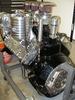
I read a lot of threads concerning the Stromberg 97's and trying to gleam some info about jetting for altitude. Currently I'm at 5500 ft. with a well build FH, 284ci, 3x2 on Navarro intake and the 97's have #65 PV and #45 Jets and progressive linkage. So this is my starting point and it's running fat.
Just read Flathead Ford V8, Perfomance Handbook by Joe Abbin. In the book they dyno two engines very simular to mine both produced HP #'s over 200 with triple 97's @ 5300 Ft. That got my attendtion and the one that produced 217 hp used #43 jets and 65 PV. So what I've done is to order two sets #42 jets and one #43. I'll keep the PV #65 for now until I can see the results of the jet change.
Ok the results; Just finished re-jetting the carbs earlier today. I think I'm getting close, but really just trying to get my brain around jetting at altitude. This is how it felt after a test ride.
It feel like it pulls a little better than my old stock FH, by third gear I'm going about 35mph maybe 40. If I kick in the secondarys it pulls very strong in 1st and 2nd gear, but the rpm's fall off quickly when I shift into third. It takes a bit but the rev's do come back up. Then the secondary's get back to work again.
The fall off could be just the tranny and rearend gearing???
Any thoughts on the subject?
Just read Flathead Ford V8, Perfomance Handbook by Joe Abbin. In the book they dyno two engines very simular to mine both produced HP #'s over 200 with triple 97's @ 5300 Ft. That got my attendtion and the one that produced 217 hp used #43 jets and 65 PV. So what I've done is to order two sets #42 jets and one #43. I'll keep the PV #65 for now until I can see the results of the jet change.
Ok the results; Just finished re-jetting the carbs earlier today. I think I'm getting close, but really just trying to get my brain around jetting at altitude. This is how it felt after a test ride.
It feel like it pulls a little better than my old stock FH, by third gear I'm going about 35mph maybe 40. If I kick in the secondarys it pulls very strong in 1st and 2nd gear, but the rpm's fall off quickly when I shift into third. It takes a bit but the rev's do come back up. Then the secondary's get back to work again.
The fall off could be just the tranny and rearend gearing???
Any thoughts on the subject?

Post Fiend
Joined: May 2008
Posts: 7,641
Likes: 21
From: Poway, Ca.
Your horsepower availability at any given rpm is on a curve - as is torque (which is what you sem to be "missing" in 3rd gear) And with the lower gearing, you will progress along that curve much (increasing rpm and horsepower proportionally) faster than in the higher gears. So the chances of lugging down are slim. But, the increase in horsepower with rpm is substantially gearter a rise than torque with rpm.
Horsepower tends to increase with rpm until you get to the top of the curve. However if your gearing is such that the available horsepower is not high enough at the gearing ratios you have to provide the torque, especially in the lower ranges, the proportion between rpm/horsepower and mechanical disadvantage from the higher gearing flattens out the torque curve at that point and there is not enough horsepower at the lower rpm to develope the torque and driving up the rpm (thus developing more horsepower) up.
Ya gotta get up over that step! Torque is pretty much constant. But in that low of a HP engine you need to get up higher in the rpms if you want to accelerate using horsepower. Cruising is a different matter.
Try shifting into 3rd gear about 300rpm higher next time and see what happens. Or, try advancing your timing about another 5 degrees for altitude and performance with the carbs.
Stock 239 Flathead Horsepower Performance Curves. Yours will be quite different of course, but it will give you an idea of what I'm talking about:

Horsepower tends to increase with rpm until you get to the top of the curve. However if your gearing is such that the available horsepower is not high enough at the gearing ratios you have to provide the torque, especially in the lower ranges, the proportion between rpm/horsepower and mechanical disadvantage from the higher gearing flattens out the torque curve at that point and there is not enough horsepower at the lower rpm to develope the torque and driving up the rpm (thus developing more horsepower) up.
Ya gotta get up over that step! Torque is pretty much constant. But in that low of a HP engine you need to get up higher in the rpms if you want to accelerate using horsepower. Cruising is a different matter.
Try shifting into 3rd gear about 300rpm higher next time and see what happens. Or, try advancing your timing about another 5 degrees for altitude and performance with the carbs.
Stock 239 Flathead Horsepower Performance Curves. Yours will be quite different of course, but it will give you an idea of what I'm talking about:
Thread Starter
|
Elder User
Joined: Nov 2008
Posts: 915
Likes: 1
From: Gunbarrel, Co.
More referances; Diff 3.50 and the tranny gears.
1st 4.01
2nd 2.41
3rd 1.41
4th 1.00

Fleet Owner


Joined: Jul 2004
Posts: 27,297
Likes: 1,059
From: NM
There's no difference in jetting for any altitude between 4000 - 6000. East side of ABQ is 6,000, the valley is 4300, and the west mesa where Bobby and I live is back to 5300. I was suggesting you go with Joe's jetting. What fuel pump are you using? what is the pressure regulator set for?
Thread Starter
|
Elder User
Joined: Nov 2008
Posts: 915
Likes: 1
From: Gunbarrel, Co.
There's no difference in jetting for any altitude between 4000 - 6000. East side of ABQ is 6,000, the valley is 4300, and the west mesa where Bobby and I live is back to 5300. I was suggesting you go with Joe's jetting. What fuel pump are you using? what is the pressure regulator set for?
Trending Topics

Elder User
Joined: Jun 2008
Posts: 693
Likes: 6
From: N E Ohio
Just a thought here. Have someone follow behind you, and when you upshift have them look for a puff of black smoke, especially when you get into the secondaries. Jetting the primary is usually the easy part. On the secondaries, they come in when there is already a decent flow passing through the manifold, so teh jetting on them can be tricky. Too lean can cause bogging as can too rich. The puff of black can indicate too rich.
FTE Stories
Ford Trucks for Ford Truck Enthusiasts

3 Best / 3 Worst Parts of Modern Ford Ownership
Brett Foote
10 Amazing Upgrades That Solve Common Ford Truck Owner Headaches
Pouria Savadkouei
Every 2026 Ford Engine Explained
Brett Foote
10 Ugly Ford Trucks That We Still Kinda Love
Joe Kucinski
10 Things Every Truck Owner NEEDS (2026 Edition)
Michael S. Palmer
Rezvani's Latest Post-Apocalyptic Monster Is a Ford F-150 Raptor Underneath
Verdad Gallardo
Top 10 Most Expensive Ford Trucks Ever Sold on Bring a Trailer
Joe Kucinski
2027 Ford Super Duty Buyer's Guide (Every Model, Engine, & Package)
Brett Foote
Top 10 Ford Truck Tragedies
Joe Kucinski
Fleet Owner
Joined: Jul 2004
Posts: 27,297
Likes: 1,059
From: NM
Lots of good anecdotal experience here:
Techno Source for the 1932 thru 1953 Flathead Ford
I wonder if you need more advance; what distributor are you using?
Techno Source for the 1932 thru 1953 Flathead Ford
I wonder if you need more advance; what distributor are you using?
Thread Starter
|
Elder User
Joined: Nov 2008
Posts: 915
Likes: 1
From: Gunbarrel, Co.
Lots of good anecdotal experience here:
Techno Source for the 1932 thru 1953 Flathead Ford
I wonder if you need more advance; what distributor are you using?
Techno Source for the 1932 thru 1953 Flathead Ford
I wonder if you need more advance; what distributor are you using?
Fleet Owner
Joined: Jul 2004
Posts: 27,297
Likes: 1,059
From: NM
Total = initial (static) timing at idle + centrifugal advance. Vacuum advance doesn't count
I also have the MSD R-to-R. Did you change the vac advance can to an adjustable? If not, it will give a whole bunch of advance, as it is for a SBC! Mr Gasket sells the adjustable, the correct one is for an early GM points-type dizzy. You'll probably want to run the vac advance off the manifold vacuum, not ported -- it will require some testing to determine what works best.
You also have to install the limiting bushing and change the springs in the MSD mech advance unit; it is not "ready to run" -- set up for an SBC. This aspect of the MSD dizzy kinda pissed me off, but once done it works absolutely perfect!
I also have the MSD R-to-R. Did you change the vac advance can to an adjustable? If not, it will give a whole bunch of advance, as it is for a SBC! Mr Gasket sells the adjustable, the correct one is for an early GM points-type dizzy. You'll probably want to run the vac advance off the manifold vacuum, not ported -- it will require some testing to determine what works best.
You also have to install the limiting bushing and change the springs in the MSD mech advance unit; it is not "ready to run" -- set up for an SBC. This aspect of the MSD dizzy kinda pissed me off, but once done it works absolutely perfect!

Cargo Master


Joined: Apr 2007
Posts: 2,063
Likes: 38
From: Valley Center, California

Just my .02 from a lot of years of racing.
Sneak up on it. Make small changes. If you jump around, you get lost. Make one change at a time and drive a while. Don't drive a mile and make a radical change unless your crazy-out of tune. Watch your plugs and make notes. If it starts to suck reverse direction. Yup, timing, accelerator pumps and everything else comes into play but if you take it slow you'll arrive.
My personal experience for street driving is that I end up too lean. Good manners on the street need to be slightly fat.
Of course.... that's the way I run my body.... as is well documented by my other friends on this Forum.....
Sneak up on it. Make small changes. If you jump around, you get lost. Make one change at a time and drive a while. Don't drive a mile and make a radical change unless your crazy-out of tune. Watch your plugs and make notes. If it starts to suck reverse direction. Yup, timing, accelerator pumps and everything else comes into play but if you take it slow you'll arrive.
My personal experience for street driving is that I end up too lean. Good manners on the street need to be slightly fat.
Of course.... that's the way I run my body.... as is well documented by my other friends on this Forum.....
Thread Starter
|
Elder User
Joined: Nov 2008
Posts: 915
Likes: 1
From: Gunbarrel, Co.
Thanks all, another up date, after changing the jets and putting some miles on the road I found I was pinging in the headers. So changed the timing from 10 deg advance to 5 and the pinging is gone. Still running rich but I think it will be fine for the next 1K. I got to say it's fun to hear this thing pulling with the triple 97's.
Post Fiend
Joined: May 2008
Posts: 7,641
Likes: 21
From: Poway, Ca.
Thanks all, another up date, after changing the jets and putting some miles on the road I found I was pinging in the headers. So changed the timing from 10 deg advance to 5 and the pinging is gone. Still running rich but I think it will be fine for the next 1K. I got to say it's fun to hear this thing pulling with the triple 97's.
And it woun't hurt anything to break the engine in a little rich. Might even provide a little safegaurd!

Thread
Thread Starter
Forum
Replies
Last Post
5 Star Tuning
Vendor Specials, Discounts, Product Announcements & Group Buys
0
Aug 21, 2015 11:50 AM
Ira Brown
1973 - 1979 F-100 & Larger F-Series Trucks
1
May 21, 2015 03:53 AM
Ranger1980
1980 - 1986 Bullnose F100, F150 & Larger F-Series Trucks
17
Feb 12, 2015 12:42 PM
Thebandit328
1961 - 1966 F-100 & Larger F-Series Trucks
4
Nov 28, 2014 03:23 PM
Turbo Dog
Big Block V8 - 385 Series (6.1/370, 7.0/429, 7.5/460)
2
Jun 16, 2014 11:34 AM
