


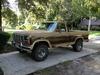

F100 4x4?

Thread Starter
|
Logistics Pro
Joined: Jun 2008
Posts: 4,990
Likes: 6
From: Florida
F100 4x4?
I've been toying around with the idea of converting to 4x4 for awhile now,and i'm leaning more towards converting.I know it can be done,but I wanna clear something up first.My truck is a 1980 F100,and has the swiss cheese frame.Would the current frame rails be too weak for a 4x4 system?Would it be best to swap to an F150 Frame?

Cross-Country
Joined: Aug 2007
Posts: 55
Likes: 0
I'm curious about this as well since I have an almost identical setup also with the swiss cheese frame. Although I have heard many of the other trucks from F-100 up had swiss cheesed frames...not sure. I have hauled a lot of weight with mine though, and have 3/4 ton class springs on it.

Post Fiend

Joined: Jan 2000
Posts: 5,330
Likes: 17
From: Dryden, ON, Canada
Your F100 has an F150 frame, it's the same deal.
If it's in good shape, it'll be fine, if it's questionable, then I'd consider building everything on a later frame and swapping your body on.
If it's in good shape, it'll be fine, if it's questionable, then I'd consider building everything on a later frame and swapping your body on.
Thread Starter
|
Logistics Pro
Joined: Jun 2008
Posts: 4,990
Likes: 6
From: Florida
Oh okay,I wasn't sure if the F150's had swiss cheese frames too or not.From what I can tell,the frame is solid,just surface rust.It's been a Cali and Florida truck all it's life.Thanks for the reply man.
Cross-Country
Joined: Aug 2007
Posts: 55
Likes: 0
I have measured my F-100 frame and a F-150's frame that I had parted out, and they seemed to be the same thickness. Not sure why ford used the classification of an F-100 V.S. F-150 as mine uses all F-150 parts. Though some did come with smaller brake components and such.
Trending Topics

Post Fiend
Joined: Dec 2007
Posts: 8,521
Likes: 16
From: Lost
The F250 from 80 and early 81 also had the same hole-filled frame. There isn't any issue with the frame's strength, unless it's rusty or involved in a crash. But, the same can be said for all truck frames.
FTE Stories
Ford Trucks for Ford Truck Enthusiasts

Top 10 Most Expensive Ford Trucks Ever Sold on Bring a Trailer
Joe Kucinski
2027 Ford Super Duty Buyer's Guide (Every Model, Engine, & Package)
Brett Foote
Top 10 Ford Truck Tragedies
Joe Kucinski
AEV FXL Super Duty - the Super Duty Raptor Ford Doesn't Make
Brett Foote
Lobo Vs Lobo: Proof the F-150 Lobo Should Be Even Lower!
Michael S. Palmer
Ford's 2001 Explorer Sportsman Concept Looks For a New Home
Verdad Gallardo
10 Best Ford Truck Engines We Miss the Most!
Joe Kucinski
2026 Shelby F-150 Off-Road: Better Than a Raptor R?
Brett Foote
2027 Super Duty Carhartt Package First Look: 12 Things You NEED to Know!
Michael S. Palmer
Moderator


Joined: Jan 2001
Posts: 56,983
Likes: 2,736
From: Virginia

If you do some digging, you might find out it was just a licensing thing or some sort of government classification issue. Some sort of red tape that doesn't really relate to actually using the truck.

Post Fiend
Joined: Jul 2004
Posts: 8,786
Likes: 28
From: Northern California
The biggest differences between the F-100 and F-150 is to get around the smog issues of the day.
F-100's were under tighter smog regulations than the F-150. Why the F-150 was brought to life in 1975 was to get out of having catalytic converters and air pumps.
By 1983 F-100's and F-150's had the same smog classification and that's why the F-100 was basicly discontinued.
Sure there were some wheel, brake and spring and suspension differences between the two after 1979, but it wont make a difference in Fordzilla's case as he's got all F-150 parts on the front and rear anyway if I remember correctly.
F-100's were under tighter smog regulations than the F-150. Why the F-150 was brought to life in 1975 was to get out of having catalytic converters and air pumps.
By 1983 F-100's and F-150's had the same smog classification and that's why the F-100 was basicly discontinued.
Sure there were some wheel, brake and spring and suspension differences between the two after 1979, but it wont make a difference in Fordzilla's case as he's got all F-150 parts on the front and rear anyway if I remember correctly.



Cross-Country
Joined: Aug 2007
Posts: 55
Likes: 0
The biggest differences between the F-100 and F-150 is to get around the smog issues of the day.
F-100's were under tighter smog regulations than the F-150. Why the F-150 was brought to life in 1975 was to get out of having catalytic converters and air pumps.
By 1983 F-100's and F-150's had the same smog classification and that's why the F-100 was basicly discontinued.
Sure there were some wheel, brake and spring and suspension differences between the two after 1979, but it wont make a difference in Fordzilla's case as he's got all F-150 parts on the front and rear anyway if I remember correctly.
F-100's were under tighter smog regulations than the F-150. Why the F-150 was brought to life in 1975 was to get out of having catalytic converters and air pumps.
By 1983 F-100's and F-150's had the same smog classification and that's why the F-100 was basicly discontinued.
Sure there were some wheel, brake and spring and suspension differences between the two after 1979, but it wont make a difference in Fordzilla's case as he's got all F-150 parts on the front and rear anyway if I remember correctly.
Moderator
Joined: Jan 2001
Posts: 56,983
Likes: 2,736
From: Virginia
I never had any trouble with the frame on my f150 4x4 either. I was reading somewhere that the holes being punched in the frame may not be as bad a thing as everyone thinks. It seems when you form and work the metal, it gets what they call "work hardened", which actually makes it stiffer that it normally would be. So this happens when they form the metal into a c channel for the frame, and they also said punching holes in the metal also hardens the metal around the hole.
Another example are derby cars that they run in the smash up derbys. Some of those guys figured out if they took a hammer and went around the whole car and hammered little dents all over it, the car sheetmetal would be stronger and harder to damage. I have heard most of the derby events now do not allow that.
I bet that's also why they don't want you to weld on the frames anymore. The heat from the welding operation would make the work hardened metal relax, and weaken it.

Another example are derby cars that they run in the smash up derbys. Some of those guys figured out if they took a hammer and went around the whole car and hammered little dents all over it, the car sheetmetal would be stronger and harder to damage. I have heard most of the derby events now do not allow that.
I bet that's also why they don't want you to weld on the frames anymore. The heat from the welding operation would make the work hardened metal relax, and weaken it.
Thread Starter
|
Logistics Pro
Joined: Jun 2008
Posts: 4,990
Likes: 6
From: Florida
Thanks y'all,that helps alot.I just wasn't sure if the frame would fail under extreme articulation should that ever come about.
And yes 81 Explorer,my F100 is basically an F150,it's just got F100 emblems,F10 on the vin,and 4 leafs in the rear instead of 5.When I rebuild the truck,i'm gonna swap to 5 leafs,so it essentially won't be an F100 anymore.I think the rear springs are the only things that make it an F100.
And yes 81 Explorer,my F100 is basically an F150,it's just got F100 emblems,F10 on the vin,and 4 leafs in the rear instead of 5.When I rebuild the truck,i'm gonna swap to 5 leafs,so it essentially won't be an F100 anymore.I think the rear springs are the only things that make it an F100.