


mpg

Post Fiend
Joined: Oct 2005
Posts: 10,626
Likes: 7
From: Plano TX and Brentwood TN
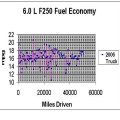
I have every Liter of Fuel tracked since I first topped up the tank (truck had 40 km on it). I was uploading it to a tech gallery but it became a waste of time because nobody looks at it. Even though I havnt uploaded it in a long time I have 31,078 consecutive miles of data (over the last 3.5 years) for a true lifetime average of my truck with notes posted as well.
Now, I also ask, how often do you calculate your mpg? Every fillup? Every trip(rather DDing, hauling, and/or plain traveling, if you are using your truck, you are measuring it's consumption)? Every other one(trip, fillup, whatever)? How often and what is the catalyst for you taking the "measurement".
Now, I'm going to assume for the sake of argument that for whatever calculations that you do use, you take them with the upmost accuracy(which is a dangerous assumption, but just to make things easy I'm going to assume that).
Alright, let me know how you believe you take better measurements of your fuel mileage.
Elder User
Joined: Apr 2006
Posts: 804
Likes: 0
From: Edmonton, AB
No offense, but I would actually be impressed if you kept up with ambient temp, barometric pressure, intake temp, speed, load, type of tune(if applicable), weight of the truck, weight of trailer(if applicable) with and without a load(if it's hooked up, the weight is noted), your weight as well(if it changed(good or bad) etc, fuel pressure, fuel level(which you can get by taking the fuel level percentage which is accounted for by the truck's computer) and various other assortment of factors that go into mileage calculations. Hell even when you changed your oil and what weight of oil, sythentic or regular dino etc all play a part in this.
Did you honestly look at my spreadsheet (in fairness its only half there) but a lot of your variables are noted there (you just may miss my shorthand), a bunch of the other ones are largely irrelevent.
Now, I also ask, how often do you calculate your mpg? Every fillup? Every trip(rather DDing, hauling, and/or plain traveling, if you are using your truck, you are measuring it's consumption)? Every other one(trip, fillup, whatever)? How often and what is the catalyst for you taking the "measurement".
Now, I'm going to assume for the sake of argument that for whatever calculations that you do use, you take them with the upmost accuracy(which is a dangerous assumption, but just to make things easy I'm going to assume that).
Now, I'm going to assume for the sake of argument that for whatever calculations that you do use, you take them with the upmost accuracy(which is a dangerous assumption, but just to make things easy I'm going to assume that).
Fleet Owner


Joined: Nov 2003
Posts: 27,915
Likes: 3,635


Post Fiend
Joined: Oct 2005
Posts: 10,626
Likes: 7
From: Plano TX and Brentwood TN
Taking measurements of the different variables is keeping track of it. If you are looking for accuracy(which I believe is what you meant when you said "true lifetime average"). Now if you just want slightly better then general idea, then what you are doing is fine, but if you are looking for accuracy, then your really need to keep track of more variables and conditions then you do. Also if you doubt that taking measurements is keeping track then do this to your spreadsheet. Take out all the numerical values that you have for for consumption, mileage and tailwind, tire psi etc, take all that out as those are measurements and you had to take them to get them. What are you left with? Just a grid with some words on it, not what I would call keeping track of. So I would say taking measurements is keeping track of.
Spreadsheet 1:
mileage and fuel used
mixed(I would assume mixed as in city/highway), what's the ratio? More highway then city, more city then highway, 50/50? You make no note of it.
city and highway; what constitutes that kind of driving? I have seen a city have all 55 mph roads for the most part, some have 35-40 roads most of the time, hills, flat etc, no mention of that.
Looks like you made note of the tailwind measurement(but it's hard to tell)but not headwind. However, you didn't measure what affects it had on load and all that as well.
You did make note of some additions, such as tonneau cover and going back to stock airbox, but you didn't not what exactly affect they had. Engine load would be the first thing that I would look at, did they actually help out with that?
Spreadsheet 2:
extensive warmup- what is that, 10 min., 15 min, higher? High idle or regular idea that is mainly programmed into the pcm from the factory?
muffler delete/intake elbow- what exactly affect did it have on the truck? load percentage and all that, did it really help the engine or are you just basing the evidence on timing? You don't keep up with enough variables to determine if any of those additions that you did helped or it was just by coincidence you have to eeck out better milage after them.
extreme headwind- what makes it extreme headwind?
drafting and hypermiling- I have actually seen very different versions of this from different people. You'll actually need to take note of your particular style and take a look at different parameters of the engine to see what it actually does.
That's what most people that I talk to do.
If there is any fault with my method it is that I dont fill to the neck, I let the pump click out and use the same pumps all the time. It really doesnt matter, what you truck gets isnt based on one tank (although there are many here who think it does), it needs to be based on an average of tanks over all conditions.
I would say you know more then just general lifetime average, because you do take note of more then most, but I wouldn't say true lifetime average. Not enough variables are being kept track of.

Resident smarta$$
Joined: Aug 2006
Posts: 4,929
Likes: 9
From: Oaks,PA
Maybe thats why she refuses to drive my truck, she's afraid of the repercussions. Well, that and shes 5 foot-nothing...

Logistics Pro

Joined: Mar 2007
Posts: 4,604
Likes: 4
From: Claremore, OK
My wife won't drive the truck; she claims it's a pain to park it at WM, at work and it doesn't turn as well has her Exploder. I don't have any issues with it...but then that's just me.
Elder User
Joined: Apr 2006
Posts: 804
Likes: 0
From: Edmonton, AB
I dont think you know what I mean by that statement. That means my truck averages approximately 18.5 U.S. MPG over the lifetime of the vehicle in true mixed driving. It cant be disputed, I know the odometer of my truck on the last fill minus the 40 km I started at divided by every liter that has ever been put in my truck.
Do you or you know of anyone else who has kept tract of this laundry list of variables absolutely over a time period of a few years?
Do you or you know of anyone else who has kept tract of this laundry list of variables absolutely over a time period of a few years?
Post Fiend
Joined: Oct 2005
Posts: 10,626
Likes: 7
From: Plano TX and Brentwood TN
I dont think you know what I mean by that statement. That means my truck averages approximately 18.5 U.S. MPG over the lifetime of the vehicle in true mixed driving. It cant be disputed, I know the odometer of my truck on the last fill minus the 40 km I started at divided by every liter that has ever been put in my truck.
You still haven't defined what mixed, highway, and city driving is to you, you are still talking in general terms. Mixed can be as small as 99% of one type and 1% of the other and any combination thereof. The more specific you are, the more accurate your measurements are.
You have to remember all my education is within the realm of basic and applied science, so accounting for as many variables as you can is very important. That's why I'm more **** then most when it comes to this type of stuff.
FTE Stories
Ford Trucks for Ford Truck Enthusiasts

3 Best / 3 Worst Parts of Modern Ford Ownership
Brett Foote
10 Amazing Upgrades That Solve Common Ford Truck Owner Headaches
Pouria Savadkouei
Every 2026 Ford Engine Explained
Brett Foote
10 Ugly Ford Trucks That We Still Kinda Love
Joe Kucinski
10 Things Every Truck Owner NEEDS (2026 Edition)
Michael S. Palmer
Rezvani's Latest Post-Apocalyptic Monster Is a Ford F-150 Raptor Underneath
Verdad Gallardo
Top 10 Most Expensive Ford Trucks Ever Sold on Bring a Trailer
Joe Kucinski
2027 Ford Super Duty Buyer's Guide (Every Model, Engine, & Package)
Brett Foote
Top 10 Ford Truck Tragedies
Joe Kucinski
Cargo Master
Joined: Mar 2007
Posts: 3,103
Likes: 32
From: AB/BC
My left foot allways goes for the clutch and my eyes to the wait to start light in anything I get into to drive.
Resident smarta$$
Joined: Aug 2006
Posts: 4,929
Likes: 9
From: Oaks,PA

Post Fiend
Joined: Oct 2005
Posts: 10,626
Likes: 7
From: Plano TX and Brentwood TN
All I have ever owned have been diesels, so I guess you can say the same thing for me. I hate driving cars, or gassers in general, they just plain suck(sorry I just got done with another psd v. gasser thread and a manual v. auto thread that somewhat touched on diesel v. gas as well, so I'm still in a tizzy).
Elder User
Joined: Apr 2006
Posts: 804
Likes: 0
From: Edmonton, AB
I have more information than what my spreadsheet says, the notes in the right hand coloum mean more to me than somebody randomly looking at it.
It is as simple as it sounds, Highway and City are pure tanks (99% of the distance is what it says)), mixed is a combination.
Without having seen your data I can only speak in generalities. I have a degree in Engineering so I have a good understanding of scientific method and statistical analysis as well. Unless you have 100% of the variables mapped then your statistical analysis breaks down (& this is impossible to do on the street). For example, is your mpg changing caused by a variable you think is different this time or one that you are not monitoring at all is significantly different. You should also only change one variable at a time as well. All measurements have a margin of error, the more data you have that is consistent the more confidence you can have that your data is right. With a huge array of variable you need an ever larger mass of data for any of those variables to mean anything.
Honestly I see claims that certain mods give you an X MPG increase. I know what Ive done and what I get and I have no confidence in making such claims, for as much data as I have, I still dont have enough data. The trends that I feel have made a difference is temperature as a global variable, in the city engine temperature matters more than anything else, meaning if your trips are short enough that the engine never comes up to operating temperature your MPG will suck, routes in the city that will give you sustained cruise will yield HWY like MPG in the city. On the Highway windspeed and direction dominate (assuming you dont change your cruise speed or hook onto a trailer).
Given what I am getting, I think the mods that I have done are in the right direction though, as most people are not getting near what I get.
You still haven't defined what mixed, highway, and city driving is to you, you are still talking in general terms. Mixed can be as small as 99% of one type and 1% of the other and any combination thereof. The more specific you are, the more accurate your measurements are.
Your "talking" to one of those nutcases right here. I've got quite alot of .vip files with all this stuff datalogged and graphed. It started out playing with toys, but then it became a game of trying to eeck out as much as I could during whatever application I was needing at the time(towing, road trip etc), but yes, I do keep up with all that. The more variables you know, the more you are able to pinpoint exactly what happens. It's not as bad as you think, as quite alot of it is covered in the truck's PCM, now we could go into the debate on how accurate those sensors are, but they are better then nothing.
You have to remember all my education is within the realm of basic and applied science, so accounting for as many variables as you can is very important. That's why I'm more **** then most when it comes to this type of stuff.
You have to remember all my education is within the realm of basic and applied science, so accounting for as many variables as you can is very important. That's why I'm more **** then most when it comes to this type of stuff.
Honestly I see claims that certain mods give you an X MPG increase. I know what Ive done and what I get and I have no confidence in making such claims, for as much data as I have, I still dont have enough data. The trends that I feel have made a difference is temperature as a global variable, in the city engine temperature matters more than anything else, meaning if your trips are short enough that the engine never comes up to operating temperature your MPG will suck, routes in the city that will give you sustained cruise will yield HWY like MPG in the city. On the Highway windspeed and direction dominate (assuming you dont change your cruise speed or hook onto a trailer).
Given what I am getting, I think the mods that I have done are in the right direction though, as most people are not getting near what I get.
Resident smarta$$
Joined: Aug 2006
Posts: 4,929
Likes: 9
From: Oaks,PA
All I have ever owned have been diesels, so I guess you can say the same thing for me. I hate driving cars, or gassers in general, they just plain suck(sorry I just got done with another psd v. gasser thread and a manual v. auto thread that somewhat touched on diesel v. gas as well, so I'm still in a tizzy).
Post Fiend
Joined: Oct 2005
Posts: 10,626
Likes: 7
From: Plano TX and Brentwood TN
I don't know if I can post .vip formats on here or not. I'll look into that.
Exactly right. However, the more variables that you are monitoring, the more you have confidence in what you are taking.
Let's take for instance, you monitor: mileage, fuel used, maybe a couple of other measurements as well(wind, weather, ambient temp, whatever you can think of). Alright, now you make a change to your truck. Add a tonneau cover, bigger exhaust, change the oil, add more weight to the truck, whatever single favorable you want to change. Then you get a few averages and get a new mpg readings. Negative or positive doesn't matter. But can you take from what readings you do get and say for any degree of certainty that the one factor that you did change, I would argue your level of confidence would be stronger or weaker preportionally to how many variables you monitor. Your right, it's damn impossible to control them all, but if you know the degrees of change of each variable that you do monitor, you can figure how just how much of a relationship that there is to your(in this case) mileage gain or loss due to the one factor that you change.
Now, you are right, you can't get them all monitored let alone controlled, however, the more you do have they better off you are in getting a clearer picture.
Absolutely, but that isn't something(as you pointed out) that you can do on the street.
Very very true. However, in order to see if you have more data that is consistent, you have to be monitoring more data. It's fairly easy to do with the datalogging equipment that is available to the average consumer. Otherwise, the more general the information that you monitor is, the more chances you have of just having temporal links, that may or may not be accurate. Now, because it's available and all that, doesn't mean that there are enough "nut jobs" like myself that have no lives that like to do this type of crap, as I doubt most do. For overall purposes, miles driven, fuel consumed would be enough to satisfy most people.
Couldn't agree more. However, unfortunately, you do have to say at one point that enough is enough, but that would depend on the individual situation. I'm sure you would have wished that I stopped at that awhile back, but it would depend on what my particular goal is. Is it just to see what I'm getting or is it to see what's affecting me so much and how much(which shows the greatest % change compared to the other % changes) or if something that I've done really helped out or not.
I really only believe one claim of mpg and that's what I get(or have gotten, depending on what stage you are talking about). Although, I will say this after you taking so many samplings, you'll start to see when readings overlap and you can compare. Now granted it's not controlled, it's random and because it's random A. it's not perfect according to the SM and B. it takes a long time to gather enough of a sampling to do this. So you get into a little more of a confidence issue with that, but if it's just to determine what's affecting "you", I don't think "you" would be crucified over it.
I will agree with you to the point that they definitely have their place as contributing factors to mpg calculations, however, going beyond that, that's a little shaky given what I've seen in your spreadsheets. Let's put it this way. How do you know if it's not a combination of ambient temp and the barometric pressure where you are that contributes to your mpg calculations, instead of just ambient temp by itself? It may(or may not be) ambient temp by itself, but temp in combination with another variable. Taking that a step further, it could be a certain combination, with how your truck, driving habits, and/or weight itself contribute to that reading as well.
Now, you are absolutely right about your assessment about getting or not getting to operating temp. All these calculations are moot if that doesn't happen.
If you are happy with that conclusion then that's great. For you, that's all that matters.
Let's take for instance, you monitor: mileage, fuel used, maybe a couple of other measurements as well(wind, weather, ambient temp, whatever you can think of). Alright, now you make a change to your truck. Add a tonneau cover, bigger exhaust, change the oil, add more weight to the truck, whatever single favorable you want to change. Then you get a few averages and get a new mpg readings. Negative or positive doesn't matter. But can you take from what readings you do get and say for any degree of certainty that the one factor that you did change, I would argue your level of confidence would be stronger or weaker preportionally to how many variables you monitor. Your right, it's damn impossible to control them all, but if you know the degrees of change of each variable that you do monitor, you can figure how just how much of a relationship that there is to your(in this case) mileage gain or loss due to the one factor that you change.
Now, you are right, you can't get them all monitored let alone controlled, however, the more you do have they better off you are in getting a clearer picture.
Absolutely, but that isn't something(as you pointed out) that you can do on the street.
The trends that I feel have made a difference is temperature as a global variable, in the city engine temperature matters more than anything else, meaning if your trips are short enough that the engine never comes up to operating temperature your MPG will suck, routes in the city that will give you sustained cruise will yield HWY like MPG in the city. On the Highway windspeed and direction dominate (assuming you dont change your cruise speed or hook onto a trailer).
Now, you are absolutely right about your assessment about getting or not getting to operating temp. All these calculations are moot if that doesn't happen.
If you are happy with that conclusion then that's great. For you, that's all that matters.
Freshman User
Joined: Sep 2009
Posts: 47
Likes: 0
I can't answer whether or not they'll save your glow plugs and injectors conclusively. But I do know that cold weather is hard on our trucks. I live in Kansas and its been below freezing here the last week. So plugging my truck in has been a must for me. Plugging in you PSD won't hurt anything it'll just make you electric bill a little higher.
Thats my .02 cents.