



Fte mythbusters

Thread Starter
|
New User
Joined: Sep 2009
Posts: 6
Likes: 0
Fte mythbusters
Lets get some reviews/opinions on going with bigger tires on your Super Duty powerstroke and what it does to your fuel mileage.
Does going to a large tire such as 35s make a significant difference or do you just plus up the tires a little bit from stock to save the MPGs?
Does going with a bigger tire really hurt a big engine like the powerful 6.0 Powerstroke?
Im not sure about what the "experts" say....The real experts are right here.
Thanks!
Does going to a large tire such as 35s make a significant difference or do you just plus up the tires a little bit from stock to save the MPGs?
Does going with a bigger tire really hurt a big engine like the powerful 6.0 Powerstroke?
Im not sure about what the "experts" say....The real experts are right here.
Thanks!

Elder User
Joined: Dec 2006
Posts: 725
Likes: 0
From: Gettysburg, PA
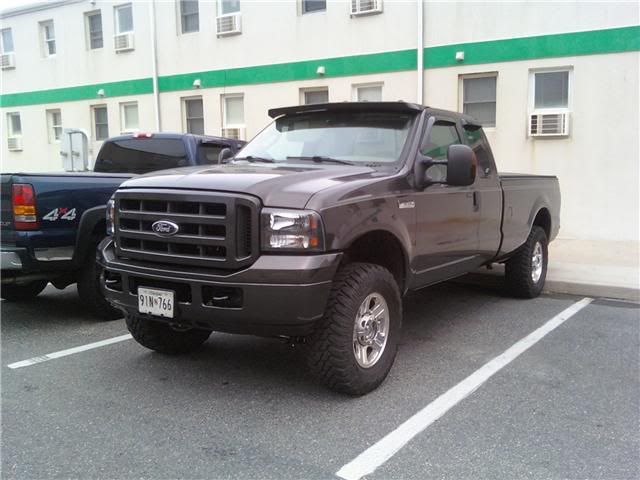
larger tires (35's) wont hurt mileage on a diesel as much as a gas truck, when I stepped up to 35's I lost around 1-1.5 mpg overall. so I went from around 14 (with 33's) down to around 12ish mpg with 35's. those arent highway numbers... my truck with stock 265's got a little over 17 on road trips, now I get 15.5 just made a recent trip to the beach and was not babying it to get each n every mile out of my gas, I had AC on the whole time and shift rpms were around 3K. truck in sig. If I was worried about my MPG I woulda kept my Tacoma. 22+ mpg. These trucks look retarded with little tires, even 35's look a little small.
Stock Form from Dealership

with Stock 275/70/18 Conti's

35x12.50 Cooper STT's and 1" Leveling Spacer up front.
Stock Form from Dealership
with Stock 275/70/18 Conti's
35x12.50 Cooper STT's and 1" Leveling Spacer up front.

Fleet Mechanic


Joined: Feb 2007
Posts: 1,852
Likes: 39

I don't have really large tires, but here's some data.
I burned 15 tanks of fuel through my truck with 265/75/16's (31.65"), and averaged 14.124 mpg.
I then changed to 285/75/16's (32.83"), and have burned 42 tanks for an average mpg of 13.729 mpg.
These numbers take into account the odometer error caused by the tire change. In fact, the odometer/speedometer was incorrect with the old tires. It is dead-on accurate with the new ones.
Summary: Going to the larger tires dropped my mileage by 2.8%, but it looks and rides way better.
I burned 15 tanks of fuel through my truck with 265/75/16's (31.65"), and averaged 14.124 mpg.
I then changed to 285/75/16's (32.83"), and have burned 42 tanks for an average mpg of 13.729 mpg.
These numbers take into account the odometer error caused by the tire change. In fact, the odometer/speedometer was incorrect with the old tires. It is dead-on accurate with the new ones.
Summary: Going to the larger tires dropped my mileage by 2.8%, but it looks and rides way better.

Posting Guru
Joined: Jul 2005
Posts: 1,617
Likes: 4
From: Denver, Co
I went from an '05 Lariat to an '06 Harley--both were 6.0L's, CC, SB, 4x4, 3.73's, F-250's.
The Lariat had LT245/75Rx17E BSW A/S = 31.5" x 9.6" x 7.2" tires.
The Harley had LT275/65Rx20E OWL A/T = 34.1" x 10.8" x 7" tires.
The 6.0L Powerstroke did quite well at masking the difference in the tire sizes from a "butt dyno" perspective. Off the line & accelerations were fairly equivalent. However, I saw a solid 1.5 - 2 MPG drop in fuel economy--roughly from 16 to 14.5 (city).
This kind of stands to reason, if you think about it. The larger Harley tire & rim combo is significantly heavier which translates to a heavier rotational mass, and they were taller & wider which increases wind & road resistances.
The Lariat had LT245/75Rx17E BSW A/S = 31.5" x 9.6" x 7.2" tires.
The Harley had LT275/65Rx20E OWL A/T = 34.1" x 10.8" x 7" tires.
The 6.0L Powerstroke did quite well at masking the difference in the tire sizes from a "butt dyno" perspective. Off the line & accelerations were fairly equivalent. However, I saw a solid 1.5 - 2 MPG drop in fuel economy--roughly from 16 to 14.5 (city).
This kind of stands to reason, if you think about it. The larger Harley tire & rim combo is significantly heavier which translates to a heavier rotational mass, and they were taller & wider which increases wind & road resistances.
Fleet Mechanic
Joined: Feb 2007
Posts: 1,852
Likes: 39
You show a 9.4% drop in fuel mileage when increasing your tire diameter by 8.25%. Definitely not a coincidence. Increasing the wheel radius (measured from the center of the axle to the ground) by 8.25% means that, for a given speed, it will take 8.25% more axle torque to push the truck down the road. Depending on where you are in the engine's HP curve, this could have a significant effect.
The actual weight difference between the old wheels and the new ones is virtually insignificant, when compared to the above. Relatively speaking, it takes very little power to get the wheels spinning and keep them spinning, compared to what it takes to actually push the truck down the road.

Cargo Master
Joined: Apr 2007
Posts: 2,659
Likes: 2
Bigger tires add weight, increase contact area with the road, increase the load on the engine, and reduces aerodynamic properties of the vehicle. All four of these things add up to reduce mileage.
Added weight on the rotating assembly is a double whammy against you. Not only do you have to move the extra weight down the road, but you also have to overcome the inertia of the mass to rotate the wheels and accelerate. It robs more power then just putting the same weight in the bed of the truck.
Larger tires have wider widths and people usually opt for more aggressive off-road tread patterns. This increases parasitic drag.
Final gear ratio includes the tire diameter and the original tire sizes and were probably optimized for fuel economy. Increasing diameter increases the engine torque needed to move your truck down the road. More torque requires more fuel.
Raising the height of the truck increases aerodynamic drag by letting more air pass under the truck and increasing frontal area.
Added weight on the rotating assembly is a double whammy against you. Not only do you have to move the extra weight down the road, but you also have to overcome the inertia of the mass to rotate the wheels and accelerate. It robs more power then just putting the same weight in the bed of the truck.
Larger tires have wider widths and people usually opt for more aggressive off-road tread patterns. This increases parasitic drag.
Final gear ratio includes the tire diameter and the original tire sizes and were probably optimized for fuel economy. Increasing diameter increases the engine torque needed to move your truck down the road. More torque requires more fuel.
Raising the height of the truck increases aerodynamic drag by letting more air pass under the truck and increasing frontal area.
Posting Guru
Joined: Mar 2007
Posts: 1,191
Likes: 1
Everytime I have put bigger tires on anything, my fuel economy has dropped... Many reason can cause this, here are a few.
More rotating mass
More tire surface touching the ground
More torque needed to start off when stopped
With bigger tires the vehicle will sit higher, changine the drag under the vehicle. The reason Ford put that little plastic valance under the front bumper. also the reason race cars want the front end as low as possible.(less drag)
One could argue, the engine is turning slower, as a result of larger tires. Seems reasonable. I have never experienced this though.
Taller tires are also a bit wider so, I am talking about tires that are not rediculously larger, but simply 33 or 35's.
More rotating mass
More tire surface touching the ground
More torque needed to start off when stopped
With bigger tires the vehicle will sit higher, changine the drag under the vehicle. The reason Ford put that little plastic valance under the front bumper. also the reason race cars want the front end as low as possible.(less drag)
One could argue, the engine is turning slower, as a result of larger tires. Seems reasonable. I have never experienced this though.
Taller tires are also a bit wider so, I am talking about tires that are not rediculously larger, but simply 33 or 35's.
Trending Topics

Post Fiend
Joined: Mar 2007
Posts: 26,966
Likes: 50
From: Texas
Welcome to FTE Jed. Some things you just can't escape. Yes bigger tires will always hurt the MPG's. It varies how much with the motor. No jumping to a tire a little bigger won't hurt the 6.0. In fact, you probably won't even notice a difference.
Put a 20,000 lb trailer on the back of your truck, and you'll notice a significant drop off in acceleration. Put on some 35" shoes and you'll notice which tree limbs in your neighborhood need a little trimming.
Put a 20,000 lb trailer on the back of your truck, and you'll notice a significant drop off in acceleration. Put on some 35" shoes and you'll notice which tree limbs in your neighborhood need a little trimming.
FTE Stories
Ford Trucks for Ford Truck Enthusiasts

Top 10 Most Expensive Ford Trucks Ever Sold on Bring a Trailer
Joe Kucinski
2027 Ford Super Duty Buyer's Guide (Every Model, Engine, & Package)
Brett Foote
Top 10 Ford Truck Tragedies
Joe Kucinski
AEV FXL Super Duty - the Super Duty Raptor Ford Doesn't Make
Brett Foote
Lobo Vs Lobo: Proof the F-150 Lobo Should Be Even Lower!
Michael S. Palmer
Ford's 2001 Explorer Sportsman Concept Looks For a New Home
Verdad Gallardo
10 Best Ford Truck Engines We Miss the Most!
Joe Kucinski
2026 Shelby F-150 Off-Road: Better Than a Raptor R?
Brett Foote
2027 Super Duty Carhartt Package First Look: 12 Things You NEED to Know!
Michael S. Palmer

Cargo Master


Joined: Jan 2009
Posts: 2,769
Likes: 8
From: Lubbock
Haven't figured the difference exactly but I drove to austin and then turned around and drove to taos last weekend. Generally see 17-18 on the overhead calculator with 35" tires on stock rims and the speedo being 5mph off at 70 I saw a solid 14.2-14.3 on the overhead. Not sure yet what the exact mpg is just yet but I'm guessing 15ish down from 16-17 at the same speeds. She is a lot slower from the butt dyno as well

Senior User
Joined: Jan 2007
Posts: 115
Likes: 0
From: Phoenix
Interresting info guys and it's a nice science experiment but when I bought my V10 I didn't really think about gas mileage economy. I am not wealthy by anyones standards but I bought this truck to take me hunting and to haul my stuff. I think Ford makes the best truck on the planet and if they want to put forth the effort to give me power and utility in a more gas efficient package I would welcome it but for now I just want grunt.
Just my .02
Just my .02
Lead Driver

Joined: Dec 2006
Posts: 7,092
Likes: 145
From: San Diego, CA
Interresting info guys and it's a nice science experiment but when I bought my V10 I didn't really think about gas mileage economy. I am not wealthy by anyones standards but I bought this truck to take me hunting and to haul my stuff. I think Ford makes the best truck on the planet and if they want to put forth the effort to give me power and utility in a more gas efficient package I would welcome it but for now I just want grunt.
Just my .02
Just my .02


Thread
Thread Starter
Forum
Replies
Last Post
Baatzy
Pre-Power Stroke Diesel (7.3L IDI & 6.9L)
15
Apr 13, 2015 08:45 AM
Purebeef
1973 - 1979 F-100 & Larger F-Series Trucks
1
Mar 25, 2015 12:34 PM
rdmobile
1999 - 2016 Super Duty
4
Nov 20, 2013 05:05 PM
