


Early 90's 351w

Thread Starter
|
Senior User
Joined: May 2009
Posts: 127
Likes: 0
Early 90's 351w
I have a chance to pick up a early 90's 351w that needs rebuilt. I plan to look at it tomorrow (Friday) or Saturday.
My question is will I have much trouble placing it in my 1970 F100. I am sure I can still use my 1970 302 heads if i wish. I don't know if it's FI or carb (I will carb it). My main issue is distributor and I also assume it's a roller block too.
I have never had a 351 so it's all new to me.
thanks for any advice, I don't want to waste my cash on the block if it will be a nightmare.
My question is will I have much trouble placing it in my 1970 F100. I am sure I can still use my 1970 302 heads if i wish. I don't know if it's FI or carb (I will carb it). My main issue is distributor and I also assume it's a roller block too.
I have never had a 351 so it's all new to me.
thanks for any advice, I don't want to waste my cash on the block if it will be a nightmare.
FTE Legend


Joined: Jun 2006
Posts: 31,930
Likes: 1,499
From: Ottawa, Ontario
The 351 block didn't become roller ready until 1994, but all 5.8 motors after 1987 were EFI. It will have E7 heads on it which are fine for a street vehicle and will respond to a cam upgrade.. which I highly recommend. You'll need an earlier 351 distributor with either the duraspark setup or points.. the EFI dissy is no good to you, and of course a 351 intake for the carb, the 302 versions won't fit this block. The motor will bolt right in where the 302 was on the same engine mounts but this block won't have the mounting location for a mechanical clutch like the old blocks since all the newer trucks with manuals use a hydraulic clutch.
Thread Starter
|
Senior User
Joined: May 2009
Posts: 127
Likes: 0
Thank you for the info, I have an automatic so I should be good there. I don't have any EGR gear on my 1970 F100, can I block the ports in the heads if the E7's have them (I am sure they do) or should I change the heads to a Non-EGR type? I look at the engine on Sunday, I will have cash in hand.
thanks again,
thanks again,

Cargo Master


Joined: May 2007
Posts: 2,071
Likes: 36
From: British Columbia
EGR blockoff
Removing the EGR crossover tube from the rear of the heads will expose the long drilled passages in the heads. These passages are tapped 5/8 NC, so can be plugged with that size of short bolt or set screw.
FTE Legend
Joined: Jun 2006
Posts: 31,930
Likes: 1,499
From: Ottawa, Ontario
Those holes are not the EGR passages they are part of the air injection system.. but they can still blocked as mentioned. The EGR ports are in the center of the heads between the middle intake ports and they match up with another passage in the intake. All you have to do is put a plate over the spot where the EGR valve would go on the outside of the intake and the system is disabled.
Cargo Master
Joined: May 2007
Posts: 2,071
Likes: 36
From: British Columbia
Oops, thanks for the correction, Conanski. As you say, those ports connect to passages in the intake manifold. On carburated engines this is simply an exhaust crossover to heat the air fuel mixture under the carburetor.
On early carburetor intake manifolds there is no external EGR port to block off.
On early carburetor intake manifolds there is no external EGR port to block off.
Thread Starter
|
Senior User
Joined: May 2009
Posts: 127
Likes: 0
Oops, thanks for the correction, Conanski. As you say, those ports connect to passages in the intake manifold. On carburated engines this is simply an exhaust crossover to heat the air fuel mixture under the carburetor.
On early carburetor intake manifolds there is no external EGR port to block off.
On early carburetor intake manifolds there is no external EGR port to block off.
Things are looking up, hope the gentleman still has the block..
Trending Topics
Cargo Master
Joined: May 2007
Posts: 2,071
Likes: 36
From: British Columbia
"So if I get an intake that has no EGR port I will not have to do anything?"
Yes, that's correct. If you do use the EGR type intake, there are a couple types of styles used. The aluminum 2V stocker has a separate rectangular port that can be blocked off with a piece of 1/4" aluminum cut and drilled to suit, while the HO 4V stock cast iron intake (1983-86, or so) has the EGR port as part of the carb mounting surface, so is usually blocked off by placing a steel shim under the carb spacer.
If using early non-EGR intakes, there is the issue of 12 bolt holes vs. 16 bolt holes. This refers to the number of bolts attaching the intake manifold to the cylinder heads. The 16 bolt hole type needs those extra 4 holes blocked off when used with later engines. The switch was made in the early 70s so the early 16 bolt hole types are the stock C90E 4V intakes, which are still commonly encountered at swap meets, and early aftermarket pieces.
"...and I can use a 'plug' to block the air passage? "
Yes, but use the correct 5/8"-11 NC bolts, not pipe plugs.
Yes, that's correct. If you do use the EGR type intake, there are a couple types of styles used. The aluminum 2V stocker has a separate rectangular port that can be blocked off with a piece of 1/4" aluminum cut and drilled to suit, while the HO 4V stock cast iron intake (1983-86, or so) has the EGR port as part of the carb mounting surface, so is usually blocked off by placing a steel shim under the carb spacer.
If using early non-EGR intakes, there is the issue of 12 bolt holes vs. 16 bolt holes. This refers to the number of bolts attaching the intake manifold to the cylinder heads. The 16 bolt hole type needs those extra 4 holes blocked off when used with later engines. The switch was made in the early 70s so the early 16 bolt hole types are the stock C90E 4V intakes, which are still commonly encountered at swap meets, and early aftermarket pieces.
"...and I can use a 'plug' to block the air passage? "
Yes, but use the correct 5/8"-11 NC bolts, not pipe plugs.
FTE Stories
Ford Trucks for Ford Truck Enthusiasts

Top 6 Best Deals Available on New Fords & Lincolns Right Now
Brett Foote
This Hennessey Takes the Expedition Tremor's Off-Roading Capability to the Next Level
Verdad Gallardo
Top 10 Fords at 2026 Carlisle Ford Nationals
Joe Kucinski
3 Best / 3 Worst Parts of Modern Ford Ownership
Brett Foote
10 Amazing Upgrades That Solve Common Ford Truck Owner Headaches
Pouria Savadkouei
Every 2026 Ford Engine Explained
Brett Foote
10 Ugly Ford Trucks That We Still Kinda Love
Joe Kucinski
10 Things Every Truck Owner NEEDS (2026 Edition)
Michael S. Palmer
Rezvani's Latest Post-Apocalyptic Monster Is a Ford F-150 Raptor Underneath
Verdad Gallardo
Cargo Master
Joined: May 2007
Posts: 2,071
Likes: 36
From: British Columbia
16 bolt and 12 bolt intake images
Let's see if I can add links to, or the actual images of the 16 bolt vs. 12 bolt intakes:
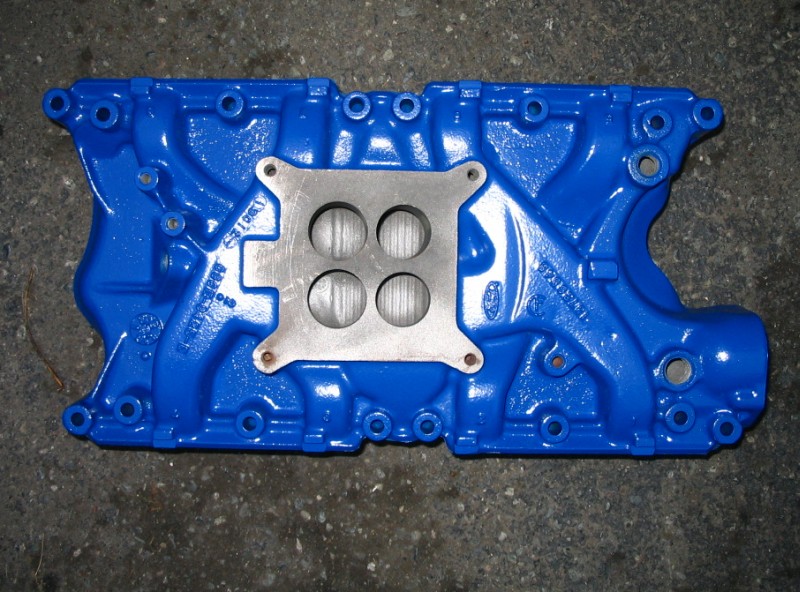
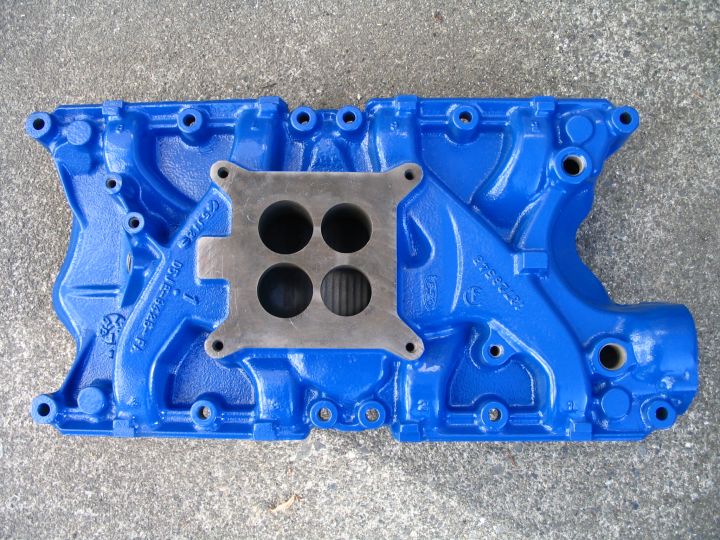
Note that other than the four bolt holes left undrilled, the 12 bolt intake is functionally identical to the 16 bolt, it was a later marine engine part made after the 351W-4V was discontinued.
The problem with those extra four bolt holes is when using later cylinder heads, there's no threaded holes to accept bolts there. However, there's water passages instead so the holes must be plugged or coolant will pour out.
The later 1983-86 4V intake manifold had a slot for the EGR on the right(?) side of the carb holes, but I can't find an image of it.
Note that other than the four bolt holes left undrilled, the 12 bolt intake is functionally identical to the 16 bolt, it was a later marine engine part made after the 351W-4V was discontinued.
The problem with those extra four bolt holes is when using later cylinder heads, there's no threaded holes to accept bolts there. However, there's water passages instead so the holes must be plugged or coolant will pour out.
The later 1983-86 4V intake manifold had a slot for the EGR on the right(?) side of the carb holes, but I can't find an image of it.

FTE Sponsor
Joined: Aug 2006
Posts: 755
Likes: 0
I have a chance to pick up a early 90's 351w that needs rebuilt. I plan to look at it tomorrow (Friday) or Saturday.
My question is will I have much trouble placing it in my 1970 F100. I am sure I can still use my 1970 302 heads if i wish. I don't know if it's FI or carb (I will carb it). My main issue is distributor and I also assume it's a roller block too.
I have never had a 351 so it's all new to me.
thanks for any advice, I don't want to waste my cash on the block if it will be a nightmare.
My question is will I have much trouble placing it in my 1970 F100. I am sure I can still use my 1970 302 heads if i wish. I don't know if it's FI or carb (I will carb it). My main issue is distributor and I also assume it's a roller block too.
I have never had a 351 so it's all new to me.
thanks for any advice, I don't want to waste my cash on the block if it will be a nightmare.
#If you decide to get a new distributor, consider our custom curved Duraspark Distributor built with our new Full Length Oil Impregnated Bronze Bushing. The full length bushing improves timing stability and spark scatter. If stock appearance is not an issue, take a look at our one piece D.U.I. Distributor. Whether you choose the Duraspark or the D.U.I., we curve each on a distributor machine based on your engine combination. Please see them at:
http://performancedistributors.com/forddistributors.htm
Also, there is now an excellent installation article on the D.U.I. Distributor on the Ford-Trucks.com site at:
https://www.ford-trucks.com/article/idx/0/358/article/DUI_Ignition_Installation_In_A_Ford_351W_V8.html
Ignition Lesson of the Month: Hystereses, the difference between the timing as the rpm and vacuum increases to the timing as rpm and vacuum decrease, needs to be kept to a minimum. A precise advance curve accomplishes this.
__________________
FTE Sponsor
Performance Distributors
www.PerformanceDistributors.com
FTE Sponsor
Performance Distributors
www.PerformanceDistributors.com

Thread
Thread Starter
Forum
Replies
Last Post
jwcnj45
Small Block V8 (221, 260, 289, 5.0/302, 5.8/351W)
4
Jan 3, 2017 09:30 AM
Rusty_S
Small Block V8 (221, 260, 289, 5.0/302, 5.8/351W)
5
Jun 22, 2016 07:52 AM
packratF350
Small Block V8 (221, 260, 289, 5.0/302, 5.8/351W)
16
Dec 12, 2011 07:53 AM
Ken Blythen
1980 - 1986 Bullnose F100, F150 & Larger F-Series Trucks
9
May 19, 2010 01:45 PM
