




Nylon air lines?

Thread Starter
|
Cargo Master


Joined: Apr 2003
Posts: 3,476
Likes: 224
From: Frequently frozen MN
Nylon air lines?
I just read about running nylon air lines for your compressor. Apparently they're available at Eastwood along with the fittings.
The author mentioned that he had been through the black pipe system ( eventually rusts) as well as the PVC system ( exploded and apparently scared the *** out of him). So, he's not new to the issues.
Here's a sample of what Eastwood has
http://www.eastwood.com/100-ft-rapid...arage-kit.html
Just wondered if anybody had any opinions. This is simple enough that I might be able to manage it.
The author mentioned that he had been through the black pipe system ( eventually rusts) as well as the PVC system ( exploded and apparently scared the *** out of him). So, he's not new to the issues.
Here's a sample of what Eastwood has
http://www.eastwood.com/100-ft-rapid...arage-kit.html
Just wondered if anybody had any opinions. This is simple enough that I might be able to manage it.

Senior User
Joined: Jul 2009
Posts: 102
Likes: 0
From: Bozeman, Montana
Nylon is almost indestructible. I have used the nylon air line and fittings for fixing air lines on semi trucks. They also send that stuff with the firestone load helpers for light duty trucks. I think you should go with it.

Posting Guru
Joined: Sep 2004
Posts: 1,616
Likes: 3
From: Sapulpa OK

The clear or white nylon tubing does not like sunlight. It will deteriorate in the sun rapidly. The black tubing will work well in the sun.
Trending Topics

More Turbo
Joined: Aug 2006
Posts: 530
Likes: 2
From: W. Wisc
I like copper for air lines as it can handle the pressure and is easier to deal with than threading iron. But either one works fine. Just avoid PVC unless you have a death wish. Haven't looked into the nylon, but it is used for air hoses a lot (the coiled retractable type are typically nylon).
Dave
FTE Stories
Ford Trucks for Ford Truck Enthusiasts

Top 10 Fords at 2026 Carlisle Ford Nationals
Joe Kucinski
3 Best / 3 Worst Parts of Modern Ford Ownership
Brett Foote
10 Amazing Upgrades That Solve Common Ford Truck Owner Headaches
Pouria Savadkouei
Every 2026 Ford Engine Explained
Brett Foote
10 Ugly Ford Trucks That We Still Kinda Love
Joe Kucinski
10 Things Every Truck Owner NEEDS (2026 Edition)
Michael S. Palmer
Rezvani's Latest Post-Apocalyptic Monster Is a Ford F-150 Raptor Underneath
Verdad Gallardo
Top 10 Most Expensive Ford Trucks Ever Sold on Bring a Trailer
Joe Kucinski
2027 Ford Super Duty Buyer's Guide (Every Model, Engine, & Package)
Brett Foote
Hotshot
Joined: Oct 2002
Posts: 18,488
Likes: 22
From: The Big, Oregon
Trucks use a type of nylon air line, and yes PVC is bad.
Here's a shot of a line that came apart at a shop I was working at:
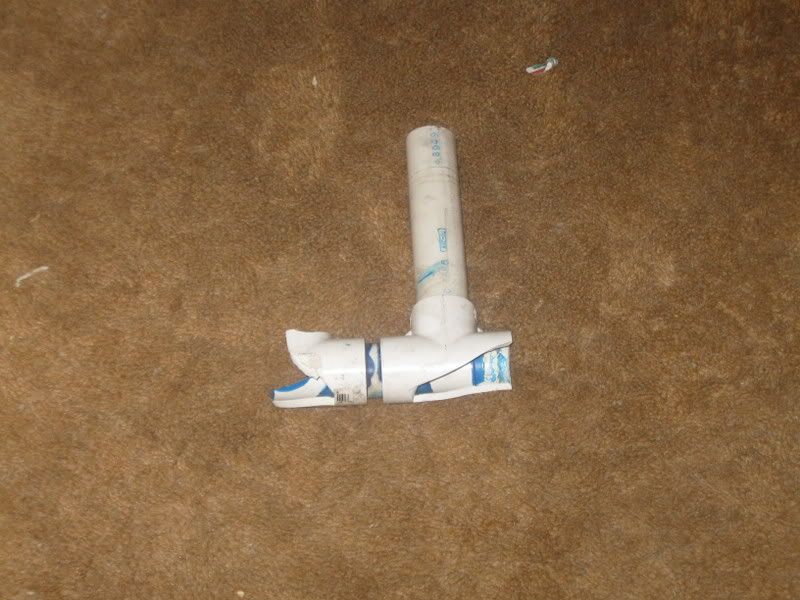
It happened at night while nobody was there, and tore the paper off about a foot square area of drywall, and kicked that line hard enough it actually broke that run at the other end also. The missing pieces went through the foil-faced foam sheet in the ceiling.
Here's a shot of a line that came apart at a shop I was working at:
It happened at night while nobody was there, and tore the paper off about a foot square area of drywall, and kicked that line hard enough it actually broke that run at the other end also. The missing pieces went through the foil-faced foam sheet in the ceiling.
Posting Guru
Joined: Nov 2006
Posts: 1,347
Likes: 0
That looks like PEX tubing with shark bite fitings thats used in plumbing. Its supposed to be able to handle 300 PSI if I remember correctly. I will still go with black iron. One thing you have to remember with air compressors and air lines (this is why I like black iron) is that its not necesarily about the PSI, but volume for your air tools. When I run my air lines, I always put a 2" x 3 to 4 foot pipe off the compressor (after the flex line off the compressor) then reduce to either 1" or 3/4", depending on how far the run is. Ultimately I always end with 3/4" tube. If you slope the pipe correctly, rust will never be an issue (they do use it for water as well) and install the proper water/oil seperators that will keep debris out of the tools.

Fleet Mechanic
Joined: Jul 2005
Posts: 1,467
Likes: 107
From: Staten Island, NY
It doesn't look like a bad idea. The one thing I would want to check, though, is if the path thru all the fittings is actually 1/2" at all points. The smallest point in the entire system determines maximum air flow. Also if you have a 1/2" line feeding a tee fitting with 2 more 1/2" lines attached to it and use both branches at the same time your air flow is cut in half. That's why in most larger facilities they use 3/4" or 1" main lines with 1/2" drops to the individual outlets. You can help with this problem by running a complete loop of tubing around the garage, connected to the compressor at both ends. Then splice in tee fittings feeding each drop. That way the drop is fed from both ends.

The Pacifier
Joined: Jan 2003
Posts: 8,245
Likes: 7
From: Cloverdale, BC

The thing you gotta be careful of is air leaks from the push in fittings. If the air line isn't cut square, or you pinch it as you cut with ... say, sidecutters, the fitting will leak 100% of the time.
That said, I'd have no problem setting up my shop with synflex. Quick and easy.
That said, I'd have no problem setting up my shop with synflex. Quick and easy.
The Pacifier
Joined: Jan 2003
Posts: 8,245
Likes: 7
From: Cloverdale, BC
Yeah, those push in fittings are prone to leakage. I prefer the push in though, as long as I'm working with all new stuff. The nut and ferrule are pretty much guaranteed not to leak though.

Thread
Thread Starter
Forum
Replies
Last Post
good to doo
1973 - 1979 F-100 & Larger F-Series Trucks
4
Aug 7, 2016 12:30 AM
jerry_s
1948 - 1956 F1, F100 & Larger F-Series Trucks
3
Feb 4, 2016 05:19 AM
cosmaar1
1948 - 1956 F1, F100 & Larger F-Series Trucks
12
Oct 17, 2014 11:41 AM
