




300 I6 pulling power
Thread Starter
|
Post Fiend
Joined: Jan 2007
Posts: 7,021
Likes: 5
From: Almost Heaven
300 I6 pulling power
Hi guys
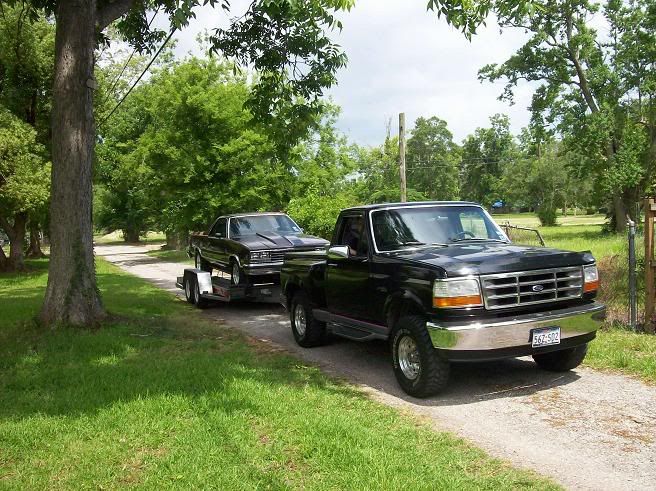
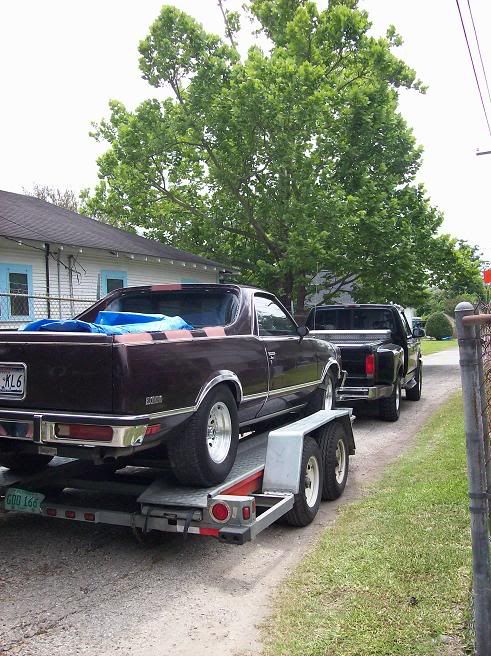
Just pulled my dad's Elky on a car hauler (pics later). The combo weighed in around 5,500 lbs. I went around the block a few times, I didn't go far. All I ever heard was how strong a pulling motor the 300 is. I was disapointed in how my truck handled, but I've never towed anything before (asides from pulling stuck trucks out of the mud).
I have the e40d and 4.11 gear ratio with 31'' tires. I never went past 2,000 rpm to get it going but it felt hard to get going. Is this normal?
Just wondering what "normal" feels like pulling a 6,000 lb load. I know my owner's manual says an F-250 with the 4.10 gear / 300 I6 is rated to two 11,000 lbs. I would not want to tow that much in my truck after pulling 6,000 lbs.
Just wanting thoughts and opinions from you guys. My first time pulling / backing a trailer with a full size car (I did pretty dang good, too!)
-Bill
Ps. Once I got the load moving, it didn't feel bad at all. I'm just wondering if it's supposed to feel so hard to get going. On a side note, my truck sounded just like a dump truck. Sounded really cool
Just pulled my dad's Elky on a car hauler (pics later). The combo weighed in around 5,500 lbs. I went around the block a few times, I didn't go far. All I ever heard was how strong a pulling motor the 300 is. I was disapointed in how my truck handled, but I've never towed anything before (asides from pulling stuck trucks out of the mud).
I have the e40d and 4.11 gear ratio with 31'' tires. I never went past 2,000 rpm to get it going but it felt hard to get going. Is this normal?
Just wondering what "normal" feels like pulling a 6,000 lb load. I know my owner's manual says an F-250 with the 4.10 gear / 300 I6 is rated to two 11,000 lbs. I would not want to tow that much in my truck after pulling 6,000 lbs.
Just wanting thoughts and opinions from you guys. My first time pulling / backing a trailer with a full size car (I did pretty dang good, too!)
-Bill
Ps. Once I got the load moving, it didn't feel bad at all. I'm just wondering if it's supposed to feel so hard to get going. On a side note, my truck sounded just like a dump truck. Sounded really cool
Elder User

Joined: Sep 2008
Posts: 563
Likes: 0
From: DeKalb, Ill.
What's the stall in you torque converter?
It may be letting that little turtle rev too high into it's power band before it engages.
Just my guess.
For this reason, I've never liked the 300 paired up with a slushbox.
Sure, you take a little life off the clutch slipping it at 1500 rpm,
but you're in control of where the drive train engages.
Murph.
Thread Starter
|
Post Fiend
Joined: Jan 2007
Posts: 7,021
Likes: 5
From: Almost Heaven
I suspect this may be an automatic trans thing.
What's the stall in you torque converter?
It may be letting that little turtle rev too high into it's power band before it engages.
Just my guess.
For this reason, I've never liked the 300 paired up with a slushbox.
Sure, you take a little life off the clutch slipping it at 1500 rpm,
but you're in control of where the drive train engages.
Murph.
What's the stall in you torque converter?
It may be letting that little turtle rev too high into it's power band before it engages.
Just my guess.
For this reason, I've never liked the 300 paired up with a slushbox.
Sure, you take a little life off the clutch slipping it at 1500 rpm,
but you're in control of where the drive train engages.
Murph.
Edit: Does it help to know my truck came with a pulling package with a 3.08 gear ratio??
Our Uhaul is a Big Block powered Ford that doesn't like to rev past 3,000 rpm. It's a puller alright!
Elder User
Joined: Sep 2008
Posts: 563
Likes: 0
From: DeKalb, Ill.
Bill, picture this.
A fan running, and directly in front of it, is a fan that is off.
The running fan will spin the fans blades that are directly in front of it. See?
Your stall is like the resistance of that fan that is off.
How fast must that running fan blow the air to spin the fan that is in front of it.
In the case of your trans, how fast does your engine need to spin
to spit trans fluid through that "second fan" to get it spinning.
That "second fan" is attached to your drive train.
Once you get that to spin, your wheels turn. Make sense?
Your torque converter has a "stall" number.
The stall number is the rpm your engine must reach before
your torque converter will engage and transfer power to the rear wheels.
It's sorta what you can do by working the clutch.
The main difference is that you are in charge...
not some dumb junky mechanical thing.
You might be able to tell that I am biased.
As far as what stall Ford used on your trans, I dunno.
Hope this helps your understanding,
Murph.
P.S. Knowing is half the battle.... Go Joe!
A fan running, and directly in front of it, is a fan that is off.
The running fan will spin the fans blades that are directly in front of it. See?
Your stall is like the resistance of that fan that is off.
How fast must that running fan blow the air to spin the fan that is in front of it.
In the case of your trans, how fast does your engine need to spin
to spit trans fluid through that "second fan" to get it spinning.
That "second fan" is attached to your drive train.
Once you get that to spin, your wheels turn. Make sense?
Your torque converter has a "stall" number.
The stall number is the rpm your engine must reach before
your torque converter will engage and transfer power to the rear wheels.
It's sorta what you can do by working the clutch.
The main difference is that you are in charge...
not some dumb junky mechanical thing.
You might be able to tell that I am biased.
As far as what stall Ford used on your trans, I dunno.
Hope this helps your understanding,
Murph.
P.S. Knowing is half the battle.... Go Joe!
Trending Topics
Thread Starter
|
Post Fiend
Joined: Jan 2007
Posts: 7,021
Likes: 5
From: Almost Heaven
Thanks a lot Murph!
Maybe my truck didn't do as "bad" as I originally thought. The load was at least 6,000 now that I think about it.
Maybe my truck didn't do as "bad" as I originally thought. The load was at least 6,000 now that I think about it.
FTE Stories
Ford Trucks for Ford Truck Enthusiasts

Top 10 Fords at 2026 Carlisle Ford Nationals
Joe Kucinski
3 Best / 3 Worst Parts of Modern Ford Ownership
Brett Foote
10 Amazing Upgrades That Solve Common Ford Truck Owner Headaches
Pouria Savadkouei
Every 2026 Ford Engine Explained
Brett Foote
10 Ugly Ford Trucks That We Still Kinda Love
Joe Kucinski
10 Things Every Truck Owner NEEDS (2026 Edition)
Michael S. Palmer
Rezvani's Latest Post-Apocalyptic Monster Is a Ford F-150 Raptor Underneath
Verdad Gallardo
Top 10 Most Expensive Ford Trucks Ever Sold on Bring a Trailer
Joe Kucinski
2027 Ford Super Duty Buyer's Guide (Every Model, Engine, & Package)
Brett Foote
Elder User
Joined: Oct 2008
Posts: 708
Likes: 1
Murph is right. The fact that you had to rev it to get the load moving is simply the nature of the beast with an automatic setup. Not an failing on the part of your engine.
The impeller (the part of a TC connected to the crank) has to accelerate ATF and slam it into the turbine (part splined to tranny input shaft). It's a fluid imparting it's inertial energy to the turbine that moves the truck. Not a mechanical connection like in a manual. If your turbine has a much greater resistance to turn (like towing) it takes much more inertial transfer from the fluid to get that turbine moving. And the only way to do that is to accelerate the impeller (crank speed) more so that the ATF gets slammed into the turbine harder and harder and finally gets it moving. Even a big old 460 with an automatic has to rev up more than normal to get a trailer moving. It's the slipping of fluid in the TC and not the engine being a pansy.
The impeller (the part of a TC connected to the crank) has to accelerate ATF and slam it into the turbine (part splined to tranny input shaft). It's a fluid imparting it's inertial energy to the turbine that moves the truck. Not a mechanical connection like in a manual. If your turbine has a much greater resistance to turn (like towing) it takes much more inertial transfer from the fluid to get that turbine moving. And the only way to do that is to accelerate the impeller (crank speed) more so that the ATF gets slammed into the turbine harder and harder and finally gets it moving. Even a big old 460 with an automatic has to rev up more than normal to get a trailer moving. It's the slipping of fluid in the TC and not the engine being a pansy.
Thread Starter
|
Post Fiend
Joined: Jan 2007
Posts: 7,021
Likes: 5
From: Almost Heaven
Murph is right. The fact that you had to rev it to get the load moving is simply the nature of the beast with an automatic setup. Not an failing on the part of your engine.
The impeller (the part of a TC connected to the crank) has to accelerate ATF and slam it into the turbine (part splined to tranny input shaft). It's a fluid imparting it's inertial energy to the turbine that moves the truck. Not a mechanical connection like in a manual. If your turbine has a much greater resistance to turn (like towing) it takes much more inertial transfer from the fluid to get that turbine moving. And the only way to do that is to accelerate the impeller (crank speed) more so that the ATF gets slammed into the turbine harder and harder and finally gets it moving. Even a big old 460 with an automatic has to rev up more than normal to get a trailer moving. It's the slipping of fluid in the TC and not the engine being a pansy.
The impeller (the part of a TC connected to the crank) has to accelerate ATF and slam it into the turbine (part splined to tranny input shaft). It's a fluid imparting it's inertial energy to the turbine that moves the truck. Not a mechanical connection like in a manual. If your turbine has a much greater resistance to turn (like towing) it takes much more inertial transfer from the fluid to get that turbine moving. And the only way to do that is to accelerate the impeller (crank speed) more so that the ATF gets slammed into the turbine harder and harder and finally gets it moving. Even a big old 460 with an automatic has to rev up more than normal to get a trailer moving. It's the slipping of fluid in the TC and not the engine being a pansy.
Yeah, I expected IMMIDIATE power off of idle (which I did, when it came to backing it in the garage, super slow speed. I could tell the low end power was coming into play here.)
I never knew there would be that much difference by just having an automatic. I mean, I'm sure I could have launched harder, but I was pulling 6,000 lbs; putting the pedal to the floor is not a good idea in this situation.
Thread Starter
|
Post Fiend
Joined: Jan 2007
Posts: 7,021
Likes: 5
From: Almost Heaven
Slushboxes are good for trucks that don't tow.

Elder User
Joined: Oct 2008
Posts: 708
Likes: 1
I agree that ZF's should have gone in everything and those mazda transmissions should never have existed.
Although I will say, people who only drive manuals because they just don't like slushboxes are control freaks
(your official flak, Murph )
)
Although I will say, people who only drive manuals because they just don't like slushboxes are control freaks
(your official flak, Murph
)
Thread Starter
|
Post Fiend
Joined: Jan 2007
Posts: 7,021
Likes: 5
From: Almost Heaven
Sure can't beat the sound ole' betsy was giving me though. Posessed Dump Truck
Elder User
Joined: Sep 2008
Posts: 563
Likes: 0
From: DeKalb, Ill.
Somehow I want to agree and disagree at the same time.
Wait, I'm not in control anymore... WHAT THE?!......