






Damage by Tire
Thread Starter
|
Senior User
Joined: Mar 2005
Posts: 249
Likes: 0
From: South Alabama
Damage by Tire
Had a bad experience this past weekend. $2000 worth of damage from tread seperation of left front tire. I knew I was pushing my luck with these tires. They are original and have 47000 mile on them. The tread seperated as I was passing a car at 63 MPH. I had my fiver behind me. Luckily the tire maintained the air and did not blow out. Tread did major damge to left front fender, inner liner, running board, front air dam and door. Tread went under trailer and hit the car I was passing. No damge to car other than crappy pants. Of course he was not alone. Georgia state trooper stopped while I was changing tire to assist. Waiting on parts for repairs now.
Cargo Master
Joined: Jan 2007
Posts: 2,243
Likes: 79
From: Roman Forest, TX
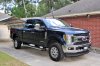
Hmmm, sounds familiar. Mine were General Ameritrac's, with about 55,000 miles on them. I was pulling my 26' travel trailer and a motorcycle in the rear end. Did yours look anything like this:


Lead Driver
Joined: Jun 2007
Posts: 6,757
Likes: 5
From: Corvallis, OR
Sorry about your problems. This is why you should always have good tires when towing though, age is as important as tread depth. Also, is it possible you had them under or over inflated?
Trending Topics

Postmaster
Joined: Jun 2008
Posts: 2,564
Likes: 11
From: Wayyy NoCal, USA
This is a great time to remind everyone about the nature of tires.
If you overload them even once, it is quite possible to cause permanent and invisible damage within the carcass. The tire may not blow or delaminate immediately - but the damage is done and they will eventually fail. The tread belts may hold it together for thousands or tens of thousands of miles, but eventually it will weaken and come apart.
And overload can mean putting more load on than allowed by the sidewall rating - OR -
Running them at lower than adequate pressure for conditions! That could mean running empty but at significantly low pressure. Yes, running a tire underinflated is just as bad as hauling heavier than allowed loads. Even an E rated tire.
The root cause is the tire carcass getting too hot and causing the various layers to delaminate - basically coming unglued. Most internal carcass heat is caused by the carcass flexing too much and causing more internal heat than the tire can dissipate.
Logic also explains why long trips and towing are even more stressful. They both result in additional sources of heat generation/accumulation in the carcass.
For this reason, I recommend being very conservative on when to replace tires on heavily worked trucks. The logic of "well, it hasn't failed yet so it ain't gonna" is not valid on a tire that was overloaded. The correct logic is "well, it hasn't failed yet, which means it is more likely to tomorrow" is more valid.
The objective engineers and scientists (those not being paid by Ford or Firestone) who reviewed the whole Firestone/Ford tire failure debacle from several years ago are pretty much convinced the real root cause was underinflation, NOT the tire construction. So the real persons to blame were the owners, not Firestone. But, jury decisions are notoriously not rational or scientifically valid.
If you overload them even once, it is quite possible to cause permanent and invisible damage within the carcass. The tire may not blow or delaminate immediately - but the damage is done and they will eventually fail. The tread belts may hold it together for thousands or tens of thousands of miles, but eventually it will weaken and come apart.
And overload can mean putting more load on than allowed by the sidewall rating - OR -
Running them at lower than adequate pressure for conditions! That could mean running empty but at significantly low pressure. Yes, running a tire underinflated is just as bad as hauling heavier than allowed loads. Even an E rated tire.
The root cause is the tire carcass getting too hot and causing the various layers to delaminate - basically coming unglued. Most internal carcass heat is caused by the carcass flexing too much and causing more internal heat than the tire can dissipate.
Logic also explains why long trips and towing are even more stressful. They both result in additional sources of heat generation/accumulation in the carcass.
For this reason, I recommend being very conservative on when to replace tires on heavily worked trucks. The logic of "well, it hasn't failed yet so it ain't gonna" is not valid on a tire that was overloaded. The correct logic is "well, it hasn't failed yet, which means it is more likely to tomorrow" is more valid.
The objective engineers and scientists (those not being paid by Ford or Firestone) who reviewed the whole Firestone/Ford tire failure debacle from several years ago are pretty much convinced the real root cause was underinflation, NOT the tire construction. So the real persons to blame were the owners, not Firestone. But, jury decisions are notoriously not rational or scientifically valid.
FTE Stories
Ford Trucks for Ford Truck Enthusiasts

Top 10 Fords at 2026 Carlisle Ford Nationals
Joe Kucinski
3 Best / 3 Worst Parts of Modern Ford Ownership
Brett Foote
10 Amazing Upgrades That Solve Common Ford Truck Owner Headaches
Pouria Savadkouei
Every 2026 Ford Engine Explained
Brett Foote
10 Ugly Ford Trucks That We Still Kinda Love
Joe Kucinski
10 Things Every Truck Owner NEEDS (2026 Edition)
Michael S. Palmer
Rezvani's Latest Post-Apocalyptic Monster Is a Ford F-150 Raptor Underneath
Verdad Gallardo
Top 10 Most Expensive Ford Trucks Ever Sold on Bring a Trailer
Joe Kucinski
2027 Ford Super Duty Buyer's Guide (Every Model, Engine, & Package)
Brett Foote
Cargo Master
Joined: Jan 2007
Posts: 2,243
Likes: 79
From: Roman Forest, TX
Well for me, my tires were not underinflated. I checked them constantly during this trip. But they were old. They were still okay (not good, but okay, and still good on the date code...only just over 3 years old) as far as tread is concerned, and they were balanced and rotated. But this was a long trip (from Houston to just north of Knoxville, TN and back). And while I was not overloaded (motorcycle and other gear may have gone 800 pounds, trailer tounge weight was about 400 pounds), it was loaded like that and driven for the two days there and two days back, and all the driving inbetween. I was going to get new tires when I got back from this trip (yeah I know...hindsight and all...I learned!).
I don't know if the truck/tires were ever overloaded prior to me getting it...I got it with 29,000 miles. Maybe, maybe not. The truck was (and still is) in superb shape. I think in my case, it was a combination of the tires just being driven, and too close to needing replacement, and the load and stress of that trip. I don't believe the tread should have separated like that, but I got over it. And I learned a lot from it. My current tires while still having great tread, have close to 40,000 miles, and I'm getting new ones pretty soon.
I don't know if the truck/tires were ever overloaded prior to me getting it...I got it with 29,000 miles. Maybe, maybe not. The truck was (and still is) in superb shape. I think in my case, it was a combination of the tires just being driven, and too close to needing replacement, and the load and stress of that trip. I don't believe the tread should have separated like that, but I got over it. And I learned a lot from it. My current tires while still having great tread, have close to 40,000 miles, and I'm getting new ones pretty soon.

Hotshot
Joined: Mar 2007
Posts: 10,101
Likes: 40
From: Pa
That really sucks. Don't take much nowadays to do $2k damage though. I liked my Ameritracs they left nice black marks and smoked nice. They were not even on my truck 20k miles before I upgraded.
I had two relatives with those recalled tires on their vehicles. Both sets were over 6 years old when they were replaced for free under warrenty. The whole deal was blown way out of porportion.
They were not even on my truck 20k miles before I upgraded.I had two relatives with those recalled tires on their vehicles. Both sets were over 6 years old when they were replaced for free under warrenty. The whole deal was blown way out of porportion.

FTE Leadership Emeritus
Joined: Jul 2002
Posts: 42,561
Likes: 423
From: Long Island USA

I had the stock General Grabber AT's on mine from the factory and at just about 2 years old, with almost no tread left, I was rotating them and found a big piece of tread missing.
Needless to say, I wasn't going on that 1000-mile roundtrip with those tires.
Glad I didn't.
Needless to say, I wasn't going on that 1000-mile roundtrip with those tires.
Glad I didn't.
Elder User
Joined: Feb 2006
Posts: 545
Likes: 5
From: FL
I had the similar tire delamination incident happened to me about a year ago . In my case , it was the fifth wheeler's tire that got delaminated and blown-up on interstate hwy. Partially delaminated tire caused some damage in the RV's tire-well as well as some damage outside the fender . At the time, my trailer tires were 5 years old & approx. 25K miles on them(more than half the thread was still on them ) . I always maintained tire press. and trailer was never overloaded . I encountered numerous RV owners in the RV discussion websites that had the same kind of tire problems . One thing I did not do was that I did not protect my RV tires from sun's UV degradation by covering them during the storage ( now I do , by using tire covers and UV protection sprays ) .
Another spin to this story ; My RV rims (wheels) turned out to have significant "horizontal run-out" (side-to-side ) on wheel balancing equipment while I was replacing all my RV tires . Then I purchased brand new rims to resolve the run-out issue . All the new rims purchased ( some made in USA and some made in China brands ) all had significant run-outs , unacceptable by automotive standards . First I did not believe the Sam's Club tire shop when they told me all the brand new rims I brought in had bad run-outs . I had this verified by another tire shop . I was going berserk .
Finally , a trailer axle manufacturer engineer at Dexter Axle Corp. put everything in perspective for me . Engineer stated that the "RV /trailer rims are not manufactured by the automotive standards (they are exempt ).
In my case , I blamed the horizontal run-out as being the prime contributor (second the UV degredation) since as the tire rolling on the highway with a horizontal run-out (side-to-side) causes additional shear forces on tire treads which will lead to delamination eventually .
What can I do to prevent it from happening again ? not much , cover the tires and/or use UV protector sprays frequently , change tires every 5 year (maximum life) regardless of tread left.
My rim run-out problem is still there , and if you have a trailer /RV most likely you have the same problem . Just be careful .
Ken
Another spin to this story ; My RV rims (wheels) turned out to have significant "horizontal run-out" (side-to-side ) on wheel balancing equipment while I was replacing all my RV tires . Then I purchased brand new rims to resolve the run-out issue . All the new rims purchased ( some made in USA and some made in China brands ) all had significant run-outs , unacceptable by automotive standards . First I did not believe the Sam's Club tire shop when they told me all the brand new rims I brought in had bad run-outs . I had this verified by another tire shop . I was going berserk .
Finally , a trailer axle manufacturer engineer at Dexter Axle Corp. put everything in perspective for me . Engineer stated that the "RV /trailer rims are not manufactured by the automotive standards (they are exempt ).
In my case , I blamed the horizontal run-out as being the prime contributor (second the UV degredation) since as the tire rolling on the highway with a horizontal run-out (side-to-side) causes additional shear forces on tire treads which will lead to delamination eventually .
What can I do to prevent it from happening again ? not much , cover the tires and/or use UV protector sprays frequently , change tires every 5 year (maximum life) regardless of tread left.
My rim run-out problem is still there , and if you have a trailer /RV most likely you have the same problem . Just be careful .
Ken
Postmaster
Joined: Jun 2008
Posts: 2,564
Likes: 11
From: Wayyy NoCal, USA
Well for me, my tires were not underinflated. I checked them constantly during this trip. But they were old. They were still okay (not good, but okay, and still good on the date code...only just over 3 years old) as far as tread is concerned, and they were balanced and rotated. But this was a long trip (from Houston to just north of Knoxville, TN and back). And while I was not overloaded (motorcycle and other gear may have gone 800 pounds, trailer tounge weight was about 400 pounds), it was loaded like that and driven for the two days there and two days back, and all the driving inbetween. I was going to get new tires when I got back from this trip (yeah I know...hindsight and all...I learned!).
I don't know if the truck/tires were ever overloaded prior to me getting it...I got it with 29,000 miles. Maybe, maybe not. The truck was (and still is) in superb shape. I think in my case, it was a combination of the tires just being driven, and too close to needing replacement, and the load and stress of that trip. I don't believe the tread should have separated like that, but I got over it. And I learned a lot from it. My current tires while still having great tread, have close to 40,000 miles, and I'm getting new ones pretty soon.
I don't know if the truck/tires were ever overloaded prior to me getting it...I got it with 29,000 miles. Maybe, maybe not. The truck was (and still is) in superb shape. I think in my case, it was a combination of the tires just being driven, and too close to needing replacement, and the load and stress of that trip. I don't believe the tread should have separated like that, but I got over it. And I learned a lot from it. My current tires while still having great tread, have close to 40,000 miles, and I'm getting new ones pretty soon.
And you are correct, the PO of your truck may have been one of those types who checked pressure once every 3 years.... So they may have been ticking when you bought it.
And yes, I did hear about Ford recommending to run lower pressures to "address" complaints about poor ride quality. I recall the pressures they were recommending were just (barely) on the safe side of allowable for the tires. But when you take into account how many people don't check and adjust pressures as often as they should and are usually running around with 5-10 psi less than recommended, that is cutting it close on safety margins. In hindsight, way too close to escape liability.