


1963 Generator/other problems

Thread Starter
|
Elder User
Joined: May 2009
Posts: 554
Likes: 1
1963 Generator/other problems
The generator on my 63' f100 is dead and I am going to replace it. the replacement is on it's way and should be here in a few days.
This is a pretty beat up truck. it hasnt run since about 2002. I charged the battery yesterday and tried to start it, but it wouldnt. I think the gas is bad and needs to be replaced. Whats the best way to get rid of old gas? there is probably 5 gallons in there at the most.
the second thing is that my dad said that the generator is "frozen and will not turn" apparently the last time he had it running the generator stopped and just seized up and is stuck. The generator light comes on when i try to start it. Again, im going to replace it.
I have a few questions-
Does the fan spin when the engine is starting (when its cranking)?
What caused the generator to stop and how can i prevent it?
also, does anyone here know where i can gen a diagram of the voltage regulator?
Does the engine require the belt to start up?
Is it as simple as taking the old generator out and putting in a new one and connecting the wires?
thanks in advance. This truck is old and has a fair amount of rust and 4 flat tires, but I am hoping to get it going. The first step is to see if i can get the engine going!
This is a pretty beat up truck. it hasnt run since about 2002. I charged the battery yesterday and tried to start it, but it wouldnt. I think the gas is bad and needs to be replaced. Whats the best way to get rid of old gas? there is probably 5 gallons in there at the most.
the second thing is that my dad said that the generator is "frozen and will not turn" apparently the last time he had it running the generator stopped and just seized up and is stuck. The generator light comes on when i try to start it. Again, im going to replace it.
I have a few questions-
Does the fan spin when the engine is starting (when its cranking)?
What caused the generator to stop and how can i prevent it?
also, does anyone here know where i can gen a diagram of the voltage regulator?
Does the engine require the belt to start up?
Is it as simple as taking the old generator out and putting in a new one and connecting the wires?
thanks in advance. This truck is old and has a fair amount of rust and 4 flat tires, but I am hoping to get it going. The first step is to see if i can get the engine going!

Mountain Pass

Joined: Dec 2003
Posts: 166
Likes: 6
The generator probably seized because the bearings got dry, but that usually takes many thousands of miles to happen. Sometimes there is a small cap on one end of the generator that can be lifted to pour a drop of oil into every now-and-then. Most of the time, though, the bearings are sealed and cannot be lubricated.
The fan should spin while cranking the engine. You don't need the belt to start the engine, but you won't be able to let it run very long without oveating.
For a diagram of the generator/regulator wiring, get a Ford service manual for your truck. They're still available on CD-ROM and a few vendors on eBay sell them.
The only trick to installing a new generator is to "polarize" it just before starting the engine for the first time. You should consult the service manual for the right procedure on that, though.
The fan should spin while cranking the engine. You don't need the belt to start the engine, but you won't be able to let it run very long without oveating.
For a diagram of the generator/regulator wiring, get a Ford service manual for your truck. They're still available on CD-ROM and a few vendors on eBay sell them.
The only trick to installing a new generator is to "polarize" it just before starting the engine for the first time. You should consult the service manual for the right procedure on that, though.
Thread Starter
|
Elder User
Joined: May 2009
Posts: 554
Likes: 1
Thanks for the reply.
I did not know that you had to polarize the generator, this maybe why it quite working after we replaced the battery.
There are three wires- arm, bat, and feild.
It says to disconnect the feild when polarizing.
Which two do i touch? the arm and bat?
I did not know that you had to polarize the generator, this maybe why it quite working after we replaced the battery.
There are three wires- arm, bat, and feild.
It says to disconnect the feild when polarizing.
Which two do i touch? the arm and bat?
Mountain Pass
Joined: Dec 2003
Posts: 166
Likes: 6
I finally dug out the service manual for 1963 to get the official procedure. I can't say which generator your truck has, though.
POLARIZING STANDARD AND HEAVY DUTY FORD AND BOSCH GENERATORS:
To polarize a rebuilt generator mounted on the truck, disconnect the field wire and the battery wire from the regulator and momentarily connect the two wires together, engine not running. Do not polarize a standard generator by any method that applies battery voltage to the field terminal of the regulator, such as shorting from the battery terminal to the field terminal of the regulator, or by connecting a jumper wire directly from the battery to the generator field terminal. This action causes excessive current to flow from the battery through the regulator contacts to ground, thus burning the points.
POLARIZING AUTO-LITE GENERATORS:
Remove the brush cover band. Place a piece of insulation between the insulated brush and the commutator. Momentarily connect a jumper lead between the BAT and ARM terminals of the regulator. This method of polarizing a generator is to be used only with the Auto-Lite generator. Always polarize this generator when mounted on the truck and all leads properly connected.
POLARIZING STANDARD AND HEAVY DUTY FORD AND BOSCH GENERATORS:
To polarize a rebuilt generator mounted on the truck, disconnect the field wire and the battery wire from the regulator and momentarily connect the two wires together, engine not running. Do not polarize a standard generator by any method that applies battery voltage to the field terminal of the regulator, such as shorting from the battery terminal to the field terminal of the regulator, or by connecting a jumper wire directly from the battery to the generator field terminal. This action causes excessive current to flow from the battery through the regulator contacts to ground, thus burning the points.
POLARIZING AUTO-LITE GENERATORS:
Remove the brush cover band. Place a piece of insulation between the insulated brush and the commutator. Momentarily connect a jumper lead between the BAT and ARM terminals of the regulator. This method of polarizing a generator is to be used only with the Auto-Lite generator. Always polarize this generator when mounted on the truck and all leads properly connected.
Mountain Pass
Joined: Dec 2003
Posts: 166
Likes: 6
I just looked at the generator that came off of my 1963 F100 w/223 and it doesn't say Auto-Lite anywhere, but it does have a FoMoCo stamp on it and looks just like this one in the NAPA online catalog:
NAPAONLINE
The catalog listing called it a "Ford Type" and I'll bet you have the same one.
The instructions for polarizing an Auto-Lite generator mention a steel band that can be removed to expose the brushes. If your generator doesn't have that feature, then it's not an Auto-Lite.
So if your generator looks like the one in the NAPA catalog, and it doesn't have a removable band covering the brushes, then it's probably safe to follow the Ford/Bosch polarization method.
NAPAONLINE
The catalog listing called it a "Ford Type" and I'll bet you have the same one.
The instructions for polarizing an Auto-Lite generator mention a steel band that can be removed to expose the brushes. If your generator doesn't have that feature, then it's not an Auto-Lite.
So if your generator looks like the one in the NAPA catalog, and it doesn't have a removable band covering the brushes, then it's probably safe to follow the Ford/Bosch polarization method.
Thread Starter
|
Elder User
Joined: May 2009
Posts: 554
Likes: 1
ya that's what it looks like.
Thanks for your help, I'm glad i started this thread, i would have ruined another generator if i hadn't.
That odd that you found that on NAPA's web site, when i went into their store to try and find one they said they didnt have any.
Thanks for your help, I'm glad i started this thread, i would have ruined another generator if i hadn't.
That odd that you found that on NAPA's web site, when i went into their store to try and find one they said they didnt have any.
Trending Topics
Thread Starter
|
Elder User
Joined: May 2009
Posts: 554
Likes: 1
Sorry for double posting, but...
From what i have gathered off the internet i need to disconnect the feild wire and touch it to the bat wire and the job is done?
edit- i have successfully totally confused my self and dont know if it is internally or externally ground. please help...
From what i have gathered off the internet i need to disconnect the feild wire and touch it to the bat wire and the job is done?
edit- i have successfully totally confused my self and dont know if it is internally or externally ground. please help...
FTE Stories
Ford Trucks for Ford Truck Enthusiasts

3 Best / 3 Worst Parts of Modern Ford Ownership
Brett Foote
10 Amazing Upgrades That Solve Common Ford Truck Owner Headaches
Pouria Savadkouei
Every 2026 Ford Engine Explained
Brett Foote
10 Ugly Ford Trucks That We Still Kinda Love
Joe Kucinski
10 Things Every Truck Owner NEEDS (2026 Edition)
Michael S. Palmer
Rezvani's Latest Post-Apocalyptic Monster Is a Ford F-150 Raptor Underneath
Verdad Gallardo
Top 10 Most Expensive Ford Trucks Ever Sold on Bring a Trailer
Joe Kucinski
2027 Ford Super Duty Buyer's Guide (Every Model, Engine, & Package)
Brett Foote
Top 10 Ford Truck Tragedies
Joe Kucinski
Mountain Pass
Joined: Dec 2003
Posts: 166
Likes: 6
The manual says to disconnect both the BAT and FIELD wires from the regulator, touch them together for just a second, and then re-connect them to the regulator. I'd be scared to deviate from that method, myself.
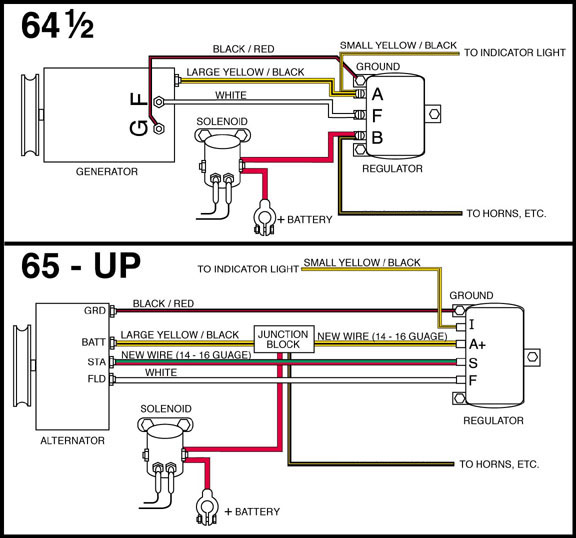
On an internally grounded unit, the entire case is considered to be the ground terminal. An externally grounded generator has a special terminal for a ground wire.
I believe my '63 generator is externally grounded because it has a "G" terminal right next to the "F" terminal. The "G" terminal connects to ground at the voltage regulator's base....like the 1964-1/2 Mustang diagram:
On an internally grounded unit, the entire case is considered to be the ground terminal. An externally grounded generator has a special terminal for a ground wire.
I believe my '63 generator is externally grounded because it has a "G" terminal right next to the "F" terminal. The "G" terminal connects to ground at the voltage regulator's base....like the 1964-1/2 Mustang diagram:
Thread Starter
|
Elder User
Joined: May 2009
Posts: 554
Likes: 1
The generator has been replaced. It needed it and should work well... if i can get the engine to start.
The engine turns over and sounds good, but there is not fuel going to the carburetor. I looked at it and my guess is that the fuel isn't getting past the pump/filter. i pumped the petal as i was cranking the engine. i also pumped it without cranking it, i cant get fuel from the tank to the carburetor.
It looks like a can with a lever on the side and has a hose going in and a hose going out. I haven't pulled it out, but I have an extra one. Is it possible that this is the problem and how do i replace it?
The engine turns over and sounds good, but there is not fuel going to the carburetor. I looked at it and my guess is that the fuel isn't getting past the pump/filter. i pumped the petal as i was cranking the engine. i also pumped it without cranking it, i cant get fuel from the tank to the carburetor.
It looks like a can with a lever on the side and has a hose going in and a hose going out. I haven't pulled it out, but I have an extra one. Is it possible that this is the problem and how do i replace it?
Mountain Pass
Joined: Dec 2003
Posts: 166
Likes: 6
I assume that you've disposed of the bad gasoline you mentioned in your first post. I'm not sure that gasoline today turns to varnish like it did in the old days, but if you ever run across a truck that's been sitting for 20 years, the fuel system can be full of a thick brown goo that has to be cleaned out with acetone or carburetor cleaner before you can safely run the engine. Otherwise, some of it will dissolve in the gasoline and bake itself onto the insides of the engine after its been running for a while. The baked-on varnish can make intake valves stick tight-enough to bend pushrods and rocker arms. I had this happen to me a couple of times with vehicles that had sat unused since the 1980s, so my first order of business with an old truck is to clean out the fuel tank with acetone and flush the fuel lines. Otherwise, I risk just having to do it later anyway....along with the carburetor, intake manifold, and cylinder heads.
If you're confident that the fuel tank and lines are clean, you can momentarily bypass the fuel pump by filling the carburetor with gasoline through the bowl vent tube. That's the tube that comes up out of the carburetor at an angle and sticks out into the middle of the air stream.
http://outdoorpowerinfo.com/repairs/...hoke_plate.JPG
To make sure that you don't over-fill the bowl, disconnect the fuel line from the carburetor and squirt gasoline into the bowl vent tube with an oil can until it starts dribbling from the inlet fitting. You can then reconnect the fuel line to the carburetor and attempt to start the engine. There should be enough gasoline in the bowl to run the engine for more than 10 seconds, which should be plenty of time to get the fuel pump primed...if it's any good.
If it still appears that the fuel pump is bad, don't replace it just yet. Check the fuel line from the pump to the tank for any bad spots, especially at the rubber splices. Any air leaks will make it difficult for the pump to draw fuel from the tank. Mechanical fuel pumps are great at pushing fuel but can't pull it very well.
There isn't any special procedure for installing a new fuel pump. Just unbolt the old one, scrape off the old gasket, and then install the new one in its place with a new gasket and a very thin layer of gasket cement.
If you're confident that the fuel tank and lines are clean, you can momentarily bypass the fuel pump by filling the carburetor with gasoline through the bowl vent tube. That's the tube that comes up out of the carburetor at an angle and sticks out into the middle of the air stream.
http://outdoorpowerinfo.com/repairs/...hoke_plate.JPG
To make sure that you don't over-fill the bowl, disconnect the fuel line from the carburetor and squirt gasoline into the bowl vent tube with an oil can until it starts dribbling from the inlet fitting. You can then reconnect the fuel line to the carburetor and attempt to start the engine. There should be enough gasoline in the bowl to run the engine for more than 10 seconds, which should be plenty of time to get the fuel pump primed...if it's any good.
If it still appears that the fuel pump is bad, don't replace it just yet. Check the fuel line from the pump to the tank for any bad spots, especially at the rubber splices. Any air leaks will make it difficult for the pump to draw fuel from the tank. Mechanical fuel pumps are great at pushing fuel but can't pull it very well.
There isn't any special procedure for installing a new fuel pump. Just unbolt the old one, scrape off the old gasket, and then install the new one in its place with a new gasket and a very thin layer of gasket cement.
Thread Starter
|
Elder User
Joined: May 2009
Posts: 554
Likes: 1
JimKoz- thank you for your help. Your knowledge is obviously far superior than mine when it comes to old trucks. This truck has been sitting for at least 6 years and with your help i got it running.
I replaced the fuel line and cleaned it out with an air compressor, then I put a little bit of gas in the carburetor and a little in the tank and it fired up almost instantly and i had it running for at least 10 minutes or so. I put some oil in it along with some water in the radiator and it works fine. Now im working on getting some tires, brakes, air filter, oil filter an many other things and will hopefully have a good usable truck.
I replaced the fuel line and cleaned it out with an air compressor, then I put a little bit of gas in the carburetor and a little in the tank and it fired up almost instantly and i had it running for at least 10 minutes or so. I put some oil in it along with some water in the radiator and it works fine. Now im working on getting some tires, brakes, air filter, oil filter an many other things and will hopefully have a good usable truck.
Mountain Pass
Joined: Dec 2003
Posts: 166
Likes: 6
You're welcome, and congratulations on getting your truck running.
When it comes time to work on the brakes, you should be aware that 1963 was an odd year for F100 2WD front brakes. That year, they used a wheel cylinder with only one piston, which didn't work out so well because they went back to dual piston wheel cylinders the next year. To top it off, nobody has made exact replacements for years.
If your truck still has the original single-piston wheel cylinders, they can be upgraded to dual-piston cylinders if you get the wheel cylinders and brake hardware for a 1964 F100. You can also upgrade to self-adjusting brakes at the same time with 1964 hardware.
When it comes time to work on the brakes, you should be aware that 1963 was an odd year for F100 2WD front brakes. That year, they used a wheel cylinder with only one piston, which didn't work out so well because they went back to dual piston wheel cylinders the next year. To top it off, nobody has made exact replacements for years.
If your truck still has the original single-piston wheel cylinders, they can be upgraded to dual-piston cylinders if you get the wheel cylinders and brake hardware for a 1964 F100. You can also upgrade to self-adjusting brakes at the same time with 1964 hardware.

Thread
Thread Starter
Forum
Replies
Last Post
cadougherty_67
1957 - 1960 F100 & Larger F-Series Trucks
2
Jul 8, 2017 10:31 AM
joegeds
1987 - 1996 F150 & Larger F-Series Trucks
3
May 26, 2017 05:17 PM
Torklift Sheryl
Vendor Specials, Discounts, Product Announcements & Group Buys
0
Oct 27, 2016 02:17 PM
jhaas63
1948 - 1956 F1, F100 & Larger F-Series Trucks
5
May 15, 2013 01:01 AM
sciondude09
1948 - 1956 F1, F100 & Larger F-Series Trucks
7
Mar 15, 2009 05:59 AM
