HELP!! Have questions.

Thread Starter
|
Freshman User
Joined: Mar 2009
Posts: 38
Likes: 0
From: Seaside, OR
HELP!! Have questions.
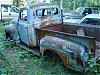
I'll start by saying hi. I'm a newbie. I just bought a '51 F-1 the other day and have some questions. I'm sure there will be many more to come but I'll start with these.
1) My truck has a flattie in it but I happened to notice last night that it's got Mercury heads on it. How do I tell if the whole thing is Mercury or if it's just the heads. Also, I've been told that the Mercury engines were better because they had more cubic inches. Is this true?
2) The truck is a non-runner currently. Everything looks in order and we should be able to get her to fire with a little tinkering. How do you know if it's been converted to 12-volt? It's got an Alternator rather than a Generator and I can't see anywhere that it says 12-volt but it is a Motorcraft Alternator which would lead me to believe that it's a 12-volt alternator....? It also has an aftermarket coil if that helps at all.
3) Lastly for this time. My brother-in-law put a mid-sixties 9-inch pickup rear end under his '48 and it seemed pretty effortless. My question is is it necessary? I will either be running a flattie or maybe a stock/slightly warmed over 302 at the most. It's not going to be on a race track anytime soon but I do like to get the pipes wrapped up when leaving a stop light every now and then. I just want to know if the stock rearend can take any light-duty abuse.
That's it for now. Thank you.
1) My truck has a flattie in it but I happened to notice last night that it's got Mercury heads on it. How do I tell if the whole thing is Mercury or if it's just the heads. Also, I've been told that the Mercury engines were better because they had more cubic inches. Is this true?
2) The truck is a non-runner currently. Everything looks in order and we should be able to get her to fire with a little tinkering. How do you know if it's been converted to 12-volt? It's got an Alternator rather than a Generator and I can't see anywhere that it says 12-volt but it is a Motorcraft Alternator which would lead me to believe that it's a 12-volt alternator....? It also has an aftermarket coil if that helps at all.
3) Lastly for this time. My brother-in-law put a mid-sixties 9-inch pickup rear end under his '48 and it seemed pretty effortless. My question is is it necessary? I will either be running a flattie or maybe a stock/slightly warmed over 302 at the most. It's not going to be on a race track anytime soon but I do like to get the pipes wrapped up when leaving a stop light every now and then. I just want to know if the stock rearend can take any light-duty abuse.
That's it for now. Thank you.

Hotshot


Joined: Jan 2001
Posts: 16,894
Likes: 3,135
From: SE Wisc. (the Rust Belt)
1) I'm not sure
2) I would say if you have an alternator it's 12 volt, I think I've heard of 6 volt alternators but they're rare.
3) If you can find a pre-'73 nine inch I'd do the swap. I have a '72 nine inch waiting for my panel this summer. I drove the panel, with the stock flattie, last summer with the stock rear end, although it sounded cool to rev up, it still didn't have much speed.
2) I would say if you have an alternator it's 12 volt, I think I've heard of 6 volt alternators but they're rare.
3) If you can find a pre-'73 nine inch I'd do the swap. I have a '72 nine inch waiting for my panel this summer. I drove the panel, with the stock flattie, last summer with the stock rear end, although it sounded cool to rev up, it still didn't have much speed.

New User
Joined: Mar 2009
Posts: 24
Likes: 0
Hello, I am new here to but have luked a long time.
1) I am running a merc flat motor in my 52 and when I bought the engine we werent sure either, they are quite a prize I am told because the stroke is 4" (like in the Beach Boys song "little deuce coupe") instead of 3.75 (I think) in the ford. The bore is the same. You have to take the heads off and turn the motor and measure the stroke from top to bottom. It was popular to put ford heads on a mercury because it increased the combustion ratio because they were smaller but I don't think they put merc heads on a ford unless that was all you had; it would work but wouldn't improve your performance.
2) I would say your 12 volts if it isn't running a generator.
3) The stock rear ends are tougher than the stock transmissions and I've been told they hold up but they are non limited slip and youll only spin one wheel when hammering it!
1) I am running a merc flat motor in my 52 and when I bought the engine we werent sure either, they are quite a prize I am told because the stroke is 4" (like in the Beach Boys song "little deuce coupe") instead of 3.75 (I think) in the ford. The bore is the same. You have to take the heads off and turn the motor and measure the stroke from top to bottom. It was popular to put ford heads on a mercury because it increased the combustion ratio because they were smaller but I don't think they put merc heads on a ford unless that was all you had; it would work but wouldn't improve your performance.
2) I would say your 12 volts if it isn't running a generator.
3) The stock rear ends are tougher than the stock transmissions and I've been told they hold up but they are non limited slip and youll only spin one wheel when hammering it!

Fleet Owner


Joined: Jul 2004
Posts: 27,300
Likes: 1,059
From: NM
It's easier to drop the pan on the engine and measure the stroke on one of the cylinders, than to pull a head. There are some identifying marks on the crank but it's so convoluted and there are many exceptions, the only sure way is to measure the stroke.
Merc heads were frequently put on Ford engines because 1) people would do things to get an engine running as cheaply as possible, and 2) there were misperceptions that "anything" Merc was a power boost. In reality like said above, Merc heads on a Ford engine lowers the compression ratio. They might breathe a little better, not much.
The only reason to put a 9" on is so you can get a different ratio.
Merc heads were frequently put on Ford engines because 1) people would do things to get an engine running as cheaply as possible, and 2) there were misperceptions that "anything" Merc was a power boost. In reality like said above, Merc heads on a Ford engine lowers the compression ratio. They might breathe a little better, not much.
The only reason to put a 9" on is so you can get a different ratio.
Senior User
Joined: Aug 2008
Posts: 153
Likes: 0
From: Pueblo, Co.
Welcome to the "site" sivertoungedevil and sac52!!.......this is the place to be!!!....great to see a couple more "buck tooth" trucks in the lineup!! I'm not to versed with the flatty's, but sounds like a 12 volt system to me.....one easy check would be your battery and conections....6 volt systems generally ran a "positive" ground, while 12 volt systems use a "negative" ground.....as for the 9in., "upgrading" would give you more "beef" as well as more choices w/gearing, posi. ect. there's alot of good threads/info on here about it, as well as a "ton" of other info available on just about anything you can think of.....use the search feature at the top of the page.....good luck with your projects and post pic's when you can......(we like visualization!!)
Later, Doug
Later, Doug

Post Fiend
Joined: May 2008
Posts: 7,641
Likes: 21
From: Poway, Ca.
Hello you silvertoungedevil you - cute name!
The guys are right on all accounts. Just a suggestion on the engine. You can measure the stroke of the piston by removing the spark plug and inserting a long thin dowel when the piston is at TDC - make a mark on it right where it touches the top of the spark plug hole. Then, manually (with a socket on the balance bolt) turn the engine until the piston bottoms out - make a second mark - that's your stroke. It should be 3.75 inches in a Ford 239; and 4 3/8 for a Ford 337. In the Mercury 255 it will be 4 inches exactly - so your measurement will have to be accurate within 1/4 inch.
On the electrical conversion, first, as mentioned, check the battery to see if it is 6 or 12 volt and is positively (6V) or negatively (12V) grounded. No battery, look at the voltage regulator for the generator or alternator. It will be on that. No regulator, can't read it? If it has an alternator, chance are 99% it's 12 volt. No alternator (short-about 7 inches deep the generator will be about a foot long). Don't have any of that stuff? Go get it in 12 volt and replace the rest with new 12 volt.
The stock rear ends were geared toward work not speed. With a transmission output at 1:1 you might get up to 45/50 mph with a stock rear end at about 3000 rpm. Putting in the 9" with a gear ratio down around 3.00, you will be able to drive at freeway speeds at 2500 to 3000 rpm. A 2.80 will put you at (approximately - for all the math hounds) 65 mph at 2600 rpm on 15 inch wheels. The Ford 9" is a stronger rear end and parts both rear end and brake are more available and less expensive. However, your wheel bolt pattern size will change to 4.5x5. So you will haveto get new wheels or run adaptors on the backs. That also means you will have to to something with the bolt pattern on the front or run different sized wheels.
Welcome again, and have fun here on FTE
The guys are right on all accounts. Just a suggestion on the engine. You can measure the stroke of the piston by removing the spark plug and inserting a long thin dowel when the piston is at TDC - make a mark on it right where it touches the top of the spark plug hole. Then, manually (with a socket on the balance bolt) turn the engine until the piston bottoms out - make a second mark - that's your stroke. It should be 3.75 inches in a Ford 239; and 4 3/8 for a Ford 337. In the Mercury 255 it will be 4 inches exactly - so your measurement will have to be accurate within 1/4 inch.
On the electrical conversion, first, as mentioned, check the battery to see if it is 6 or 12 volt and is positively (6V) or negatively (12V) grounded. No battery, look at the voltage regulator for the generator or alternator. It will be on that. No regulator, can't read it? If it has an alternator, chance are 99% it's 12 volt. No alternator (short-about 7 inches deep the generator will be about a foot long). Don't have any of that stuff? Go get it in 12 volt and replace the rest with new 12 volt.
The stock rear ends were geared toward work not speed. With a transmission output at 1:1 you might get up to 45/50 mph with a stock rear end at about 3000 rpm. Putting in the 9" with a gear ratio down around 3.00, you will be able to drive at freeway speeds at 2500 to 3000 rpm. A 2.80 will put you at (approximately - for all the math hounds) 65 mph at 2600 rpm on 15 inch wheels. The Ford 9" is a stronger rear end and parts both rear end and brake are more available and less expensive. However, your wheel bolt pattern size will change to 4.5x5. So you will haveto get new wheels or run adaptors on the backs. That also means you will have to to something with the bolt pattern on the front or run different sized wheels.
Welcome again, and have fun here on FTE

Post Fiend
Joined: Jun 2001
Posts: 7,493
Likes: 7
From: Erie, pa
5x5.5 are on the following Ford Trucks.
1996-75 FORD TRUCK - Bronco (Full Size), F100, P100, E100, E150, F150 (W/15")
1992-75 E100, E150, Econoline Vans, Club Wagons
1992-48 F100, F150, P100
1996-75 FORD TRUCK - Bronco (Full Size), F100, P100, E100, E150, F150 (W/15")
1992-75 E100, E150, Econoline Vans, Club Wagons
1992-48 F100, F150, P100
Trending Topics
Hotshot
Joined: Jan 2001
Posts: 16,894
Likes: 3,135
From: SE Wisc. (the Rust Belt)
Man, I hope the bolt pattern is the same, I have a '72 9 inch waiting to be installed in my panel this spring. I know they are because I've had parts trucks with new wheels on them.
FTE Stories
Ford Trucks for Ford Truck Enthusiasts

Top 10 Fords at 2026 Carlisle Ford Nationals
Joe Kucinski
3 Best / 3 Worst Parts of Modern Ford Ownership
Brett Foote
10 Amazing Upgrades That Solve Common Ford Truck Owner Headaches
Pouria Savadkouei
Every 2026 Ford Engine Explained
Brett Foote
10 Ugly Ford Trucks That We Still Kinda Love
Joe Kucinski
10 Things Every Truck Owner NEEDS (2026 Edition)
Michael S. Palmer
Rezvani's Latest Post-Apocalyptic Monster Is a Ford F-150 Raptor Underneath
Verdad Gallardo
Top 10 Most Expensive Ford Trucks Ever Sold on Bring a Trailer
Joe Kucinski