


CCV relocation with Pictures

Thread Starter
|
Junior User
Joined: Sep 2006
Posts: 87
Likes: 0
CCV relocation with Pictures
After seeing some oil dripping from my IC boots, I decided it was time to do something about it before one of my boots blow off.
I apologize. This is not a complete write-up as there are plenty of other write-ups for this mod. I just wanted to show you folks another way of doing it.
My main goal was to modify it without making it permanent. No parts were destroyed and can easily be put back to stock. So, here is what I did:
I first built a canister that will collect the oil and vent the pressure. I then decided on a location (directly above the driver's side mudflap inside the fender).
I took the intake boots off and pulled out the CCV elbow from the valve cover filter. I left the elbow attached to the metal boot. I only cut two bands. I cut the band for the elbow that goes directly into the intake and the one that holds the fexible rubber onto the elbow that plugs into the valve cover filter. I pulled out the elbow that goes into the intake tube, trimmed the protrusion, and reinserted. I used a 3/4" PVC cap and pushed it into the flexible hose that is still attached to the intake tube, blocking any possible flow. I did not glue it as the cap has a ridge on it that would prevent it from being sucked into the intake.
I bought a bunch of 1" heater hose but found that 3/4" heater hose would fit inside the 1" and snake through the engine bay much easier. I slipped the 1" over the elbow and then slipped the 3/4" inside the 1". I secured it all with hose clamps. It attaches to my canister via the same meathod as stated.

This is a picture of the elbow comming out of the valve cover vent. The orange hose is the 1" and the black is the 3/4". You can also see the white PVC cap stuck in the fexible hose that leads to the intake.
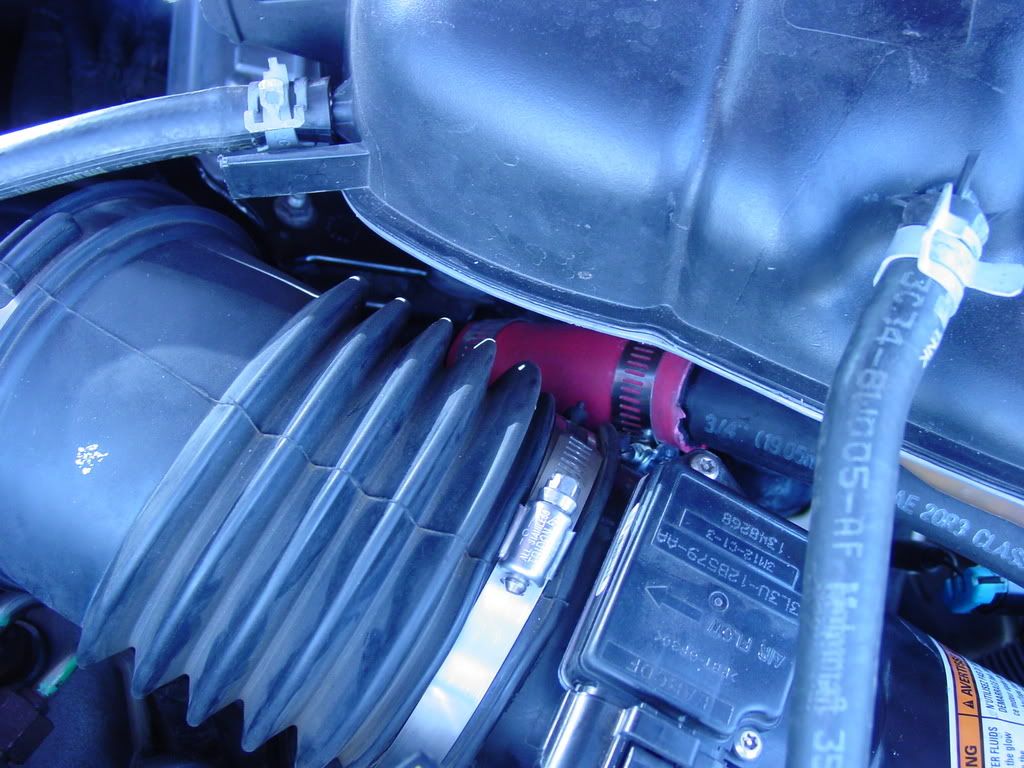
This is just another view to get perspective.
I made my canister from 3" ABS pipe. I used a screw cap on top and a permanent cap on the bottom. I used a brass ball valve for the bottom drain which was rather easy to install. I just drilled a hole and allowed the valve to self tap into the plastic. I used another brass barb adaptor to attach the filter to. It is 3/8 BRB X 1/4 MPT. I used 3/4" PVC that was fit into the canister and glued.

This is the canister fastened and connected.

This is just another view to see how long the canister is. Its only about 8" long. Not too big. It will get the job done.
I may eventually put the filter on the inside, creating a closed unit with a return line back to the intake to take advantage that the vacuume has on the crank case.
<!-- / message --><!-- sig -->
I apologize. This is not a complete write-up as there are plenty of other write-ups for this mod. I just wanted to show you folks another way of doing it.
My main goal was to modify it without making it permanent. No parts were destroyed and can easily be put back to stock. So, here is what I did:
I first built a canister that will collect the oil and vent the pressure. I then decided on a location (directly above the driver's side mudflap inside the fender).
I took the intake boots off and pulled out the CCV elbow from the valve cover filter. I left the elbow attached to the metal boot. I only cut two bands. I cut the band for the elbow that goes directly into the intake and the one that holds the fexible rubber onto the elbow that plugs into the valve cover filter. I pulled out the elbow that goes into the intake tube, trimmed the protrusion, and reinserted. I used a 3/4" PVC cap and pushed it into the flexible hose that is still attached to the intake tube, blocking any possible flow. I did not glue it as the cap has a ridge on it that would prevent it from being sucked into the intake.
I bought a bunch of 1" heater hose but found that 3/4" heater hose would fit inside the 1" and snake through the engine bay much easier. I slipped the 1" over the elbow and then slipped the 3/4" inside the 1". I secured it all with hose clamps. It attaches to my canister via the same meathod as stated.
This is a picture of the elbow comming out of the valve cover vent. The orange hose is the 1" and the black is the 3/4". You can also see the white PVC cap stuck in the fexible hose that leads to the intake.
This is just another view to get perspective.
I made my canister from 3" ABS pipe. I used a screw cap on top and a permanent cap on the bottom. I used a brass ball valve for the bottom drain which was rather easy to install. I just drilled a hole and allowed the valve to self tap into the plastic. I used another brass barb adaptor to attach the filter to. It is 3/8 BRB X 1/4 MPT. I used 3/4" PVC that was fit into the canister and glued.
This is the canister fastened and connected.
This is just another view to see how long the canister is. Its only about 8" long. Not too big. It will get the job done.
I may eventually put the filter on the inside, creating a closed unit with a return line back to the intake to take advantage that the vacuume has on the crank case.
<!-- / message --><!-- sig -->

Mountain Pass
Joined: Sep 2005
Posts: 237
Likes: 6
I have not done this mod, but I have two concerns.
The first is that if you used heater hose, as you stated, it is not oil resistant like the other type of rubber hose (Trans fluid Power steering, etc.)
The other concern is that you have a 3/4 inch PVC plug in the intake without glue because you stated the suction would hold it in. Is it a tight enough fit that if you are pulling a load really on the throttle under high boost, and are forced to let off of the throttle quickly, that the turbo fart will not blow it out?
The first is that if you used heater hose, as you stated, it is not oil resistant like the other type of rubber hose (Trans fluid Power steering, etc.)
The other concern is that you have a 3/4 inch PVC plug in the intake without glue because you stated the suction would hold it in. Is it a tight enough fit that if you are pulling a load really on the throttle under high boost, and are forced to let off of the throttle quickly, that the turbo fart will not blow it out?

Senior User
Joined: Sep 2008
Posts: 226
Likes: 0
Is there a sleeve inside the 3/4 hose? Rubber clamped to rubber will not hold unless there is some sort of Infrastructure to clamp to. If you were to redesign your set up and relocate the filter to the inside of your 3" pipe and connect it directly to your white PVC pipe, then run a new hose from where the filter was located, back to the manafold .... you would have a very functional oil trap.
Thread Starter
|
Junior User
Joined: Sep 2006
Posts: 87
Likes: 0
I have not done this mod, but I have two concerns.
The first is that if you used heater hose, as you stated, it is not oil resistant like the other type of rubber hose (Trans fluid Power steering, etc.)
The other concern is that you have a 3/4 inch PVC plug in the intake without glue because you stated the suction would hold it in. Is it a tight enough fit that if you are pulling a load really on the throttle under high boost, and are forced to let off of the throttle quickly, that the turbo fart will not blow it out?
The first is that if you used heater hose, as you stated, it is not oil resistant like the other type of rubber hose (Trans fluid Power steering, etc.)
The other concern is that you have a 3/4 inch PVC plug in the intake without glue because you stated the suction would hold it in. Is it a tight enough fit that if you are pulling a load really on the throttle under high boost, and are forced to let off of the throttle quickly, that the turbo fart will not blow it out?
No sleave. Just adhesive. Even if it pops off it will not damage the engine.
There is no concern with the PVC plug comming out or going back in. The plug is a larger diameter than the plastic hole at the intake. Pressure will follow the path of least resistance on a turbo fart which will backflow through the filter. I have tested this very theory and could not make it pop out. I was going to hose clamp it but it is in there too tight for it to make a difference.

Senior User
Joined: Sep 2006
Posts: 253
Likes: 0
From: Santee, CA
Excellent write up and imagination. I have been researching similar ways to use filter/oil traps for less than you can buy the kits, but have found them hard to find. This looks like an excellent alternative. I will have to give this one a try.
Rep point to you..
Rep point to you..
Thread Starter
|
Junior User
Joined: Sep 2006
Posts: 87
Likes: 0
Is there a sleeve inside the 3/4 hose? Rubber clamped to rubber will not hold unless there is some sort of Infrastructure to clamp to. If you were to redesign your set up and relocate the filter to the inside of your 3" pipe and connect it directly to your white PVC pipe, then run a new hose from where the filter was located, back to the manafold .... you would have a very functional oil trap.
Thread Starter
|
Junior User
Joined: Sep 2006
Posts: 87
Likes: 0
BTW, I love your avatar.
Trending Topics
Senior User
Joined: Sep 2006
Posts: 253
Likes: 0
From: Santee, CA
Another thought came to mind. I was looking at other CCV canisters/filters and many of them have material (like steelwool) to collect the oil. If the canister is open, much of the oil will just stay suspended in the air and only be picked up by the external filter. Putting the filter internal would help. I think adding some type of screen with steelwool trapped below it (but above the inlet tube) would also help to pull much of the oil out of suspension. Just some thinking out loud so to speak.
FTE Stories
Ford Trucks for Ford Truck Enthusiasts

Top 6 Best Deals Available on New Fords & Lincolns Right Now
Brett Foote
This Hennessey Takes the Expedition Tremor's Off-Roading Capability to the Next Level
Verdad Gallardo
Top 10 Fords at 2026 Carlisle Ford Nationals
Joe Kucinski
3 Best / 3 Worst Parts of Modern Ford Ownership
Brett Foote
10 Amazing Upgrades That Solve Common Ford Truck Owner Headaches
Pouria Savadkouei
Every 2026 Ford Engine Explained
Brett Foote
10 Ugly Ford Trucks That We Still Kinda Love
Joe Kucinski
10 Things Every Truck Owner NEEDS (2026 Edition)
Michael S. Palmer
Rezvani's Latest Post-Apocalyptic Monster Is a Ford F-150 Raptor Underneath
Verdad Gallardo
Senior User
Joined: Sep 2008
Posts: 226
Likes: 0
My thought is, supply line in is routed from the top end of the canister from the outside, after it is internal, run the plumbing to the lowest end of the canister leaving it open. The return line is screwed into the upper most end of the canister and the filter is installed on the inside. The oil laden air is drawn into the bottom canister by the vacuum created at the top, and that is then filtered as it is drawn back into the intake manifold.
Thread Starter
|
Junior User
Joined: Sep 2006
Posts: 87
Likes: 0
Another thought came to mind. I was looking at other CCV canisters/filters and many of them have material (like steelwool) to collect the oil. If the canister is open, much of the oil will just stay suspended in the air and only be picked up by the external filter. Putting the filter internal would help. I think adding some type of screen with steelwool trapped below it (but above the inlet tube) would also help to pull much of the oil out of suspension. Just some thinking out loud so to speak.
Thread Starter
|
Junior User
Joined: Sep 2006
Posts: 87
Likes: 0
My thought is, supply line in is routed from the top end of the canister from the outside, after it is internal, run the plumbing to the lowest end of the canister leaving it open. The return line is screwed into the upper most end of the canister and the filter is installed on the inside. The oil laden air is drawn into the bottom canister by the vacuum created at the top, and that is then filtered as it is drawn back into the intake manifold.
Senior User
Joined: Sep 2008
Posts: 226
Likes: 0
My thought is, you are using the relatively small amount of positive pressure on the valve cover pushing air over a long hose that is vented to the atmosphere, via a filter, it will work but how efficient is anybody's guess. If you reroute it back to the intake manifold you will have a positive vacuum through your filtered canister and it will work as originally designed with the exception of the filtered oil trap.
Thread Starter
|
Junior User
Joined: Sep 2006
Posts: 87
Likes: 0
Thats right. Though that small positive pressure is rather strong. At idle I opened my valve at the bottom and I could see and feel the vapor rushing out. before I run a return line I want to make sure I get the canister to condensate almost all of the oil out of the air.

Senior User
Joined: Aug 2006
Posts: 125
Likes: 0
I have my CCV routed to a 1" inside diameter heater hose. It is vented to atmosphere and the hose terminates just before my fuel tank.
I have had this routed for about 40,000 miles now. I have never had a drip from the hose (that ended up on the garage floor), the bottom of the truck is a little oily due to the vapors, but it is hardly anything. It may take a long time to recover an amount of oil you can drain from your "can".
Great design!
I may do that to mine, but I'm not routing it back to the intake.
I have had this routed for about 40,000 miles now. I have never had a drip from the hose (that ended up on the garage floor), the bottom of the truck is a little oily due to the vapors, but it is hardly anything. It may take a long time to recover an amount of oil you can drain from your "can".
Great design!
I may do that to mine, but I'm not routing it back to the intake.

Posting Guru
Joined: Jan 2009
Posts: 1,328
Likes: 0
good write up and pics. why not just vent the ccv line to atmosphere?. when i do mine it's gonna be routed to just behind the rear doors and down. do they leak that much oil to where they need a catch for it?. (never mind, thanks bradcollison)