



Shift Point
Thread Starter
|
Senior User

Joined: Sep 2007
Posts: 159
Likes: 0
From: Fort Collins
Shift Point
As a new operator of a diesel truck I have a question about the shift point. I've noticed that when you stand on it it shifts up toward 3000 rpm. Wouldn't it be better for it to shift in its power band of 2000 rpm? Is there a control box that will let you shift at that point? I read about the Gear Vendors gear splitter and read that they reduce the shift point to 2000 rpm.

Posting Guru
Joined: Oct 2005
Posts: 1,285
Likes: 1
i don't really know what your asking exactly but our trucks make their most HP @3000 and torque @2000 (using round even numbers). so to me sounds like when you "stand on your tuck" it will rev out to the 3000 rmps easily.
Elder User
Joined: Aug 2007
Posts: 516
Likes: 8
From: Milwaukie, Oregon
short shifting doesnt help in a diesel truck because it makes better torque in low rpms. if you shift before ideal conditions it wont pull as much because your not letting it get to its optimal rpm area for torque.
Thread Starter
|
Senior User
Joined: Sep 2007
Posts: 159
Likes: 0
From: Fort Collins
But as I understand it the optimal rpm for torque is 2000 rpm. I would think the best shift point under load would be at most 2300 rpm bringing the rpm back to 1700 or so then up to 2300 again before the next shift. Diesels are not high reving engines and torque drops off very quickly past 2000 rpm.
Thread Starter
|
Senior User
Joined: Sep 2007
Posts: 159
Likes: 0
From: Fort Collins
But torque is what pulls. Thats why a semi truck has 12 forward gears. It keeps the engine in its pulling band of peak torque. Torque vs HP has always given me problems. My understanding is that torque is the actual force the engine is generating whereas HP is a function of torque applied through gearing. HP relates more to speed than pulling power.

Lead Driver


Joined: Sep 2007
Posts: 8,180
Likes: 669
From: Scio, OR

But as I understand it the optimal rpm for torque is 2000 rpm. I would think the best shift point under load would be at most 2300 rpm bringing the rpm back to 1700 or so then up to 2300 again before the next shift. Diesels are not high reving engines and torque drops off very quickly past 2000 rpm.
When I'm shifting for most power, like when I'm hauling the camper up the mountain pass, I'm shifting so that at the finish of the shift I'm around 2200 RPM. Which puts my shift around 3000 RPM. When I'm in a steep enough grade, I just leave it in 4 and can run up to 65 or so without any problem.
Trending Topics
Lead Driver

Joined: Sep 2006
Posts: 5,665
Likes: 164
From: Cartersville, Ga
But torque is what pulls. Thats why a semi truck has 12 forward gears. It keeps the engine in its pulling band of peak torque. Torque vs HP has always given me problems. My understanding is that torque is the actual force the engine is generating whereas HP is a function of torque applied through gearing. HP relates more to speed than pulling power.
FTE Stories
Ford Trucks for Ford Truck Enthusiasts

3 Best / 3 Worst Parts of Modern Ford Ownership
Brett Foote
10 Amazing Upgrades That Solve Common Ford Truck Owner Headaches
Pouria Savadkouei
Every 2026 Ford Engine Explained
Brett Foote
10 Ugly Ford Trucks That We Still Kinda Love
Joe Kucinski
10 Things Every Truck Owner NEEDS (2026 Edition)
Michael S. Palmer
Rezvani's Latest Post-Apocalyptic Monster Is a Ford F-150 Raptor Underneath
Verdad Gallardo
Top 10 Most Expensive Ford Trucks Ever Sold on Bring a Trailer
Joe Kucinski
2027 Ford Super Duty Buyer's Guide (Every Model, Engine, & Package)
Brett Foote
Top 10 Ford Truck Tragedies
Joe Kucinski
More Turbo
Joined: Feb 2007
Posts: 713
Likes: 0
From: KS
if it shifts at 2000, you drop to ~1300 or so, and that's not enough to do anything with. i've never needed to wrap it much more than 26 or 2700 pulling, but that's because i've done all my pulling out on the flats. but things do move much faster with the extra revs. especially when empty. and they sound so nice @ 3300 rpm...
Lead Driver
Joined: Sep 2006
Posts: 5,665
Likes: 164
From: Cartersville, Ga
if it shifts at 2000, you drop to ~1300 or so, and that's not enough to do anything with. i've never needed to wrap it much more than 26 or 2700 pulling, but that's because i've done all my pulling out on the flats. but things do move much faster with the extra revs. especially when empty. and they sound so nice @ 3300 rpm...
Cargo Master
Joined: Mar 2007
Posts: 3,103
Likes: 32
From: AB/BC
I have the 6.0L with a manual transmission, so I get to control the RPM's that I pull at. From experience I can say it makes it's best power over 2000 RPM's. Using your example, if a shift drops the RPM's to 1700, you'd be at a serious power disadvantage.
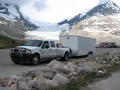
When I'm shifting for most power, like when I'm hauling the camper up the mountain pass, I'm shifting so that at the finish of the shift I'm around 2200 RPM. Which puts my shift around 3000 RPM. When I'm in a steep enough grade, I just leave it in 4 and can run up to 65 or so without any problem.
When I'm shifting for most power, like when I'm hauling the camper up the mountain pass, I'm shifting so that at the finish of the shift I'm around 2200 RPM. Which puts my shift around 3000 RPM. When I'm in a steep enough grade, I just leave it in 4 and can run up to 65 or so without any problem.

Thread Starter
|
Senior User
Joined: Sep 2007
Posts: 159
Likes: 0
From: Fort Collins
Let's say for grins that they came up with a new transmission for the 6.0 that would hold a set rpm. Your primary power gauge would then be boost but what rpm would you run it at?