



Oil weight?

Posting Guru
Joined: Sep 2008
Posts: 2,498
Likes: 2
I personally use Mobile One 5W20 just figured that Ford knows more about what weight oil their engines should have anyone else.
I don't think 10W30 will hurt anything, but with winter here I would think about the next oil change going to 5W20 it may even start easier in cold weather and the thinner oil will lube at start up a little quicker.
I don't think you can go wrong on what the factory recomends.
03 Excursion
Black 4X4
V-10 Limited
Bone Stock Modless
I don't think 10W30 will hurt anything, but with winter here I would think about the next oil change going to 5W20 it may even start easier in cold weather and the thinner oil will lube at start up a little quicker.
I don't think you can go wrong on what the factory recomends.
03 Excursion
Black 4X4
V-10 Limited
Bone Stock Modless

Post Fiend
Joined: May 2006
Posts: 10,007
Likes: 4
From: Central Florida
yes and no. If you like in a warmer climate, it's not a bad idea to run a little heavier oil, but in the colder places the oil will not flow as quickly during start up. I don't think it will harm much, maybe open up the tight clearances a bit, but nothing that should cause a failure.
I flip my 5.4 between 5w20 and 5w30 and occasionally I will use 10w30 in the summer. Mostly because I order the wrong PN.
I flip my 5.4 between 5w20 and 5w30 and occasionally I will use 10w30 in the summer. Mostly because I order the wrong PN.

Tuned

Joined: Aug 2004
Posts: 449
Likes: 0
From: North Texas
Disclaimer... I'm not a petroleum engineer or an expert... just a voracious reader...
I had the same question about 5w-20 vs 5w-30 last weekend when I went to Sams to get oil for my daughter's Accord & all they had was 5w-20 & 10w-30. As it turns out, the push toward 5w-20 has generated by our stupendous legislature pushing up the CAFE standard & the auto companies using a thinner oil as a factor to get to there.
Basically, 5w20 has a lower shear threshold than 5w30 so it's in essence, thinner. In cold climates, it should be fine, in warmer climates, I'd go with the 5w30.
This could turn into a religious discussion much like dino vs. synthetic, so Google "5w20 vs 5w30" & make your own decision.
I had the same question about 5w-20 vs 5w-30 last weekend when I went to Sams to get oil for my daughter's Accord & all they had was 5w-20 & 10w-30. As it turns out, the push toward 5w-20 has generated by our stupendous legislature pushing up the CAFE standard & the auto companies using a thinner oil as a factor to get to there.
Basically, 5w20 has a lower shear threshold than 5w30 so it's in essence, thinner. In cold climates, it should be fine, in warmer climates, I'd go with the 5w30.
This could turn into a religious discussion much like dino vs. synthetic, so Google "5w20 vs 5w30" & make your own decision.
Tuned
Joined: Aug 2004
Posts: 449
Likes: 0
From: North Texas
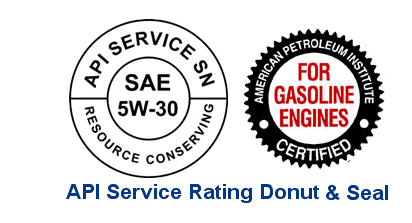
You're safe with the warranty as long as you're using the API rated oil specified in your owner's manual.
Trending Topics

Posting Guru
Joined: Jul 2006
Posts: 1,720
Likes: 1
Disclaimer... I'm not a petroleum engineer or an expert... just a voracious reader...
I had the same question about 5w-20 vs 5w-30 last weekend when I went to Sams to get oil for my daughter's Accord & all they had was 5w-20 & 10w-30. As it turns out, the push toward 5w-20 has generated by our stupendous legislature pushing up the CAFE standard & the auto companies using a thinner oil as a factor to get to there.
Basically, 5w20 has a lower shear threshold than 5w30 so it's in essence, thinner. In cold climates, it should be fine, in warmer climates, I'd go with the 5w30.
This could turn into a religious discussion much like dino vs. synthetic, so Google "5w20 vs 5w30" & make your own decision.
I had the same question about 5w-20 vs 5w-30 last weekend when I went to Sams to get oil for my daughter's Accord & all they had was 5w-20 & 10w-30. As it turns out, the push toward 5w-20 has generated by our stupendous legislature pushing up the CAFE standard & the auto companies using a thinner oil as a factor to get to there.
Basically, 5w20 has a lower shear threshold than 5w30 so it's in essence, thinner. In cold climates, it should be fine, in warmer climates, I'd go with the 5w30.
This could turn into a religious discussion much like dino vs. synthetic, so Google "5w20 vs 5w30" & make your own decision.
So if you really want the advantages of both fuel and protection. My Mercedes REQUIRES 0w40 Full synthetic. Great flow at 0 and solid protection at 100 F and 100 mph.
One other small point the new oils have removed some if not all of the (zinc I think ) to protect the cat. converter. This resultes in lower film strength and will quickly wipe out the lobes on a non-roller tappet cam. So be warned about using these oils in older cars with out the roller tappet camshaft.
FTE Stories
Ford Trucks for Ford Truck Enthusiasts

Top 6 Best Deals Available on New Fords & Lincolns Right Now
Brett Foote
This Hennessey Takes the Expedition Tremor's Off-Roading Capability to the Next Level
Verdad Gallardo
Top 10 Fords at 2026 Carlisle Ford Nationals
Joe Kucinski
3 Best / 3 Worst Parts of Modern Ford Ownership
Brett Foote
10 Amazing Upgrades That Solve Common Ford Truck Owner Headaches
Pouria Savadkouei
Every 2026 Ford Engine Explained
Brett Foote
10 Ugly Ford Trucks That We Still Kinda Love
Joe Kucinski
10 Things Every Truck Owner NEEDS (2026 Edition)
Michael S. Palmer
Rezvani's Latest Post-Apocalyptic Monster Is a Ford F-150 Raptor Underneath
Verdad Gallardo
Senior User
Joined: Dec 2004
Posts: 120
Likes: 0
Oil
NewXer-My manual indicates to use SAE5W-20 that meets Ford specification WSS-M2C153-H. Does this specification appear on any of the oils certifications which you posted? Or does Ford just want the "API certified for gasoline engines" to appear on the container, regardless of the viscosity rating? Thanks in advance for your answer. Tom

Mountain Pass
Joined: Jan 2008
Posts: 168
Likes: 0
From: Alberta, Canada
The manufacturer specs never made any sense to me. I'd have thought the wider the range the better. eg. something like 0W50 would go from very thin in cold weather (say -40 degrees) to very thick in the hottest weather (100 degrees F).


Senior User
Joined: Jun 2007
Posts: 283
Likes: 0
From: Minnesota
Stop the self inflicted damage now !!
Why is this such an issue?
Read your owners manual.
There is a chart listing the recommended oil for your ambient (outside) temperature.
I have always used 5W20 semi synthetic.
I have only been down 1/4 qt in 3-4000 miles.
The engineers know what they are doing so why second guess their design.
Buy a good filter, change your PCV valve, keep it in tune and stop thinking in your 1970's mindset.
The 5w-20 oil is a very stable oil.
The tolerences of your engine are tight and if you use a greater viscosity oil you WILL DO ENGINE DAMAGE !!!
The additives will break down and sludge with the wrong oil.
Your cold starts are more damaging with that 2-5 sec. dry start/bearing time then driving on oil with 7500+ miles on it.
In Europe they usually change the filter and run the oil longer than we do in the ole' USA.
And by the way ALL OIL WEIGHS ABOUT THE SAME. Viscosity NOT Weight.
The W stands for Winter pour point
the 20,30,40,50,90,140 is the base the oil is designed from thus the breakdown threshold. (in simple terms)
I have broken down engines from guys who put Rotella 15w-40 in their auto (gas) vehicles (OEM recommended 5w-30 or 10w-30)
The beautiful copper colored rainbows on the crankshaft and the lack of bearings left me convinced that they were a brain surgeon doing auto repairs.
I'm sorry to rant but this is an avoidable cause of alot of my future profits.
NO WAIT JUST KEEP DOING WHAT YOU WANT EINSTEIN.
Read your owners manual.
There is a chart listing the recommended oil for your ambient (outside) temperature.
I have always used 5W20 semi synthetic.
I have only been down 1/4 qt in 3-4000 miles.
The engineers know what they are doing so why second guess their design.
Buy a good filter, change your PCV valve, keep it in tune and stop thinking in your 1970's mindset.
The 5w-20 oil is a very stable oil.
The tolerences of your engine are tight and if you use a greater viscosity oil you WILL DO ENGINE DAMAGE !!!
The additives will break down and sludge with the wrong oil.
Your cold starts are more damaging with that 2-5 sec. dry start/bearing time then driving on oil with 7500+ miles on it.
In Europe they usually change the filter and run the oil longer than we do in the ole' USA.
And by the way ALL OIL WEIGHS ABOUT THE SAME. Viscosity NOT Weight.
The W stands for Winter pour point
the 20,30,40,50,90,140 is the base the oil is designed from thus the breakdown threshold. (in simple terms)
I have broken down engines from guys who put Rotella 15w-40 in their auto (gas) vehicles (OEM recommended 5w-30 or 10w-30)
The beautiful copper colored rainbows on the crankshaft and the lack of bearings left me convinced that they were a brain surgeon doing auto repairs.
I'm sorry to rant but this is an avoidable cause of alot of my future profits.
NO WAIT JUST KEEP DOING WHAT YOU WANT EINSTEIN.
Last edited by Move over I'm coming; Dec 24, 2008 at 03:02 AM. Reason: spelling
Senior User
Joined: Dec 2004
Posts: 120
Likes: 0
Oil
I do not have an owner's manual as I purchased used. I have accessed the manual on Ford's web site but I did not see a chart which listed the proper oil for ambient temperatures. Care to share what your manual shows for this chart "Move Over I'm Coming"?
Posting Guru
Joined: Jul 2006
Posts: 1,720
Likes: 1
The engineers know what they are doing so why second guess their design.................
The tolerences of your engine are tight and if you use a greater viscosity oil you WILL DO ENGINE DAMAGE !!!............
In Europe they usually change the filter and run the oil longer than we do in the ole' USA.
And by the way ALL OIL WEIGHS ABOUT THE SAME. Viscosity NOT Weight.............
The tolerences of your engine are tight and if you use a greater viscosity oil you WILL DO ENGINE DAMAGE !!!............
In Europe they usually change the filter and run the oil longer than we do in the ole' USA.
And by the way ALL OIL WEIGHS ABOUT THE SAME. Viscosity NOT Weight.
............Perhaps the Mercedes engineers know what they are doing as they REQUIRE 0w40 full synthetic in my custom build V8 350+ hp that was dynoed and signed off by one person before installation.
Incorrect viscosity in many cases will damage an engine especially on cold start. But compare the flow point on 0w20 to 0w40 full synthetic. UMMM very close aren't they. And the 40w part of the synthetic really doesn't get thick it just provides protection that a 40W would but a the lower viscosity.
The channel point of synthetic is much lower temp than conventional oils, even in the 0W so there is an advantage using a 0w or 5W synthetic oil in cold temperatures.
I suppose the Europeans are just trying to conserve their expensive oil. Synthetic in Germany sells for about $125 for 4 ltrs or about 4 qts. So given my Mercedes takes 8 qts this would be about $250 for the oil in german not to mention $45 for the filter. So that would be a very expensive oil change in germany at about $300.00. But then I guess the Mercedes Engineers missed another one because we have been following their recommendation at 14,000 mile oil change intervals. For my son to use a full synthetic in his Ford 6.0 Diesel in Europe the cost would be about $600 for each oil change.
Don't understand how Rotella oils would cause failure in gas engines given the oil meet the mfg specs for that engine.
But then I have seen the bearing material worn to the copper in main bearings in 460 big block engines that even using good lubricants in specifications worn to the copper at 50,000 miles. The last set of main bearings I changed out were in a 460 that used oil meeting spec at 50,000 miles. The engine was like new otherwise. So there is something else working on the bearings,, perhaps heavy loading at low rpm resulting in bearing loads exceeding the capability of the lubricant's film strength. Consider that the zinc was removed from most oils to protect cat. converters perhaps this is why the film strength is not high enough and you should not use the current modern oils in older engines expecially those with conventional tappets.
I am sure this conversation and different opinions has been going on since animal fat was used to lubricate the wooden cart wheels of the Romans during the time of Nero or RB Journal was developed to prevent rail box fires on the railroad cars.
But aren't we having fun discussing lubricants.

Posting Guru
Joined: Sep 2008
Posts: 2,498
Likes: 2
Guy's
I personally know nothing about oil but:
I had many of the same questions you guys have.
I got all kinds of conflicting answers.
I finialy called 1-800-ASK-MOBIL They have the answer's.
WWW.MOBILOIL.COM
For example if you are using Mobile 1 oil say 0W40 and this is just an example.
You are 1200 feet above sea level
The outside tempature is 26 degrees
The motor tempature of your car is 188 degrees
They have a chart that will tell you:
How thick the oil was when you started the car at 26 degrees (Viscosity)
How thick the oil is at 188 degrees (Viscosity)
How thick the oil is at 220 degrees (Viscosity)
Just bear in mind that oil once marketed is no longer in its natural state, for every 42 gallons of crude oil 10 gallons of additives is added. This is approximate.
Until I called Mobil several years ago in reguards to a Yamaha engine in my SHO Taurus I had no idea the research that is done on oil.
So in a nutshell many different variables are implemented in multi grade oils and surrounding factors are also involved.
Be warned:
If you want to know specif answers about your oil:
Call the manafactuer
Tell them your information
Ask them your questions
Seek for yourself what causes Bearing Wash
Best of luck to everyone and I hope no one looses an engine by using the wrong oil.
Bear in mind that engine builders are not experts in oil and additives, they relie on the oil company's spec's
The oil compinies get their spec's from research and field experiences.
They actually know what they are doing.
03 Excursion
V-10 Limited
4X4 Black
I personally know nothing about oil but:
I had many of the same questions you guys have.
I got all kinds of conflicting answers.
I finialy called 1-800-ASK-MOBIL They have the answer's.
WWW.MOBILOIL.COM
For example if you are using Mobile 1 oil say 0W40 and this is just an example.
You are 1200 feet above sea level
The outside tempature is 26 degrees
The motor tempature of your car is 188 degrees
They have a chart that will tell you:
How thick the oil was when you started the car at 26 degrees (Viscosity)
How thick the oil is at 188 degrees (Viscosity)
How thick the oil is at 220 degrees (Viscosity)
Just bear in mind that oil once marketed is no longer in its natural state, for every 42 gallons of crude oil 10 gallons of additives is added. This is approximate.
Until I called Mobil several years ago in reguards to a Yamaha engine in my SHO Taurus I had no idea the research that is done on oil.
So in a nutshell many different variables are implemented in multi grade oils and surrounding factors are also involved.
Be warned:
If you want to know specif answers about your oil:
Call the manafactuer
Tell them your information
Ask them your questions
Seek for yourself what causes Bearing Wash
Best of luck to everyone and I hope no one looses an engine by using the wrong oil.
Bear in mind that engine builders are not experts in oil and additives, they relie on the oil company's spec's
The oil compinies get their spec's from research and field experiences.
They actually know what they are doing.
03 Excursion
V-10 Limited
4X4 Black